Commentary: How do I have 'the AI talk' in my classroom?
Published in Op Eds
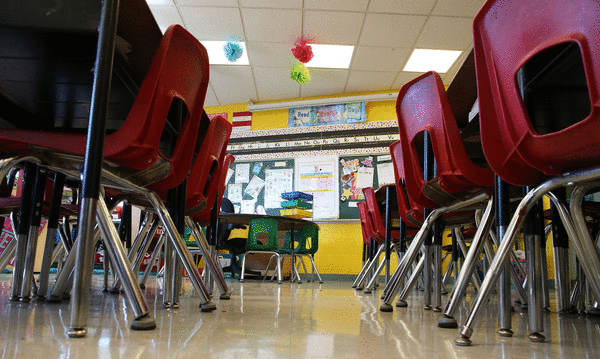
I’ve been back to school for a week, and I still haven’t had “the AI talk.” To me, it’s almost as bad as the sex talk I avoided with my kids years ago. What should a teacher say about artificial intelligence? I’ve followed protocol and pasted pages of our English department policy into my syllabus. Normally, I would read that aloud with students on our first day, but this year, I didn’t. This year, I’m taking extra time alone to craft a few thoughts.
Our English department policy states, “AI is evolving faster than our capacity to respond to it in well-informed, intellectual, academically useful ways. As a result, we don’t want to engage in haste simply because the rest of the world seems to embrace AI. Instead, we want to be intentional with our students about AI’s place in our discipline.” Teachers should be intentional, but the policy admits the evolution of AI is faster than we can figure out how to respond.
What I realized last year: Most papers turned in were smudged with AI’s digital fingerprints.
I’ve used AI to discover AI in my students’ essays. Fight fire with fire. But then there’s the question of punishment. In our school, if we detect AI, that’s a failing grade, an email to an administrator, a phone call home to parents and a tense conversation with your student who will swear they didn’t use AI. Your time to plan lessons or decompress is eaten away. Also, no AI detector is flawless. The last thing a teacher wants to do is harm a student’s record using a flawed system. Teachers know we’re flawed enough without technology helping us to besmirch the students we’re trying to nurture.
I often share with students my struggles as a writer. Writing is complicated. It can be so difficult to find your voice, and learning how to leverage words to persuade or protest may take a lifetime. Unlike music, math and chess, there are few writing prodigies. You go through trial and error, hopefully with the help of a fellow sufferer who can show you how to improve. AI makes people who don’t know how to write think they are prodigies: Look, flawless sentences! But to someone who loves the sound and sense of words, AI sentences read like smooth cardboard.
Last year, a parent said, “But I use AI to write all my emails.” It’s an excellent tool and saves time. A former student who works as a writing tutor in college said he doesn’t report all the AI he sees because the students can be kicked out. He tells them, “Don’t do it. It’s not worth it.” When I ask my former student if he uses it, he says he does, but only to organize his thinking. It’s an organizational godsend. My youngest son who works in finance said he uses AI every day to code. AI is a moneymaker.
Recently, I needed to produce a two-paragraph book synopsis for a literary agent. It’s a heinous task because you’re reducing 98,000 hard-earned words to two paragraphs. So I fed my chapter outline into an AI machine, and presto! No sweat, no anxiety, no fear over leaving plot elements out or putting everything in its right place. Yet, I’m happy to report, AI fell short. It didn’t know how to create empty space. Every nook and cranny of those paragraphs was filled like a synopsis was a quadratic equation to be solved.
Great writing is what is not there. What is left out. Where meaning is felt. AI only knows what is there. It’s the difference between talk of love and the act of love.
It’s safe to say that high school English teachers are worn down by the ubiquity of AI. Universities are changing their admissions policies, dropping supplemental essays because what they’re getting is Teflon-smooth. This puts more emphasis on the personal statement, and even last year, I sat with a parent and talked about how his son’s essay was seamless but lacked life. The dad said his son wouldn’t change anything. We both knew AI was in the room, getting paid, destroying our planet. If parents won’t fight against AI, teachers can’t do much.
When I have “the AI talk,” I’ll say I don’t like how AI is on my computer without my consent. I’ll say that writing is like going to the gym and lifting weights for your brain, and if a robot lifts the weights for you, your muscles will atrophy, “and your brains will flow out your ears like tapioca pudding.”
The students will ask, “What is tapioca pudding?” I tell them, “Look it up on your new school-issued iPads,” which are supposed to prevent the use of AI but won’t.
And I’ll think to myself because I’m not allowed to say it at school: Students should know how AI is used by Israel to kill people in Palestine with programs such as Lavender that analyze phone data, social media and video as targeting info for missiles. Its companion AI program “Where’s Daddy?” tracks people identified by Lavender so when they arrive home, they can be bombed with their families. That’s an AI talk every American family should have.
Even if I don’t say it aloud in the classroom, like with great teaching, maybe students will feel it. I don’t want to fail them.
____
Adam Patric Miller has taught high school for 25 years in three states and currently teaches in St. Louis. He is the author of the book “A Greater Monster.”
___
©2026 Chicago Tribune. Visit at chicagotribune.com. Distributed by Tribune Content Agency, LLC.


















































Comments