Commentary: At 6 months, there is no clear winner in the Iran war
Published in Op Eds
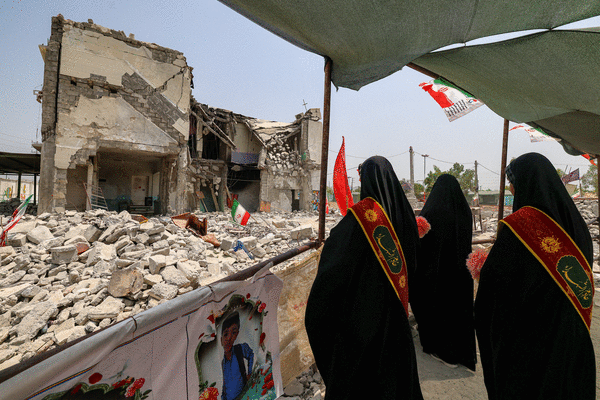
The war in Iran, the “little excursion” that was supposed to be over in four to six weeks, passed its six-month mark on Friday. And notwithstanding President Donald Trump’s premature declarations of victory, threats to pummel the Iranians into submission and his repeated proclamations that the United States is winning the conflict, the actual result thus far is a blurry picture. The endgame is likely to be far less impressive than the pro-democratic Iranian revolution he called for on the opening day of the war.
The conflict has taken on a predictable pattern: Tit-for-tat violence is replaced by diplomacy, which then collapses into renewed shooting and a subsequent series of unilateral ceasefires that are eventually challenged by more barrages. In its quest to get the Strait of Hormuz open, the Trump administration has spent months throwing spaghetti at the wall to see what would stick.
When consecutive weeks of U.S. airstrikes against Iranian missile batteries, small boats and drone manufacturing facilities failed to compel Tehran to reopen the waterway, the White House switched to a naval embargo of Iranian ports in the hope the economic pain would reach an intolerable level.
When that strategy fell short of the mark, the administration coupled the embargo with what Treasury Secretary Scott Bessent labeled “Operation Economic Outcast,” yet another economic pressure campaign designed to penalize any individual, company or country that trades with Iran. The aim: Strangle the Iranian economy and push the regime to get back to the negotiating table on American terms.
The Iranians, however, haven’t demonstrated much propensity to toe the line. Instead, every U.S. measure has reaffirmed a prevailing belief within the regime that Washington is merely interested in its downfall. Trump, who in the past upended diplomacy with Iran twice in favor of bombing, is viewed across the Iranian political establishment as the devil incarnate: somebody who believes blunt force trauma will get the other side to surrender its vital interests.
If the Iranians were once willing to consider a deal to end the war and bring the Strait of Hormuz back to normal, they’re now wondering whether any deal they sign with Trump is worth the paper it’s written on.
Trump’s war with Iran was supposed to result in a clear-cut American victory, according to what the administration sold us at the outset. We were told that Iran would no longer be able to threaten the Middle East because its military capacity would be shredded. Tehran’s nuclear program, a problem every U.S. president since Bill Clinton has had to contend with, was going to be abolished for good. The regime itself would even fall apart as the Iranian people took matters into their own hands.
Of course, six months later, none of this has happened. Yes, Iran’s military capability has taken a beating — thousands upon thousands of U.S. and Israeli airstrikes will do that — but the regime has still surprised the U.S. intelligence community with how fast it rebuilt some of its military-industrial complex. Iran’s stockpile of highly enriched uranium is thought to be buried somewhere in one of its damaged nuclear facilities, yet the lack of international inspectors on the ground means that nobody can be 100% sure about its exact location or whether Iran has managed to retain some of the centrifuges required to churn out more.
As far as an overthrow of the mullahs goes, well, that hasn’t worked out. If Trump thought killing Iran’s senior leadership during the war’s first weeks would get the regime to collapse like a house of cards, then it severely misjudged the nature of its enemy as well as the power of nationalism in the face of foreign aggression. Whatever moderates were left in the Iranian system have been marginalized and rendered impotent.
The demise of Supreme Leader Ayatollah Ali Khamenei, national security chief Ali Larijani and Mohammad Pakpour, the commander of the Revolutionary Guard, among many others, produced a situation whereby hard-liners grabbed ever-greater control of the state.
The new supreme leader, Mojtaba Khamenei, is more interested in acquiring a nuclear weapon than his father was. The regime as a whole is now governed by security men whose formidable experience was the nearly eight-year war with Saddam Hussein’s Iraq in the 1980s. Compromise is now a dirty word, and Iran’s price for ending the conflict with the Americans has gone up.
Despite an increasingly inept Iranian economy, rising inflation and food prices going through the roof, the powers that be are no more interested in surrender today than they were on the war’s first day.
After so much death and destruction and so little movement one way or the other, it’s hard to see any clear winners here. Indeed, the only thing the war has achieved is pushing up gas prices for Americans who are already tired of paying more for pretty much everything. Every problem the Trump administration wanted to solve is still a problem. And in the process of embarking on a war that didn’t need to be fought, the United States has created new ones, first and foremost turning one of the world’s most critical shipping arteries for energy supplies into a front line.
The United States and Iran are in a long staring contest. For the Iranians, the objective is simple: Survive the American onslaught and come out the other side intact. Iran may be the weaker party militarily, but it at least knows what it wants.
The same sense of clarity can’t be found on the other side. At this point, with so few wins and no good options, Trump’s goal should center on extricating the country from this conflict. Whether his ego will allow him to exit Iran is the question that will determine whether the United States puts out a fire of its own making or throws more gasoline on it.
____
Daniel DePetris is a fellow at Defense Priorities and a foreign affairs columnist for the Tribune.
___
©2026 Chicago Tribune. Visit at chicagotribune.com. Distributed by Tribune Content Agency, LLC.















































Comments