Editorial: Walmart is cutting prices to share tariff refunds. Did you get the benefit where you shop?
Published in Op Eds
Following the Supreme Court’s decision early this year that President Donald Trump’s tariff regime was unconstitutional, many corporations have seen substantial windfalls in the form of federal refunds for the tariffs they paid.
That’s put some of them, particularly retailers that passed much of that tariff bill along to consumers, in the ticklish position of deciding whether, and if so how, to help their customers share in the good fortune.
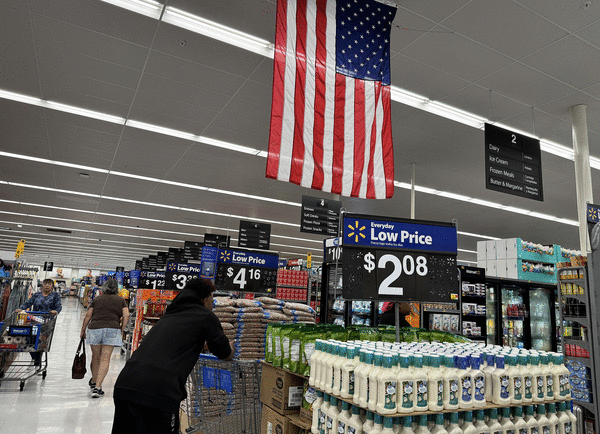
So it’s heartening to see that Walmart, the nation’s second-largest retailer after Amazon, has cut prices on about 11,000 products, using a chunk of the $2.9 billion in tariff refunds paid to the Arkansas-based giant. That included savings on ground beef, the cost of which has soared and made it a potent symbol of persistent inflation in the U.S.
“We’re investing heavily in price because customers need us to and because we believe it delivers market share gains over time,” Walmart CEO John Furner said on the company’s Aug. 20 quarterly earnings call.
That is a very refreshing message to hear from a titan of corporate America.
Offering consumers value while being fair is also what Walmart thinks will keep those customers coming back after the tariff refunds dry up. We think they’re right.
Other companies are doing the same. As of early August, the federal government had refunded about $100 billion in tariffs imposed after Trump’s “liberation day” announcement in April 2025, with more to come.
Beauty products company E.l.f. Beauty cut prices across a broad swath of its offerings using $50 million in tariff refunds, The Wall Street Journal reported. Another example the business paper cited: Tractor Supply, a large retailer in exurban and rural communities, is offering more special promotions and cutting prices on specific products like high-end pet food with its tariff reimbursement.
These moves counter the sour narrative that arose soon after the Supreme Court ruling. Tariffs were paid to the government by importers — that is, companies — not by consumers. So the refunds would go to the companies. Yet in most cases consumers bore the brunt of the levies in the form of higher prices charged by the affected companies. Before companies even had seen a dime, there were critics fuming that firms simply would pocket the windfall, leaving consumers holding the bag for these unauthorized charges.
The actions by Walmart et al also confirm — despite Trump’s repeated assertions that his tariffs don’t raise prices and are paid for by foreign businesses — what economists told us repeatedly during the early debates following liberation day: Tariffs in effect are taxes paid by consumers. Walmart wouldn’t be paying for reduced prices with tariff refunds if it hadn’t passed much of the costs of those tariffs to consumers in the first place.
Recall May 2025 when Doug McMillon, then Walmart’s CEO, told shareholders in no uncertain terms that Trump’s tariffs would mean higher prices on Walmart products. “We aren’t able to absorb all the pressure given the reality of narrow retail margins,” McMillon said.
Trump angrily responded in a Truth Social post that Walmart should “EAT THE TARIFFS.”
Needless to say, Walmart didn’t heed Trump’s demand, nor could it have done so given its fiduciary duty to shareholders.
Of course, not all retailers are responding alike. Home Depot, another major retailer that imports many of its products, received $730 million in tariff refunds in late June. But it plans to use that windfall to offset higher fuel and other costs that “we did not have as part of our outlook for 2026,” Home Depot Executive Vice President Billy Bastek said Aug. 18 on the company’s earnings call. Of that $730 million rebated for the tariffs, $685 million was on goods already sold to consumers; the rest was on products in inventory.
In other words, consumers likely absorbed much of the cost of Home Depot’s tariffs.
You know who else didn’t have these far steeper gas prices in their “outlook for 2026”? Consumers.
But Joe and Jane Commuter won’t be getting any Home Depot-like relief to ease their price at the pump.
In a market economy, of course, it’s the prerogative of Home Depot or other any other retailer to weigh the health of the bottom line versus growing market share. And it’s up to consumers to determine whether those actions will influence their future buying behavior.
The dramatic effect of Trump’s tariffs, both their imposition and their reversal, has added an element of fairness to these routine business decisions that could reverberate for well-known brands for some time to come.
___
©2026 Chicago Tribune. Visit at chicagotribune.com. Distributed by Tribune Content Agency, LLC.















































Comments