John M. Crisp: Playing football is a choice. (Well, sort of)
Published in Op Eds
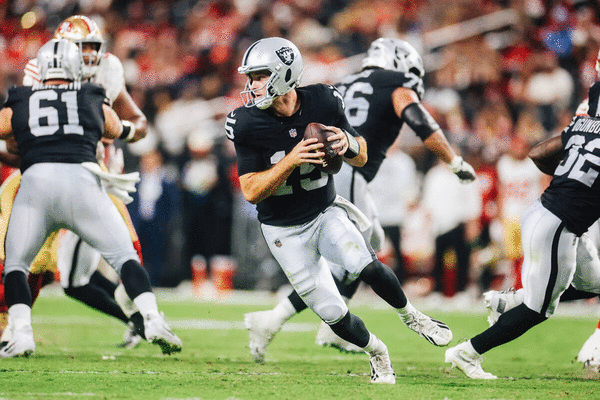
Anyone searching for good news in a report published last week in the BMJ—a prominent British medical journal—might turn to the headline under which the New York Times published the report’s conclusions: “Study’s Alarming Finding: At Least 1 in 4 N.F.L. Players Gets Brain Disease.”
The brain disease is C.T.E., chronic traumatic encephalopathy, a condition caused by the cumulative effects of concussive and non-concussive blows to the head. Its symptoms include memory loss, mood swings, depression, addiction and suicide, among others.
Twenty-five percent is a staggering toll of human suffering. But no one should find solace in the headline’s suggestion that 75% of the National Football League’s players could escape C.T.E.
The Times acknowledges that the “actual prevalence could be far higher.” The study itself reports that of 1,712 N.F.L. players who died from 2008 to 2021, 338 brains were examined; 315 of those (over 92%) were diagnosed with C.T.E.
This figure is consistent with a 2017 Boston University study of the brains of 111 former N.F.L. players; 110 were diagnosed with C.T.E.
The BMJ study, the Boston University study and the New York Times all point out that the brains under examination are far from a random sample. In many cases, they were submitted for examination because players were already exhibiting symptoms of C.T.E. Researchers call this “selection bias,” and it’s certain to indicate a higher prevalence of C.T.E. than would a random sample.
The takeaway? For reasons not yet understood, some N.F.L. players will sustain thousands of blows to the head without developing C.T.E. But somewhere between 25% and 92% of the rest will suffer life-altering damage to their brains.
The BMJ study attracted some attention, but it merely puts confirming numbers to something that we already knew: America’s favorite sport involves a great deal of damage to the physical and mental wellbeing of its players.
It’s beyond the scope of this column to say what—if anything—should be done. Consider, instead, the chief justification used to defend professional football: The players are grown men; they love playing football; they understand the risks; they are richly rewarded with fame and money; and they make an informed choice.
This is probably more of a rationalization than a rationale, but it’s difficult to gainsay the reasoning. In America, we’re quite rightly disinclined to limit private behaviors, even if they involve considerable risk.
But some context is worth noting:
First: the difficult tradeoff—health versus fame and money—that professional football players face depends entirely on America’s passion for the game, which is the source of the fame, adulation and, above all, money that make an N.F.L. career extremely hard to resist, despite the obvious dangers.
Second: The N.F.L. depends on a supply chain of young players that starts with Pee Wee football, for five-year-olds, and extends through middle school, high school and college.
At every level of public school and in most colleges, football is subsidized by taxpayer money. On many campuses, football is the most prominent cultural expression, and many boys want to be a part of that.
Whether they admit it or not, many of these millions of players have aspirations for the N.F.L., almost none of which will be achieved. The percentage of high school players who eventually enjoy the rewards of the N.F.L. is less than .03.
Unfortunately, however, C.T.E. starts early. Research at Boston University has found signs of the disease in 12-year-olds and confirmed cases in players in their teens and 20s. In addition, many players suffer orthopedic injuries that they bear with them for the rest of their lives. In short, the N.F.L. is the tiny tip at the top of a pyramid of considerable carnage.
But in the face of the attractions of football and the pressure to play, one wonders how much capacity a 14-year-old has for a rational choice between his health and the elusive rewards of the N.F.L. Is he really prepared to make this decision?
And I wonder if, as a culture, we could give him better choices.
_____
ABOUT THE WRITER
______
©2026 Tribune Content Agency, LLC

















































Comments