Commentary: The Chicagoan who rebuilt trust in the justice system after Watergate
Published in Op Eds
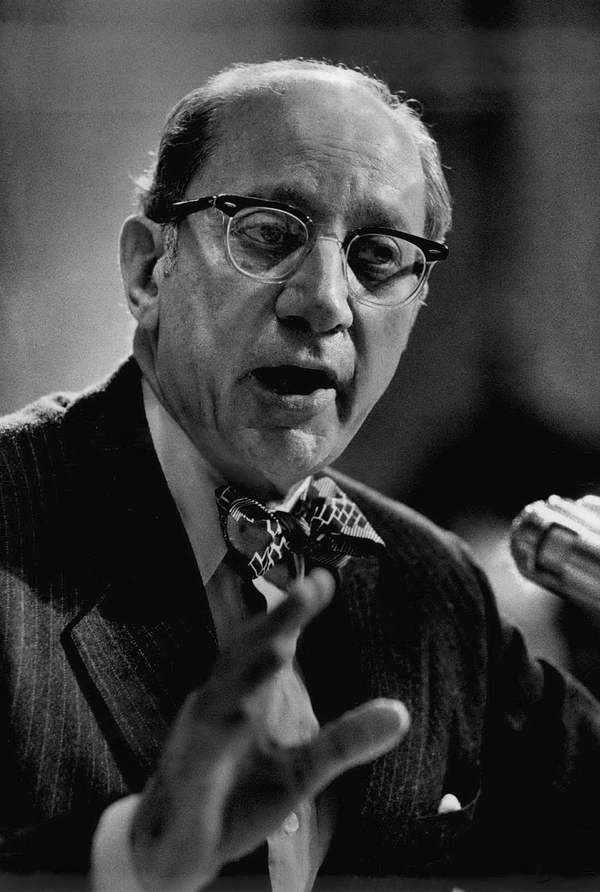
The current national conversation on Watergate offers an important reminder of the slough through corruption and ethical erosion that tested the foundations of American democracy, degraded public faith in government and depleted the credibility of the United States attorney general. It is also a reminder of those who worked assiduously to restore that faith and credibility, notably including a legal scholar and academic from Chicago.
From 1972 through 1974, five different men served as either permanent or acting attorney general, an extraordinary leadership turnstile that undermined the principles and effectiveness of the office.
Of these five men, John Mitchell was convicted of conspiracy, obstruction of justice and perjury for activities that began while in office. His successor, Richard Kleindienst, was convicted of contempt of Congress. The highly regarded Elliot Richardson and his deputy, William Ruckelshaus, both resigned as part of the “Saturday Night Massacre.” Their successor, Robert H. Bork was succeeded by U.S. Sen. William Saxbe, who served until shortly after President Gerald Ford’s inauguration.
More broadly, over 20 government-serving lawyers resigned or were indicted, disbarred and/or imprisoned in connection with Watergate-related abuses. Apart from Mitchell and Kleindienst, they included an acting FBI director, the chairman of the Securities and Exchange Commission, the president’s assistant for domestic affairs, the White House counsel, a special counsel to the president, the general counsel to the committee to reelect the president and the president’s personal counsel.
Upon taking office, Ford was determined to redeem the integrity and trust of the justice system in general and the Department of Justice in particular. Ford knew that a traditional political appointment would not achieve that goal, that politics had no place in law enforcement — particularly not in decisions regarding specific cases. He thus sought as his attorney general a person who understood that distinction. For that extraordinary task, he selected the University of Chicago president, Edward H. Levi.
Levi was essentially a Chicago native, having been schooled from kindergarten through law school within the University of Chicago educational system. After serving in the Department of Justice during World War II, he was appointed dean of the university’s law school in 1950. He later served as provost and was ultimately tapped as president in 1968, where he led the university through the most turbulent social and political times until he was nominated as attorney general in early 1975.
Levi had no illusions regarding the difficulties he faced in office. At his swearing-in ceremony, he observed that “Nothing can more weaken the quality of life or more imperil the realization of the goals we all hold dear than our failure to make clear by words and deed that our law is not an instrument of partisan purpose.” He thus set about reviving the Department of Justice’s historical principles of transparency, independence and integrity, which had deteriorated during the three Watergate years.
Levi’s most tangible achievements in office arose in response to law-enforcement abuses exposed in the Watergate investigations. These achievements included the development of what became known as the Foreign Intelligence Surveillance Act and preparing specific attorney general guidelines with respect to FBI domestic security investigations.
But more impressive and enduring were his intangible achievements, which were institutional in nature. They included restoring the administration of justice to its traditional “foundation of fairness and not upon favor,” his insistence on impartiality in law enforcement and the contribution of his reputation, candor and intellect to the department’s culture. From these achievements, others came to regard him as “the model of a modern attorney general.”
Of course, Levi was not the only Chicagoan engaged in addressing Watergate abuses. Famed defense attorney Albert E. Jenner Jr., served as minority counsel for the House Judiciary Committee’s impeachment inquiry. Jill Wine-Banks was an assistant special prosecutor who famously cross-examined Nixon’s secretary, Rose Mary Woods. And a young Yale law school graduate from Park Ridge, Hillary Rodham, was a staff researcher for the Judiciary Committee.
Yet in many ways, Levi’s task was more elusive, and necessarily more daunting, than that of the prosecutors: remedying harm to the rule of law caused by Watergate’s great abuses. In that role, he championed the role of the Department of Justice as a “special advocate,” with respect to both defending governmental decisions at law and infusing them with the “qualities and values” that had historically been the bedrock of the nation’s constitutional system.
Following completion of his term in office, Levi returned to the University of Chicago, where he continued to pursue academic and public service, rather than self-advancement or personal financial gain. Upon Levi’s death in 2000, President Ford described him as “the attorney general against whom all others are measured.”
History has done a credible job of identifying the many villains who participated in the Watergate scandal. It has done a less credible job of recognizing the far fewer heroes who helped the country overcome that scandal. We would thus do well to remember the heroic service of Chicagoan Edward H. Levi.
_____
Michael Peregrine a retired Chicago attorney and a graduate of Northwestern University Law School.
_____
©2026 Chicago Tribune. Visit at chicagotribune.com. Distributed by Tribune Content Agency, LLC.















































Comments