David Fickling: To avert flood disasters, Nepal needs more giant dams
Published in Op Eds
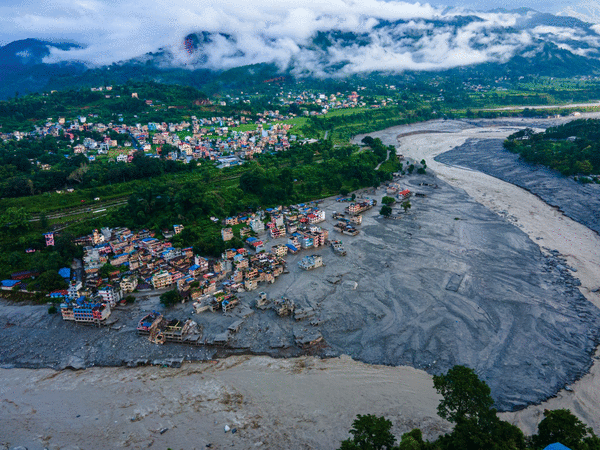
In the popular imagination, there’s only one threat to picturesque mountain landscapes that can compete with the destruction wrought by flood disasters like the torrent that swept through valleys on the Nepalese-Chinese border: dams.
These concrete behemoths replace the occasional catastrophic natural inundation of such regions with one that’s permanent and artificial. Pristine river valleys disappear beneath reservoirs. Communities are forcibly relocated, their lives uprooted.
Those criticisms are true. But the events of the past week, with 955 dead and more than 4,000 still missing, should be a warning that the imagined counterfactual is false. Roads, tourism, trade and settlement are already transforming remote mountain communities. Meanwhile, warming is destabilizing the very soil on which homes are built, and sparking disastrous floods. The question isn’t whether such places will change, but whether the development will include the infrastructure needed to manage their increasingly volatile rivers.
The damage caused by some large dam projects is real. India’s efforts to build a string of reservoirs on the Narmada River displaced hundreds of thousands of often poor, tribal and low-caste families. That injustice sparked a protest movement championed by novelist Arundhati Roy, and helped give hydro such a bad name that multilateral development banks largely stopped funding it in the 1990s.
In retrospect, this was a terrible outcome. Hydroelectricity is one of the few forms of generation to match the rock-bottom prices of wind and solar.(1) When it’s built with a storage reservoir, it also provides on-demand, zero-carbon electricity that can be stored from one month to the next. Such dams also help to control the floodwaters that can do such grievous damage to downstream communities.
A potent example happened in 2018 on the other side of the Tibetan plateau. After a landslide blocked part of the upper Yangtze River and formed a vast unstable lake, dam managers at six reservoirs downstream proactively dumped 1.3 billion cubic meters (46 billion cubic feet) of water so they’d have enough capacity to absorb an outburst flood. Along with other measures, that appears to have substantially reduced the damage done. The same result has shown up in Europe. Storage dams in Austrian river valleys in recent decades have reduced extreme water levels by about a third relative to their previous peaks, according to a 2022 study.
The withdrawal of funding from aid donors in rich countries didn’t stop hydro being built. With the World Bank sitting on the sidelines in the 1990s, China self-financed the Three Gorges Dam, the world’s biggest power station. Africa’s largest, the Grand Ethiopian Renaissance Dam, was also largely paid for out of Ethiopia’s meager domestic budget, amid objections from neighboring countries. Tanzania is now doing the same.
Nepal itself is going through a mini-boom, but it’s being driven by private developers building so-called run-of-river generators — a sort of water-wheel on a massive scale that can’t store significant volumes. About 90% of hydro in Nepal is this type, which provides little of the on-demand power or flood-control benefits of storage dams. The workers missing or miraculously rescued from flooded construction tunnels after last week’s disaster were all building run-of-river plants.
The funding drought from multilateral donors has been remarkably persistent. As far back as 2004, the World Bank argued the pendulum had swung too far against hydro and vowed to reverse this trend. Despite that, the sector has failed to benefit from the surge in spending on renewable energy since.
Commitments for hydro comprised just 2.8% of energy funding by major development banks in 2022, the lowest share since 2009. Since the 2015 Paris Agreement on climate change, they’ve promised $8.67 billion. Even fossil-fuel production and generation have done better, at about $12 billion.
That’s a perverse outcome. Hydro these days is likely being crowded out by more bankable solar, wind and battery plants, but the whole point of development banks is to finance projects that don’t pencil out well in raw cashflow terms. It’s hard to put a dollar value on the lives saved and livelihoods preserved if a once-in-a-century flood can be prevented by the sort of water engineering rich nations take for granted. The benefits are nonetheless real.
Nepal’s vast natural water resource and relatively small population should be allowing it to earn good money selling electrons to its energy-hungry neighborhood. And yet until 2023, it was importing more power from India than it was exporting. A transmission line to Bangladesh only went into operation last year. Even amid the current building boom, it has completed just 3.4 gigawatts of the 42 gigawatts of hydro that’s economically viable, with another 4.3 gigawatts under construction.
The question for the future isn’t whether Nepal will continue to develop its rivers. It’s whether the next generation of hydro projects merely extracts electricity with run-of-river, or builds storage dams to give downstream communities greater protection against the consequences of our increasingly deadly climate.
_____
(1) In the U.S. and oil exporting countries, gas turbines can achieve similar prices since the fuel is being provided at negligible cost. That's not the case in countries that depend on LNG, however.
This column reflects the personal views of the author and does not necessarily reflect the opinion of the editorial board or Bloomberg LP and its owners.
David Fickling is a Bloomberg Opinion columnist covering climate change and energy. Previously, he worked for Bloomberg News, the Wall Street Journal and the Financial Times.
_____
©2026 Bloomberg News. Visit at bloomberg.com. Distributed by Tribune Content Agency, LLC.


















































Comments