Aisha Sultan: Why everyone loved Dolly
Published in Op Eds
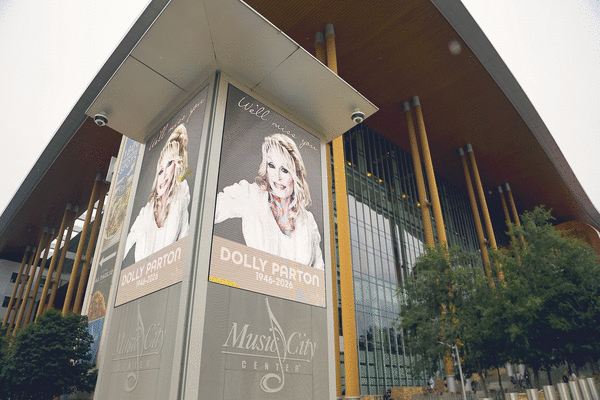
Riding in the backseat of a long, black Chevy Caprice Classic in 1983, I heard an unforgettable melody.
A woman’s light and airy soprano harmonized with a man’s velvety baritone.
Sail away with me
To another world
And we rely on each other, ah-ah
From one lover to another, ah-ah
To my 9-year-old ears, Dolly Parton and Kenny Rogers' iconic duet, "Islands in the Stream," was the sweetest, most enchanting thing I’d ever heard.
I grew up in conservative Muslim home, in a conservative, heavily white Christian suburb of Houston, Texas, and Dolly looked unlike any other woman I had ever seen in my young life. She seemed to be playing a character, with her big blond wigs, rhinestone costumes and surgically enhanced breasts, while remaining completely genuine and authentic.
Over the years, I learned that at her core, underneath the mega-talent, brilliant business sense and glitter, was an unmatched kind and generous heart.
She was born into a poor, rural family. Her sharecropper father, who could not read or write, paid the doctor a bag of cornmeal for her delivery. Her mother, married at 15, had the first of 12 children at age 16. The circumstances of her birth in Tennessee weren’t much different from a girl born in a village in Pakistan.
As she rose to the heights of international fame and success, Dolly never forgot where she came from. Among the millions she’s given away for humanitarian causes, her Imagination Library felt the most personal. This early-childhood literacy program mails a free, age-appropriate book every month to enrolled children from birth until age 5, regardless of their family's income. The book arrives addressed directly to the child.
She wanted children to love reading. She wanted their parents to read to them, even though her own Daddy couldn’t.
The Imagination Library has delivered more than 300 million books to children across the world.
It doesn’t surprise me that Dolly is the most popular person in America — by a long shot.
Even the Republican lawmakers who cut state funding to support her reading program, who slash funding for libraries, who want to ban certain books, said to lower the flags and mourn the loss of Dolly.
Even those who cast doubt on life-saving vaccines and refused the COVID shot, mourn Dolly, who donated a million dollars toward COVID-19 research supporting the Moderna vaccine.
Even those who attack the right of trans people to exist, praise Dolly, a stalwart LGBTQ ally, who wrote and sang the song, “Travelin’ Thru,” for "Transamerica," a film about a transwoman traveling across America.
Even those who demonized the protestors at Black Lives Matter rallies, loved the woman who said publicly in 2020, “Of course Black lives matter. Do we think our little white asses are the only ones that matter? No!”
Even those who want cut food assistance and lunches for hungry children want to mourn the woman who gave away millions of free books.
Why do the ones who vehemently opposed the very things Dolly stood for want to honor her now?
I think it’s because she never rejected them.
People need to belong to something. For some, a political affiliation provides that sense of identity, even when it runs counter what they know to be right. It’s why Missouri voters will vote to make abortion safe and legal, raise the minimum wage, establish paid sick leave, expand Medicaid, approve campaign finance reform, protect the state income tax — all the while voting for Republican politicians often fighting against those very things.
People have to be manipulated and taught to hate others. We are instinctively drawn to compassion and generosity, and Dolly personified both, even to those who opposed her causes.
Dolly never publicly shared how she voted politically. She let her actions speak louder than her words. She took the opportunities this country offered and used her success to help the least among us, to spend her hard-earned money for the benefit of others, to show us how to accept and love one another.
She was the best among us, a reminder of how much goodness and sparkle still exist.
The entire world mourns that loss.
©2026 STLtoday.com. Distributed by Tribune Content Agency, LLC.




















































Comments