Commentary: No rising star today could stay neutral like Dolly Parton
Published in Op Eds
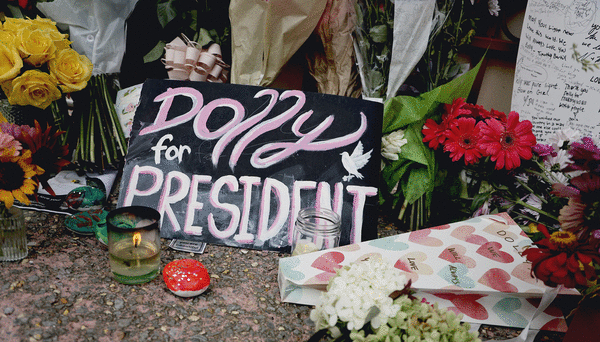
Dolly Parton died Tuesday at 80, and for a moment, America did something it almost never does. It agreed on someone. Democrats and Republicans, the churched and the unchurched, posted the same grief for a devoutly, openly Christian woman claimed just as hard by people who can’t stand each other. It looked like proof that faith still could belong to everyone. It was actually a eulogy for the era when that was possible.
Parton got away with it because she came up in a country that no longer exists. If someone — anyone — tried to build that same career today, it couldn’t happen.
I am a faith elder at Christ Citadel International Church in Los Angeles, a Black woman who has spent her life inside American Christianity. My own tradition never has had the luxury of staying out of politics: The Black church built the civil rights movement because neutrality wasn’t an option, and Black Protestants remain one of the most reliably courted, and reliably written off, blocs in American politics. Watching a white Southern Christian stay undeclared for 60 years, and get loved by everyone for it, is what makes her death read as more than one singer’s loss to me. It exposes how much room this country still had left for a faith like hers, that stayed out of politics and wasn’t punished for doing so.
That faith was never the soft, unobjectionable kind. It was the challenging kind that takes the commandments of love seriously — that calls believers to follow Jesus’ path of compassion. She was raised Pentecostal in the Smoky Mountains, the fourth of 12 children, the granddaughter of a preacher. She called the church of her childhood hellfire and brimstone and said she found God on her own, as a girl, in an abandoned church house near her family’s home, a wrecked building where people went to drink, with Bible verses still on the walls.
That’s a very Christian story, a very Protestant and American one. And yet there is less and less tolerance here for that kind of authentic faith. And it’s largely politicians who punish it.
In his second term, President Donald Trump has relentlessly tested the limits of Dolly’s style of faith, at home and abroad. In Nigeria, he threatened military action over the killing of Christians, warning he’d go “guns a-blazing” against Islamic terrorists in what he called that “now-disgraced country.” In South Africa, he built a fast-tracked refugee pipeline for white Afrikaners who claimed they faced racism.
That test has a legal front at home too. In July 2025, the IRS told a federal court that churches can endorse candidates from the pulpit without losing tax-exempt status, the latest breach of the wall the Johnson Amendment has held since 1954.
Parton built her identity by staying out of that fight. She lived her faith publicly in other ways, such as through the creation of the Imagination Library, quiet disaster-relief giving, a radical and simple theology of “ just love everybody,” and the plainspoken grief after her husband Carl Dean’s 2025 death that she never turned into a cause. Her theology lived in what she did, not what she argued for. She twice turned down the Presidential Medal of Freedom. Asked directly about the 2016 election, she said simply that she tries not to get political.
That falls squarely in a noble tradition of faith as service rather than allegiance. And yet if said today by a rising public figure, that same sentence would read as a dodge, and she’d be pressured, from both sides, to prove her loyalty before either would let her keep her audience.
That pressure is easy to prove. A 2022 Pew survey found 77% of Americans, including 62% of white evangelicals and 63% of Black Protestants, say churches shouldn’t endorse candidates. Clergy do it anyway, more openly each year: ProPublica and the Texas Tribune found at least 20 such violations in a single two-year window, more than the IRS had investigated in the prior decade. People don’t like it, but they expect it — so much so that now each faith tradition and public figure is obliged to take a stand on one side or another of certain red lines — abortion, gay rights, immigration. In this climate, no Parton-like figure could get a career off the ground.
That mantle of neutrality and pursuit of common good is shifting from individuals to institutions. No single person can hold the neutral ground Parton held for 30 years, so that work increasingly is falling to organizations built to do it collectively and structured to refuse to take sides on political controversies.
The United Religions Initiative is one model, a grassroots interfaith network with more than 1,100 local groups in over 100 countries, doing this work daily by design, not by luck. The Muslim World League is another. Nine months after Trump called Nigeria a “disgraced country” over its treatment of Christians, the league under Secretary General Mohammed Al-Issa convened dozens of Christian and Muslim leaders in Nigeria this month to adopt the joint Ajuba declaration on religious cooperation, a shared commitment to stop letting religion be turned into the same loyalty test Trump has started running.
That’s the shape of what’s replacing figures like Parton — not a successor, but a system. Individuals get pressured into declaring. Institutions, if they’re built right, don’t.
None of this canonizes Parton. Challenging as it surely was to maintain, her public neutrality also did allow her to dodge some hard questions. What’s most remarkable is the climate that made her neutrality possible: a country still willing to let a Christian be devout and undeclared at once, and let her fans decide for themselves what that meant.
If nothing changes, the next Dolly Parton won’t get 30 years to build a following before the public demands she pick a side on some litmus-test issue of the day. She’ll get a single news cycle, and she’ll lose half the country as a result of however she handles the test. The solution for that intolerant culture doesn’t start in Washington. It starts with congregations that keep pulpits as pulpits, with grassroots networks doing the work that requires remaining above the political fray, and with the rest of us refusing to read a public figure’s silence as something she’s hiding.
In Dolly Parton’s decades of fame, we saw what it looks like when someone is allowed to be both devout and undeclared. We should notice it already was becoming impossible, long before she was gone.
____
Nathalie Beasnael, a doctor of divinity, is a faith elder at Christ Citadel International Church in Los Angeles and founder of Health4Peace. She serves as diplomatic envoy to the U.S. for the Republic of Chad.
©2026 Los Angeles Times. Visit at latimes.com. Distributed by Tribune Content Agency, LLC.
















































Comments