Marc Champion: Trump is copying Putin's losing playbook with Canada
Published in Op Eds
It sometimes feels as though the Trump administration gets its worldview and foreign policy ideas from a Kremlin School of International Relations course taught by Vladimir Putin — though at a CliffsNotes level that fails to consider how those strategies played out.
Take the recent breakdown of U.S. trade talks with Canada. The White House approached the meetings less as a negotiation between two partners than as an effort to force tribute from a vassal. Trump portrayed his decision to change the previously agreed terms of trade between the two countries as a righting of past wrongs. But in reality, it’s part of something much more profound: a U.S. effort to ensure its economic interests and physical security in the Western Hemisphere by coercion, rather than through alliances and soft power.
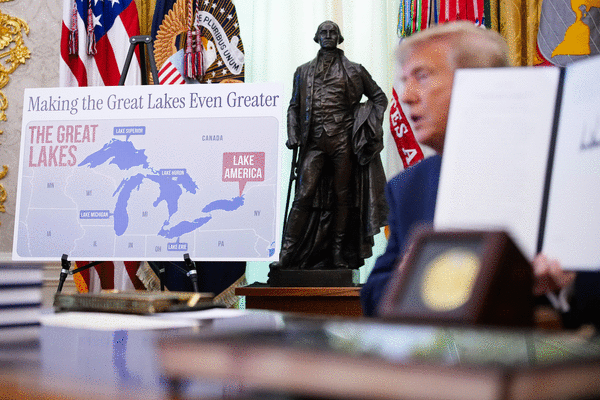
This is further underpinned by an ideology that assumes the U.S. has a natural right to correct what Trump and his supporters consider aberrations of geopolitical history. So, Greenland should naturally belong to the U.S., and would already if not for some absurd American decisions at the end of World War II. Canada isn’t a real country, but rightly the 51st U.S. state. The Gulf of Mexico was really the Gulf of America all along — and now, Lake Ontario is Lake America, too. If we’re to believe Prime Minister Mark Carney about why the U.S.-Canada talks collapsed, it’s because Washington made last-minute demands to dictate Canada’s domestic language policies and destroy its car-manufacturing industry.
All of this echoes policies that Putin has employed since the mid-to-late 2000s. In the Kremlin’s worldview, Belarus, modern-day Kazakhstan (in its current borders) and Ukraine aren’t real countries but historical aberrations, conjured up by the Bolsheviks. And as with Trump’s “Donroe Doctrine” for the Americas, all countries within Moscow’s so-called near abroad must bow to its will. They have no right to attach their economies, let alone security policies, to anyone other than Russia, because it is a great power, which they are not.
Russia’s stance on Ukraine is perhaps a far-fetched comparison with Trump’s view of Canada, because it suggests a future in which American tanks pour across the border and U.S. pilots and missile crews blow up Canadian cities. But that’s just the worst-case destination for policies of coercion, which tend toward escalation when weaker countries are shocked into confronting their dependencies. Instead of forcing them into line, the coercion more often has the opposite effect, prompting them to diversify their security provision and trade.
The pressure on Kyiv to accept its vassal status was also primarily economic at first, involving disputes over natural gas prices in 2006 and 2008-2009, election interference and de facto trade embargoes. Russia also claimed a civilizational right to determine Ukraine’s language laws. And when bribery and intimidation didn’t work to keep friendly regimes in place, Moscow began to carve out territorial claims, starting with Crimea. It took almost two decades to get to an open invasion, and in the interim, Ukraine’s exports to and imports from Russia fell to 5.1% and 8.4% respectively, in 2021, from 24% and 42% in 2000, when Putin came to power.
It’s perhaps easier to see the U.S./Canada parallels in what’s happening now between Armenia and Russia, which has begun banning selected imports (on sanitary grounds) in response to Armenian Prime Minister Nikol Pashinyan’s effort to end his country’s near-total reliance on Moscow. He already froze Armenia’s participation in Russia’s equivalent of the North Atlantic Treaty Organization, the Collective Security Treaty Organization, in 2024. This week the parliament adopted a new government program for 2026-2031 that — for the first time — does not list Russia as a strategic partner.
Pashinyan, who won re-election by a landslide in June, said last week that his government would apply for European Union membership "in the near future,” and that he would then hold a referendum to approve the decision. He's also working on normalizing relations with Azerbaijan and Turkey, building on the U.S.-backed Trump Route for International Peace and Prosperity, which could eventually form part of a corridor providing energy to Europe, bypassing Russia and Iran. The Kremlin isn’t happy. It’s demanding that Armenia hold the EU referendum by December, and so confront the painful consequences this would entail, including loss of access to Russian markets.
Moscow officials express outrage that Armenia (substitute Ukraine, Georgia or Moldova at will) should be trying to gain the benefits of integration with the EU at the same time as it enjoys membership in Russia’s equivalent, the Eurasian Economic Union. The suggestion is that countries must choose between trading partners not when they join the EU — something they may never do — but before. This need not be a matter for confrontation, but it very likely will become one.
The irony is that Armenia was for a long time the model of a submissive Russian ally. Trade between the two rose between 2000 and 2021, instead of falling as it did for those that had contentious relations with Moscow. Now, Pashinyan has almost dared Putin to kick Armenia out of the CSTO, which it joined as a founding member in 1992. The hope at the time was that, together with the grant of military basing rights to Russia, membership would ensure Yerevan’s continued control over Nagorno-Karabakh, an enclave of Azerbaijan. Azerbaijan and Turkey closed their borders as a result, making Armenia wholly dependent on Russia militarily, as well as economically. But when Azerbaijan retook the enclave in 2023, Armenia’s bet on Russian protection failed to pay out. Hence the current attempt to diversify.
This is a pattern of coercion that Russia has applied to every ex-Soviet state that’s challenged its exclusive right to a sphere of influence.It has not worked. Russians are not better off for it. Their state has not gained influence as a result. Putin has instead squandered the enormous soft power — through trade, language and common history — that Russia enjoyed in 1991 as a result of allowing the former Soviet Union to collapse, rather than fighting to preserve its empire.
Had post-Soviet Russia treated its neighbors as partners and allies, as well as legitimate economic competitors, it might now have a bigger share of trade with wealthier partners who never wanted to be forced to choose. This was the genius of post-war America’s Marshall Plan, which sought to develop prosperous allies to trade with in Europe, rather than just to control and coerce them. Instead, Russia began backing separatist movements in ex-Soviet neighbors to gain leverage, wielded energy, transport and other dependencies as threats, and ultimately — in two cases to date — invaded, to little benefit and enormous cost.
Russia had some excuses, including a lack of funds for any Marshall Plan-style approach and a history of land invasions that has created a deep culture of security paranoia. Trump has none. His choice to adopt Moscow’s playbook is an unforced error that is already destroying U.S. alliances and forcing dependents in North America and Europe to reduce their reliance on the U.S. for markets and security. It is not a winning model.
_____
This column reflects the personal views of the author and does not necessarily reflect the opinion of the editorial board or Bloomberg LP and its owners.
Marc Champion is a Bloomberg Opinion columnist covering Europe, Russia and the Middle East. He was previously Istanbul bureau chief for the Wall Street Journal.
_____
©2026 Bloomberg News. Visit at bloomberg.com. Distributed by Tribune Content Agency, LLC.















































Comments