Commentary: Sept. 11 hasn't yet found its meaning
Published in Op Eds
Every nation and every faith has rituals to bind its wounds, celebrate its victories, or commemorate deliverance. Americans set aside a Thursday in November to give thanks for a crucial harvest and sustain a founding myth of peaceful coexistence. Israelis sound a siren on Yom HaShoah and stand still and silent. Shiite Muslims mark Ashura with processions of grief for a seventh-century massacre that still organizes political identity today.
These achieve different ends. Some carry a traumatized people through grief while holding the nation together. Others assign meaning to tragedy, work that can take decades to unfold. The sharpening debate over the Iran war, and, tangentially, over the U.S.-Israel relationship, suggests that second kind of memorialization may finally be coming into view for Sept. 11.
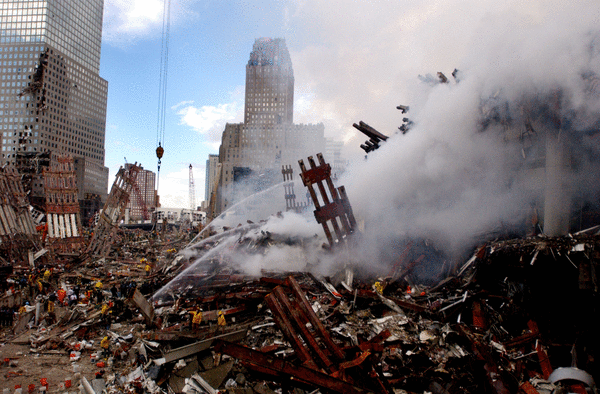
The attacks have been commemorated every year for a quarter century. Names are read aloud. Towers of light shine from Lower Manhattan. These rites belong to the first kind of memory, the kind that let the country grieve and keep functioning in the disorienting aftermath. The second phase has not yet coalesced. A shared understanding of the catastrophe and its long, unfinished aftermath remains elusive.
Part of the reason is that 9/11 never resolved into a story the way Pearl Harbor did. December 7th was an attack by a state with clear war aims. The United States answered with a three-and-a-half-year campaign that ended in Japan’s unconditional surrender following two nuclear attacks. Sept. 11 felt more like an asteroid strike, sudden, catastrophic, driven by forces most Americans could not name, let alone place in a story with a beginning and an end. Only in recent years have historians and legal investigators begun filling those gaps. The fact is that you cannot assign meaning to an event you do not understand.
The other reason is that almost everything that followed seemed only loosely tethered to the attack itself. Osama bin Laden spent his last years an aging, irrelevant figure in a walled Pakistani compound; when a Navy SEAL finally shot him dead in his boudoir in 2011, a decade later, it was too late to offer real closure. The Afghan war ground on for another decade, having lost its purpose once bin Laden slipped into Pakistan through the Tora Bora passes in December 2001.
The invasion of Iraq, justified by 9/11, struck even many supporters as a non sequitur. Saddam Hussein's government had nothing to do with al-Qaeda, a fact the government knew and obscured. A vast surveillance apparatus grew up in response, invisible until Edward Snowden exposed it in 2013, alongside torture, rendition and secret prisons abroad. That machinery, built to hunt Islamist terrorists, has since been repurposed by a 2025 presidential directive naming "anti-Christian" and "anti-American" beliefs as indicators of domestic terrorism. Guantanamo has been replicated by “Alligator Alcatraz” in Florida, and immunity for extrajudicial killings abroad, both descended from the war on terror, but which neither traces back to the attacks themselves.
Then there is the ledger. The Costs of War project at Brown University puts the price of the post-9/11 wars at roughly eight trillion dollars, nearly all borrowed, with veterans' care running for decades. More than 30,000 service members and veterans have taken their own lives since 2001, over four times the roughly 7,000 killed in combat in those wars. Veterans showed up among the crowd that stormed the Capitol on January 6th at more than double their share of the population and make up something like a quarter of militia membership nationally.
Terrorism as a practical threat has turned from a fear of another 9/11 into a marker of what kind of American someone is. A 2025 poll found 68% of Republicans considered international terrorism a critical threat, versus 52% of Democrats and 48% of independents. Those numbers have barely moved in years, through three major Islamist attacks on American soil. A gap that wide and stable, regardless of events, suggests terrorism no longer factors much into how people see it. It has become just another marker of political identity.
For most of the last 25 years, a shared account of 9/11 has been out of reach. Opinion split along party lines early and stayed there, untouched by events. Military defeat did little to move Republican opinion; relinquishing commitments did little to move Democratic opinion. Americans had no appetite to argue about what 9/11 meant.
That may be changing, from an unlikely direction. What began in June 2025 as a single round of strikes on Iran's nuclear sites has become a devastating war: oil prices past $100 a barrel, a key waterway closed, energy facilities destroyed on both sides of the Gulf, serious U.S. military vulnerabilities exposed. None of this has produced the usual partisan sorting.
In late July, the House passed a war powers resolution ordering the president to end the war, 214 to 208; the Senate killed a companion resolution by two votes, 49 to 47. Those margins split each party rather than follow the usual lines, itself a sign of change. Polling shows a majority of Americans, across party lines, wanting Congress to approve such strikes before they happen, not after.
Some of that anxiety has curdled into something uglier. An argument about Israel that borrows the Iran fight's emotional charge without quite being about the same thing. But the storm over the U.S.-Israel relationship is also standing in for a fight about the War on Terror Americans have not yet found a way to have directly.
Taken together, the country looks to be edging, awkwardly and without much self-awareness, toward a reckoning it has avoided for a generation. The 2028 election, arriving as the instincts and institutions built after 9/11 keep resurfacing in stranger, more distant forms, may finally force the argument into the open. Even so, the 25th anniversary will not be the moment for the second kind of memorialization, the one that assigns meaning rather than marks loss. We are, at best, at the start of that work, and will need to wait for the 30th anniversary, or beyond, to say what Sept. 11 meant to this country, and what this country did with it.
____
Steven Simon is a senior research fellow at the Quincy Institute for Responsible Statecraft and a distinguished fellow and visiting professor at Dartmouth College. He served as the National Security Council senior director for counterterrorism in the Clinton White House and for the Middle East and North Africa in the Obama White House and in senior positions at the U.S. Department of State.
_____
©2026 Tribune Content Agency, LLC.
















































Comments