Editorial: Voters deserve to know when influencers are being paid to sell candidates
Published in Op Eds
Influencers aren’t just hawking lip gloss, vacation ideas and exercise tips these days. Increasingly, they’re being paid to shape how voters view elections.
If podcasts were the battleground for the 2024 presidential election, the battlefield today is Instagram and TikTok, where influencers are increasingly peddling not only talking points and messages but “exclusive” interviews and puff pieces — for a price.
“One more way to buy influence in our politics? Pay online influencers with followings to tout you or your issue, in messages that do not disclose that money has changed hands,” is how longtime Democratic politico David Axelrod put it in an Aug. 29 post on X.
Consider a video from the account @becky.in.chicago, which features Mayor Brandon Johnson in a one-on-one interview with Rebecca Lehmann, a self-described “cool auntie in Chicago helping you explore the city.” This video, part of a series of conversations with the mayor, is mixed in among neighborhood tours of Pilsen and Andersonville, among others, and features Johnson talking about his plans to invest in communities like Englewood.
It could pop up in feeds unbidden, courtesy of paid advertising spends or simply Instagram’s unknowable algorithm. Or maybe you just follow Becky (more than 30,000 people do).
What stood out to us about the video is that it was clearly marked as a paid partnership with Brandon Johnson for Chicago.
That’s important, especially since it is now widely assumed that Johnson will announce his re-election campaign shortly after Labor Day. Viewers should understand the nature of the content they’re viewing.
“Content creation is skilled work, after all,” Lehmann told the Tribune, by way of justification for the cash. “I’ve been transparent about how I approached it as a creator, and handled it with care knowing that it would generate a discussion. Beyond that, I’m going to let the content speak for itself.”
Not all influencers posting on behalf of candidates are so forthcoming.
To be clear, we see nothing wrong with influencers being paid to stump for a politician. But they should be subject to the same truth-in-advertising rules as all other political ads, such as the ones you watch on TV.
Paid content dressed up as a voter’s sincerely held beliefs is deceptive, manipulative and confusing.
The lack of transparency frankly should make everyone on social media skeptical about the authenticity of the messages with which they’re being blasted in their feeds.
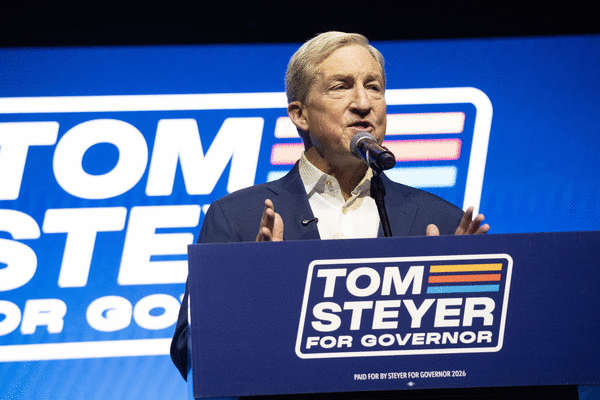
Josh Greene, an influencer known as “Josh the Progressive” on social media, is well-known for his takes on candidates and issues and has amassed a following of some 458,000 Instagram users. He’s interviewed Sen. Bernie Sanders and New York City Mayor Zohran Mamdani. But as The New York Times discovered recently, he’s receiving money from some politicians to post certain content. For example, former California gubernatorial candidate Tom Steyer paid Greene over $21,000, according to the Times.
Greene also featured an interview with Johnson in May after the mayor announced plans to visit Pope Leo at the Vatican.
As the Times reported, Greene does take payment from campaigns. His video with Johnson was not marked as a paid partnership, so we don’t know if any cash changed hands. We reached out to the Johnson campaign for clarification and didn’t hear back by our deadline.
It’s hardly just our mayor getting in on this trend. Smart politicians on both sides have recognized the need to gain influence on social media platforms, and many candidates themselves post short-form content they hope will garner attention. It’s always helpful when the message comes from someone else, too.
“Any campaign worth their salt will be trying to figure out: In the same way you pay for airtime, you pay for screen time,” Johnson campaign director Christian Perry told the Tribune last month. “This is not anything nefarious, new or unsavory. This is where people are getting their news and information.”
And their ads.
This is quite the gold rush for influencers, who often understand better than outsiders how to capture eyeballs and offer users content that pops.
In politics, you always follow the money. When it comes to influencers and whether their content is native or bought and paid for, that’s not always possible.
When a political ad runs in a newspaper or on TV, there are legal requirements that viewers be informed who paid for it. The evolution of social media has created a much less regulated landscape when it comes to politicking.
Campaigns have to report their payment, yes, but there are not clear requirements that the influencers themselves have to disclose the paid nature of their partnership with a campaign. And that’s a problem that needs fixing fast.
The Federal Election Commission should update our regulatory framework to address the creator economy. Requiring “paid for by” on content that has been, well, “paid for” by a political campaign is essential.
Voters have to sift through enough noise without having to parse whether a video comes with a side of political influence.
In the meantime, be extremely skeptical of the seemingly organic content you see online. You never know who paid for your eyes.
__
©2026 Chicago Tribune. Visit at chicagotribune.com. Distributed by Tribune Content Agency, LLC.















































Comments