Commentary: Voters, don't be fooled by state tax-cut measures
Published in Op Eds
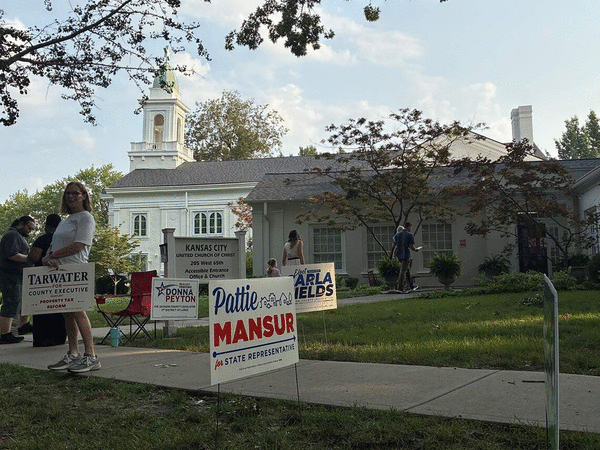
You might not know it yet, but there is more at stake in this year’s midterm elections than just which party wins control of Congress.
Across the country, politicians and wealthy special interests have put billions of dollars in state tax cuts on the ballot. It’s a familiar strategy that often works. But this year’s crop of tax ballot initiatives is historically aggressive and costly, and voters are already pushing back.
The first test of this came on Aug. 4, when Missourians rejected Amendment 5 — an extreme attempt to scrap their income tax in favor of enormous increases in the sales tax. The organization I lead, the State Revenue Alliance, tracks and helps defend against efforts to sabotage state tax revenue, including at the ballot. According to our data, Missouri’s Amendment 5 is the worst-performing major tax ballot question in any state in at least 14 years.
Amendment 5 lost in every Missouri county by a huge margin. In the end, a group of wealthy, undisclosed donors spent tens of millions of dollars to win only 17% of the total statewide vote.
Unfortunately, Amendment 5 was only the first of 18 ballot measures across the country that seek to make it harder for states to raise revenue or are tax giveaways to the rich.
Adding them up, the remaining 2026 ballot measures that aim to cut taxes represent more than $16 billion in direct or potential lost public revenue each year. Some would make it significantly harder for future generations to reverse course, either through ballot initiative or legislative means.
Among the most troubling initiatives is Florida’s Amendment 3. It would cost $12 billion a year and could permanently reduce local governments’ ability to function or provide safety and emergency services. Amendment 3 isn’t just bad policy — it’s a national disaster-in-waiting. Florida’s recurring experience with natural disasters requires significant local and state resources. By restricting the state’s ability to prepare and recover, Amendment 3 could cause needless harm and perhaps require the federal government to fill the funding void.
In Washington state, perennial anti-tax ballot activists and billionaires are bankrolling initiatives to repeal recent progressive tax increases. The North Carolina legislature, perhaps fearing an electoral loss in November, forced income tax and property tax measures onto the ballot that tie the hands of both state and local governments in responding to budget pressures.
In various ways, voters in California, Colorado, Iowa, Oklahoma, North Dakota, South Dakota, Tennessee, Utah and Wyoming will be asked to cut property taxes by hundreds of millions of dollars or raise barriers to future revenue increases, making it more difficult for future legislatures to respond to changing economic realities. This at a time when President Donald Trump’s One Big Beautiful Bill Act is putting state budgets in a bind.
Backed by corporate lobbyists and their politician friends, these measures are meant to stand in the way of citizen-led efforts to make state codes fairer, more equitable and better able to support the programs and services that families use on a day-to-day basis.
The outcome in Missouri is a good sign that cynical strategies to cut taxes for the wealthy and well-connected won’t work because voters are facing problems that tax cuts for the wealthy do not solve.
Families are worried about paying for the basics — affordable housing, rising insurance costs, childcare, quality public schools, safe roads and jobs that are safe in an AI-driven economy. Communities want governments capable of responding to wildfires, floods and public health emergencies. Education and physical infrastructure are among the most important drivers of economic competitiveness.
In this context, the efforts of politicians to starve state budgets and pursue deep tax cuts to lure billionaires are not just ill-advised and risk future fiscal crises, but also tone-deaf, completely out of touch with their communities and unlikely to lead to economic growth.
Regardless of where they live or what political party they usually vote for, voters should say “no” to tax cuts for the wealthy on their November ballots.
____
Amber Wallin is executive director of the State Revenue Alliance and Alliance Action Fund. This column was produced for Progressive Perspectives, a project of The Progressive magazine, and distributed by Tribune News Service.
_____
©2026 Tribune Content Agency, LLC.













































Comments