Gustavo Arellano: Dolly Parton stood up for undocumented immigrants when few others would
Published in Op Eds
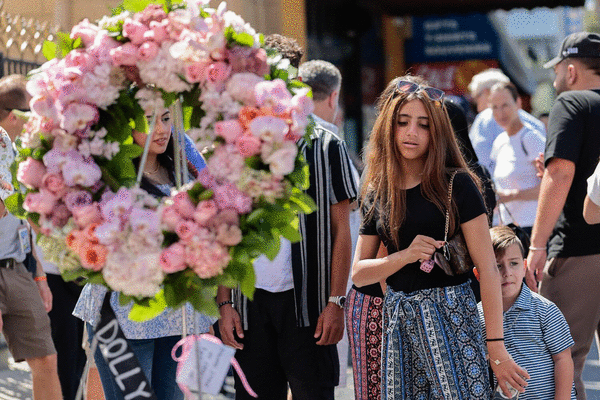
My favorite Dolly Parton song is nowhere near her most famous and not even among her best.
But if you want to honor the late country music legend's legacy — a testament to the Gospel's radical notions of love, acceptance and uplifting the marginalized — you need to blast her cover of Woody Guthrie's "Deportee (Plane Wreck at Los Gatos)."
Guthrie wrote the weeper in 1948 to commemorate a plane crash in California's Central Valley that killed all 32 passengers, including 28 Mexican nationals with a one-way ticket back home. The leftist balladeer was furious that media accounts named the four white victims but none of the Mexicans, reducing them to their status as mere deportees.
Musical giants like the Byrds, Joan Baez, Johnny Cash and Pete Seeger had covered "Deportee," but no one with Parton's mainstream fame. She released her version in 1980 as part of a concept album hailing blue-collar workers that was a companion to her hit film "9 to 5."
Parton could have limited her tracks to farmers, coal miners, swing shifters, assembly line workers and other laborers whom country music constantly lionizes, and no one would have complained. It would have been the safe option, anyway. The Reagan revolution was remaking American politics. American sentiment was turning against newcomers, whether Vietnamese refugees, Cuban and Haitian boat people, Central Americans fleeing civil wars or Mexicans looking for economic opportunity.
But Parton felt that immigrants — legal and not — were part of America's story, too.
She sings "Deportee" like the dirge it is — and then goes further. She recites the names of the Mexicans Guthrie envisioned on the plummeting plane — Juan, Rosalita, Jesús and María — with tenderness, not pity. With lines like "They chase us like outlaws, like rustlers, like thieves," she embodies the fears of Mexican immigrants, then and now — that an American society that works them to exhaustion will toss them like "the oranges piled in their creosote dumps" that Guthrie so memorably described.
The Tennessee native rarely injected venom into her voice, even when singing about difficult subjects — but she does it here.
"Who are these dear friends all scattered like dry leaves?" she asks toward the end of the song. "The radio said, 'They were just deportees'" — she spits out, stating the words, not singing them.
The singer never revealed why she included "Deportee" in "9 to 5 and Odd Jobs." It's one of the few times she so explicitly addressed politics, which she famously and repeatedly said wasn't her thing. In the decades that followed, Parton never brought up immigrants again — but she didn't need to.
Honoring the undocumented and decrying their persecutors at the height of her career, against political headwinds and with nothing to gain and everything to lose, was par for her life, and a challenge for all us to do the same.
Can someone send that memo to President Donald Trump and his supporters as they trip over themselves with hollow praise in the wake of Parton's death?
Trump, who has long sneered at the helpless and continues to ramp up his deportation deluge, ordered American flags on federal grounds to be flown at half-staff for a week to honor Parton.
"This is a true loss for millions of people," he wrote on social media. "There has never been anyone like her, and never will."
The president is definitely not like Parton. Earlier this year, his administration marked the anniversary of the "Deportee" plane crash with a social media post dismissing the victims as "illegal Mexican aliens," even though most of them were braceros whose contracts had expired.
I can't say I was the biggest fan of Parton's music — Loretta Lynn and Kitty Wells are more my thing when it comes to country — but her life story and worldview long ago sealed her in my heart.
Her arc mirrored that of my Mexican immigrant parents, who were also mountain people who grew up in big farming families with no plumbing or electricity, snuggling with siblings during winter nights in unheated bedrooms. They fled to modernity — Parton to Nashville, my parents to Southern California — as soon as they could but never forsook their hometowns, helping those who remained and taking their culture with them.
Mami and Papi didn't become multimillionaire celebrities like Parton. But they taught my siblings and me not to be ashamed of our roots and to give to those less fortunate, a philosophy that Parton practiced to the end of her 80 years. Parton and my mom taught that literacy was key to succeeding — Mami regularly took us to the library, while Dolly created a nonprofit that provides free books to young children, including Spanish-language options.
All three derived their empathy from a strong faith in Jesus — but also because that's what small-town folks do. Compare that to America's most famous self-proclaimed hillbilly, Vice President JD Vance. He preaches selfishness instead of selflessness, avarice instead of charity and going after the least of us instead of raising them up. His worldview has brought nothing but havoc to Americans, whereas Parton provided a guidebook for a national redemption.
No wonder Vance didn't immediately issue a statement praising his fellow Appalachian, leaving the job to his wife, Usha.
The plight of immigrants is one of the defining moral issues of our time, and more and more big name musicians are following the trail Parton blazed so long ago.
Earlier this year, Bruce Springsteen released "Streets of Minneapolis" to mark the killings of Renée Good and Alex Pretti at the guns of immigration agents. Tom Morello, Kathleen Hanna, Ozomatli and other alt-music stars will release an anti-ICE album this fall, with proceeds going to the National Day Laborer Organizing Network and Unión del Barrio.
And just last week, Kacey Musgraves urged concertgoers in Chicago to donate to a nonprofit that helps children separated from their "unfairly" deported parents.
"It's not a political thing," the singer said to a cheering crowd. "It's just, these kids need help."
MAGA-land went nuts, as it did earlier this year after Musgrave opened her shows with a mariachi quartet consisting of a father and his sons who had been detained by ICE.
Somewhere, Parton is smiling.
_____
©2026 Los Angeles Times. Visit latimes.com. Distributed by Tribune Content Agency, LLC.

















































Comments