David M. Drucker: Can Congress pass big reforms anymore? Paul Ryan isn't sure
Published in Op Eds
Democrats and Republicans, in Congress and the White House, once collaborated on fraught legislation to address major public policy and fiscal challenges: Social Security reform in 1983, Welfare reform in 1996, the Troubled Asset Relief Program of 2008 that arguably saved the U.S. from financial ruin. That’s just in my lifetime.
Today, an ever-dysfunctional federal government can barely keep the lights on. Polarizing shutdowns over key issues like health care and national security are happening with increasing frequency: three times in 2018, including a 34-day stretch; once last year, a record 45 days for a full government shutdown; and twice this year, including a record-breaking 76 days for a partial shutdown. It’s a dismal track record, especially compared to how Washington worked in earlier eras.
To sidestep the ongoing stalemates, the “continuing resolution” — Washington-speak for legislation that maintains spending at existing levels from year-to-year, regardless of current economic conditions or social priorities — has supplanted responsible, tailored budgeting.
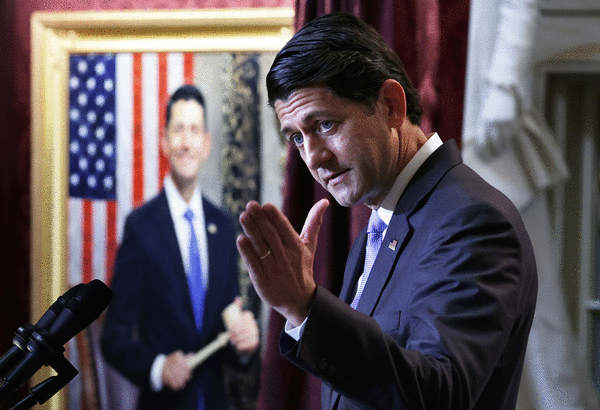
“It’s because we’re in a cycle of identity politics, practiced by both parties — and both parties are practicing their version of grievance populism, which lends itself to be counterproductive and partisan,” Paul Ryan, a Wisconsin Republican who served as the 54th speaker of the House of Representatives, told me in a telephone interview. “I think it’s a moment; it’s an era. Those come; those go.”
That’s why Ryan hasn’t been discouraged from tackling seemingly intractable problems, much as he did during his 20 years in Congress. His latest effort is a proposal, drawn up by his conservative nonprofit organization, the American Idea Foundation, to overhaul a patchwork of social safety-net programs that cost taxpayers in excess of $1.6 trillion annually, including but not limited to the Supplemental Nutrition Assistance Program (SNAP aka food stamps), the Temporary Cash Assistance for Needy Family (TANF), and the Children’s Health Insurance Program (CHIPS).
Because policymakers can’t resist an acronym, the plan is called RISE, for “Resources for Independence, Stability and Employment.” Ryan bills the blueprint as an alternative to a government-funded “guaranteed” or “universal basic income,” liberal proposals rising in popularity as policymakers grapple with the impact of AI. “It’s bad for people,” the former speaker argued. “It’s going to be bad for the country.”
RISE essentially calls for streamlining the alphabet soup of social safety net programs into a single, federal aid emporium that eases the cumbersome application process and maximizes benefits based on individual need. There are also work requirements and other benchmarks recipients must meet to obtain assistance, designed to both improve their standard of living and transition them off government assistance, in part by eliminating disincentives for getting ahead financially.
For instance, the RISE program discards “benefit cliffs,” in which greater earning power leads to ineligibility for aid. They often discourage needy recipients from seeking employment with higher pay, to avoid losing benefits.
A program of this magnitude is possible, Ryan emphasized, due to modern, and until recently, unavailable, blockchain technology, which also safeguards against fraud. But tellingly, the former House speaker and his colleagues at the American Idea Foundation aren’t trying to sell RISE to President Donald Trump or lawmakers on Capitol Hill. Rather, the reform is being marketed to states, with encouragement to develop pilot programs that best fit their populations. This approach has worked before.
In the early 1990s, some states enacted their own versions of welfare reform, amid policymakers’ concerns that the federal program was failing to improve the lives of recipients. Voters were also complaining that some beneficiaries were taking advantage of taxpayers’ generosity. Those individual state efforts led to the landmark Bipartisan Welfare Reform Act of 1996, approved by a Republican-controlled Congress and signed into law by President Bill Clinton, a Democrat. Ryan is confident history can repeat itself; he’s also realistic.
Ryan, a policy wonk who only ever aspired to be chairman of the House Budget Committee, experienced his share of setbacks in Congress. He fell short on efforts to repeal the Affordable Care Act (aka Obamacare.) And although Ryan convinced some fellow Republicans, for a time, to support painstakingly crafted proposals to overhaul Medicare, Medicaid and Social Security — the biggest drivers of a burgeoning, $40 trillion debt — members of his own party, never mind Democrats, eventually thwarted those efforts.
That’s why Ryan is pitching RISE to the states. It’s the only viable political play at a time when there’s little appetite for legislating of any kind in Washington. “I think it’s just a smart way to do policy; I think it’s a fast way to do policy; and given where Congress is these days, it’s the only way to do policy,” he told me. (The pilot programs would reduce federal expenses, Ryan confirmed, although implementation across various states would determine how much taxpayer savings would be generated.)
Quibble if you want.
Republicans under Trump enacted a massive tax and spending package — twice; once this presidency and another time during his first administration, in concert with Ryan, who was then the speaker of the House.) The Democrats under President Joe Biden approved a bipartisan infrastructure bill and a partisan package of economic aid and climate-related measures. But those bills, however arduous to pass, were largely about doing what voters love most: spending money. On the other hand, programs that alter social services, like Ryan’s proposal, are usually interpreted by voters as taking benefits away, and few actions spark their fury like closing the government spigot.
So what happens when the federal debt, which is the highest in history, finally comes due? It’s unclear if Congress and the president, whoever they are, will have the fortitude to codify legislation that tells voters “no.”
_____
This column reflects the personal views of the author and does not necessarily reflect the opinion of the editorial board or Bloomberg LP and its owners.
David M. Drucker is a columnist covering politics and policy. He is also a senior writer for The Dispatch and the author of "In Trump's Shadow: The Battle for 2024 and the Future of the GOP."
_____
©2026 Bloomberg L.P. Visit bloomberg.com/opinion. Distributed by Tribune Content Agency, LLC.




















































Comments