Commentary: Sacramento should save the program that is saving the grid
Published in Op Eds
Your power bill is too high. Electricity prices have risen by as much as 40% since 2020, far outpacing overall inflation. And after decades of nearly flat growth in energy consumption, data centers are driving up grid demand for the first time in roughly 35 years. Then heat waves, like the one currently cooking Southern California, push the whole system to the edge.
That’s why In 2022, California launched the Demand Side Grid Support program.
I ran the Department of Energy during the Biden administration. I know innovation when I see it. California’s grid program has been historic and should serve as a model for the entire United States.
To understand the program, start with how the grid becomes strained. During a heat wave, like the one currently cooking Southern California, millions of people turn on their air conditioning to keep cool. Suddenly, their homes use a lot more power. Certain power plants — called “peakers” because they come on during peak demand — rev up to generate more electricity. These plants are more expensive than others to run, so electricity costs more. Sometimes, there still isn’t enough power, and we get blackouts.
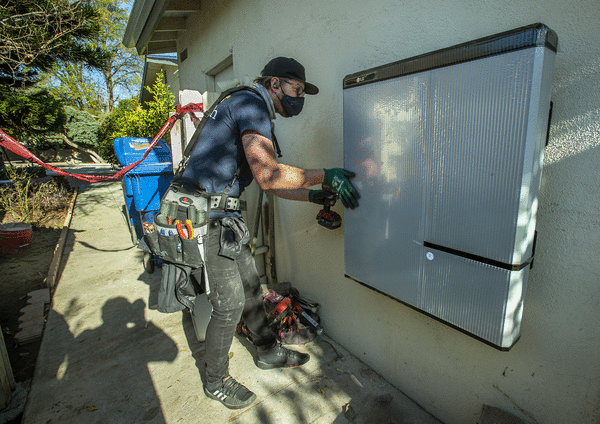
The Demand Side Grid Support program steps in to prevent blackouts and price spikes with hundreds of thousands of home batteries. The program pays customers to send energy from their solar and storage systems when Californians need extra power and when the price of electricity spikes. This vast network of batteries is what energy wonks call a “virtual power plant.” In effect, it works much like a traditional “peaker” power plant. Except instead of burning fossil fuels, cheap, clean energy surges in from people’s homes to keep the lights on.
The effect has been inspiring. Last year, more than 200,000 at-home batteries discharged more than 1 GW back to the electricity grid, about the size of a nuclear power plant. That’s enough to keep up in real time with San Francisco’s peak demand. And they can do this every day.
The state’s grid support program also benefits lower-income Californians. It has participants in 53 of the state’s 58 counties. One in four sites is located in a county where the median solar adopter earns less than $100,000 a year. Lower-income adopters actually enroll at higher rates.
And its price tag is manageable. In the four years since the Demand Side Grid Support program began, the program has cost just $13 million to administer while paying $66 million to participating households. California stood up a vast, flexible, clean energy (virtual) power plant that lowers bills for California without building any new infrastructure. This is innovation at its finest.
California’s largest utility, PG&E, praised the system’s performance after it successfully discharged during several test events last summer, saying it “proved that everyday Californians now play a big role in keeping the lights on.”
But if the program isn’t funded this legislative session, it will run out of money by the end of this year. Lawmakers shouldn’t let this happen. Every dollar spent on this program returns $2, according to research by UC Santa Barbara. It’s projected to save all California ratepayers $206 million if extended to 2028. This significant return investment is worth preserving for California.
Importantly, the Demand Side Grid Support program is tied to a school electrification program, which pays for the HVAC upgrades that keep classrooms cool, save schools money and let students breathe clean air. Unfortunately, nearly$200 million sits unspent in the California Schools Healthy Air, Plumbing, and Efficiency Program — known as CalSHAPE — while thousands of schools await critical funding for upgrades. Unless the program is extended, it will sunset at the end of this year too.
I have worked in government. I understand that there are budget constraints. There always are. But grid resiliency and school electrification (and ventilation) are no-brainers for California. If we turn our back on them, we’ll be stifling years of innovation and leaving our communities less protected.
California is currently baking under another heat wave. Deactivating 1 GW of capacity and blocking air conditioning for schools does not make sense, especially with a “ super” El Niño on the horizon that will break even more heat records. California should send a message that it is still the nation’s leader in clean energy innovation. New Jersey, Illinois, Massachusetts and Virginia are doubling down on customer-sited, distributed energy as a clean and affordable solution to support the electric grid. California should stay out in front.
Gov. Gavin Newsom and state lawmakers should be proud of their nation-leading energy programs. They should act now to restore funding for the Demand Side Grid Support program and support school electrification by extending CalSHAPE. Importantly, the California Senate’s budget plan included a proposal to do exactly that, but it did not end up in the final adopted budget.
Sustaining this progress is not only the fiscally responsible thing to do but also lets working-class Californians help alleviate grid strain, manage their utility bills and keep kids safe in school. Let’s continue to dream big and boldly tackle our hardest challenges.
____
Jennifer Granholm was governor of Michigan and secretary of the U.S. Department of Energy. She lives in Oakland.
©2026 Los Angeles Times. Visit at latimes.com. Distributed by Tribune Content Agency, LLC.





















































Comments