Commentary: Eat local, help farmers, avoid pathogens
Published in Op Eds
Amid the cyclospora outbreak that has sickened more than 27,000 people in 47 states, causing more than 800 hospitalizations and two untimely deaths, many people are blaming the federal government for letting its guard down on the monitoring of food-born illnesses.
That criticism is warranted: Under President Donald Trump, funding for the Centers for Disease Control and Prevention has been slashed. Thus, it has been harder to respond to the current outbreak, traced in part to iceberg lettuce grown at the massive food production operation run by Taylor Farms and sold at outlets including Walmart and Taco Bell.
But with our combined experience — spanning over four decades — writing about local food systems and working for leading nonprofits in the food movement, we’ve noticed that news coverage of the outbreak is missing one crucial point: Consumers have the power to limit the impact of this and future outbreaks. All they have to do is buy from local farmers.
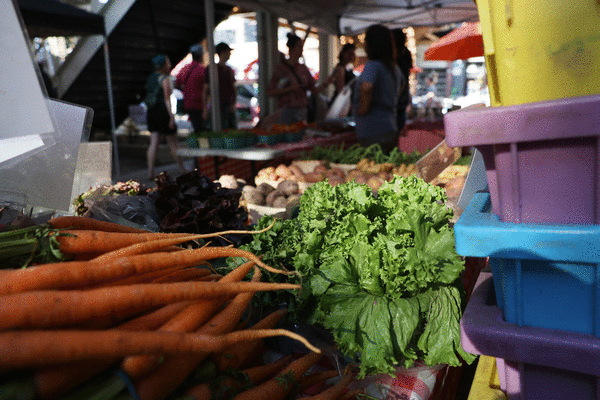
Sometimes the industrial food system feels inescapable — we’re awash in big box stores, grocery store chains, and fast food restaurants. But locally grown food is more widely accessible than many people realize. In 2025, researchers at the University of Wisconsin–Madison found that 80% of Americans shop at farmers markets at least once a year. There are 8,700 farmers markets in this country. Surprisingly, that’s over 50% more than the 5,206 Walmart and Sam’s Club stores in the U.S. in 2024.
Though local produce can cost slightly more — especially if it’s organic — eating local is not, as often portrayed, an elitist practice of the wealthy. Gathering Together Farms in Oregon, where we buy our lettuce, provides enough vegetables for a family of four in its community-supported agriculture (CSA) program at a cost of only $12 per person per week. The Philomath-based farm sells at six farmers markets and provides 400 CSA boxes a week. Over 40% of markets accept SNAP-EBT — and almost all of those offer matching programs.
Compare this to the 265 million servings of salad and vegetables per week produced at Taylor Farms, and you begin to understand the potential risk differential in eating lettuce from these two different sources.
The fact is, most Americans can buy directly from farmers if they make the effort. Finding one is as easy as searching on Local Harvest or the Department of Agriculture’s Local Food Directories.
Eating locally is also the path to reviving rural America. The latest USDA data shows that U.S. farmers receive only 12 cents of every dollar when selling to a distributor for far-away consumption. But when consumers buy from them directly, farmers receive upwards of 90 cents on the dollar, according to the Farmers Market Coalition. Farmers who sell directly to consumers also experience lower rates of bankruptcy.
Finding restaurants that source local ingredients is easier in some places than others. But all across the country, you’ll find affordable local restaurants and regional chains that source locally like Burgerville in the Northwest, Local Foods in Texas and Farm Burger in the Southeast. To find more, try the Buy Fresh, Buy Local directory or your local Slow Food chapter’s website. Or simply search online for “Restaurants sourcing local food in (city/state).” If all else fails, chat up a farmer at one of those 8,700 farmers markets.
We realize not everyone will stop patronizing national chains like Taco Bell or buying lettuce from Walmart. There are still food deserts in this country — places where it’s hard to find fresh, nutritious, affordable food.
But even a small shift towards buying local produce could help contain outbreaks like the one we’re facing. And that’s a much better way to go than the method many people are now adopting —swearing off healthy veggies altogether. A recent CBS News poll showed that 40% of Americans were buying less produce as a result of the current cyclospora outbreak.
We shouldn’t have to avoid vegetables to avoid pathogens. Seek out local farmers, or restaurants that buy their produce from them. You’ll be less likely to become a statistic in an outbreak while also shifting food dollars back into rural America.
_____
Hannah Wallace is a Portland-based journalist who is working on a book about how regenerative agriculture could unite our country. Sarah Weiner, founder of the Good Food Awards, recently launched Project Americana, which brings rural and urban eaters together to forge a food system that serves everyone. This column was produced for Progressive Perspectives, a project of The Progressive magazine, and distributed by Tribune News Service.
_____
©2026 Tribune Content Agency, LLC.





















































Comments