Commentary: Citizens in name only: What the Supreme Court can't fix
Published in Op Eds
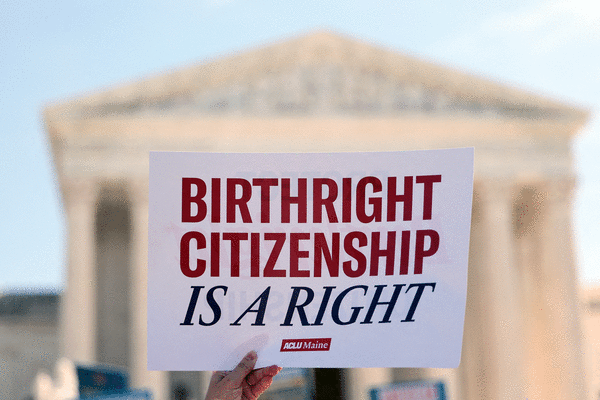
The Supreme Court will soon rule on Trump v. Barbara, the case that could upend birthright citizenship as we have known it for over a century.
But the current debate over birthright citizenship overlooks the fact that legal citizenship— by birthright or naturalization — has never fully protected marginalized Americans. People of color, women, LGBTQ, and lower-income Americans have long been CINOs: Citizens in Name Only. Throughout our 250-year history, they have lacked full social citizenship -- access to social/welfare entitlements, political citizenship – access to voting rights, and cultural citizenship– recognition as members of the American family. So, while a court ruling can determine who gets a U.S. birth certificate, it cannot guarantee societal inclusion.
Race has been at the core of determining citizenship eligibility since the 1790 Naturalization Act, which explicitly reserved it for "free white persons." Though the 14th Amendment and women's suffrage expanded legal citizenship, Supreme Court cases like Plessy v. Ferguson and United States v. Bhagat Singh Thind contracted it again for certain Americans. Consider that Native Americans— the original Americans — were not extended legal citizenship until 1924, a century ago, and even then, were denied the right to vote for decades more.
As a sociologist who has spent 15 years researching how Latino immigrants navigate race, healthcare, and legal status in the United States, I have seen this gap between paper citizenship and lived experience up close. One consistent theme runs across my research: Legal citizenship does not protect people from being profiled as not "American." In my most recent book, I argue that racialized legal status — the intersection of race, ethnicity, and documentation status — undermines immigrants' and citizens' access to healthcare even under reforms like the Massachusetts and Obamacare policies designed to expand them.
As I found in my research conducted from 2012-2019, Latinos, for instance, reported that they were prevented from getting necessary medical care because of the collision of racial discrimination in health care, law and immigration enforcement that target their communities, and legal status restrictions that shape eligibility for health insurance and driver’s licenses. Being a CINO did not spare Latino citizens from being treated as noncitizens.
This is not a new phenomenon. In 2016, as Trump's first campaign gained momentum, Charles, a naturalized U.S. citizen from Brazil, told me: "Whether I like it or not, they will see me as an immigrant. Even with my citizenship, I will never be, in the minds of Americans, a real American."
Under Trump 1.0, Cecilia, a naturalized citizen from El Salvador, told me about being assaulted on the street by a White woman who threw coffee at her and said, "You should be out of here. Go back to your country." Sebastiao, a naturalized citizen from Brazil, began carrying his passport card everywhere he went in 2019 after a White gym member demanded he show proof of his status. "Even though I am a citizen," he told me, "I don't always feel like one. We are on the defensive all the time."
In 2026, that defensiveness has deepened. ICE has detained, assaulted, deported and even killed U.S. citizens, with agents ignoring their attempts to show proof of citizenship. The Trump administration is pursuing the largest denaturalization campaign in modern history, targeting the roughly 25 million foreign-born Americans who became citizens through naturalization. The Supreme Court has effectively gutted the Voting Rights Act, impeding citizens’ constitutional right to vote and redrawing racially discriminatory voting districts, and diluting Americans’ of color political representation.
But the power of citizenship has also diminished for White Americans, too, along with others who haven’t experienced citizenship as contingent. The One Big Beautiful Bill Act is dismantling healthcare and the social safety net that once made citizenship meaningful, particularly for millions of White working-class Americans. And record numbers of US citizens are leaving the country and renouncing their citizenship. These are clear signs that “being American” – at home and abroad – no longer holds the same weight.
What would make citizenship valuable again for all of us? Not only a Supreme Court ruling, though that matters. We need to reckon with the gap between the legal citizenship written in our founding documents and the lack of social, political and cultural citizenship experienced by those this nation has never fully claimed.
That means we need policies promoting social citizenship — the right to healthcare and economic security regardless of race. It requires laws advancing political citizenship – the right to vote and have political representation without targeted barriers. And we need compassion and recognition of our shared fate to ensure cultural citizenship – the right to be recognized as fully American without being asked for proof at the gym, on the street, or behind the wheel.
None of us should have to carry our passport cards to exist safely in this country. After two and a half centuries, being a CINO is not good enough. Full, multifaceted citizenship is still owed to us all.
____
Dr. Tiffany Joseph is Associate Professor of Sociology and International Affairs at Northeastern University and the author of Not All In: Race, Immigration, and Health Care Exclusion in the Age of Obamacare.
___
©2026 The Fulcrum. Visit at thefulcrum.us. Distributed by Tribune Content Agency, LLC.



















































Comments