Commentary: What 99 men from Chicago's most violent neighborhoods teach us about crime
Published in Op Eds
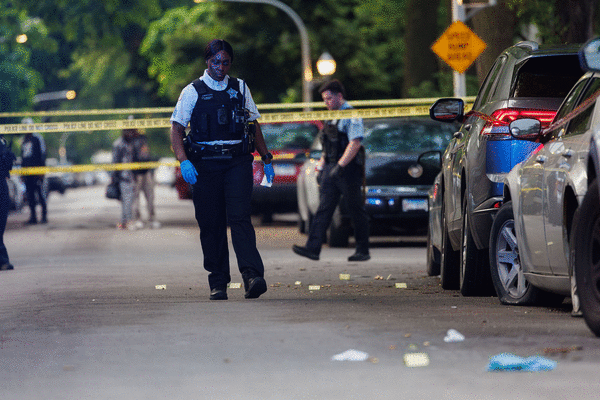
Chicago recorded its fewest violent crimes in 60 years last year. That’s the good news. The bad news is what’s happening so far this year. While other cities continue reducing crime, in Chicago, homicides are actually up 7%. And summer is here, a time when violence spikes.
Chicago just can’t spend its way out of the problem. Federal pandemic relief to cities ended. Downtown struggles due to remote work. One might diplomatically call Chicago’s budget situation not ideal, which means we need to get more out of every dollar spent.
Chicago has recently invested $100 million in community violence interventions, known as CVI. CVI is not a Marshall Plan for solving poverty. It is a narrower approach that deploys community organizations to interrupt the interpersonal conflicts that are at the heart of most shootings in Chicago and across the country. CVI works to keep conflicts from escalating into gun violence through street outreach, mentoring, jobs programs and case management.
There is another component — cognitive behavioral interventions — that may be a force multiplier of the CVI dollars Chicago is already spending. I know this because I helped conduct in-depth interviews with 99 men from Chicago’s highest-violence neighborhoods who participated in READI Chicago, one of the city’s largest CVI programs, that offered those at highest risk of violence a subsidized job, cognitive behavioral intervention and support from street outreach workers for 18 months. At baseline, 98% had been arrested, and 35% had been shot.
From these interviews, we learned how past violence reshapes how people react to future events in ways that can make violence more likely and how that cycle can be broken. Three patterns came up again and again.
What these 99 men told us explains why.
First, being the victim of violence rewires how you perceive the world.
One participant, shot at 17, told us that before getting shot, a sideways remark would roll off his back. Afterward, ambiguous interactions often put him on edge. He would be quick to assume someone wanted to fight him or even shoot him. In READI, he and others learned to recognize that their first interpretation of a situation might be anchored in a past experience, not an accurate read on the present one.
Another participant described how, instead of reacting when someone disrespected him on the street, he learned to consider that the other person might just be having a bad day. Learning to pause, to question your first read of a situation before acting on it, is the core of what cognitive behavioral interventions teach.
Second, chronic exposure to violence narrows your sense of how you can respond when conflict arises.
One man learned a close friend had been killed the day before our interview. His first instinct was retaliation. He went home and loaded his gun. Before READI, he told us, he would have gone through with it. Through the program, he learned to recognize that he had alternative options he could not see in the moment and that revenge might bring relief for a day or two but would not bring his friend back.
Third, when you have done violent things, you may come to believe that you are a violent person.
That self-perception makes it more likely that you will engage in violence in the future. One participant told us he had spent years believing he was a bad person, that after all the harm he had caused in his community, there was no good left in him. Through READI, he came to see himself differently: not as someone who was bad, but as someone who had been through bad situations. He traced it to losing his sister in a house fire as a child and then several loved ones to gun violence after, trauma he had carried into adulthood without ever naming it until READI.
These three patterns are not moral failures. They are predictable responses to exposure to chronic violence. Most people who lived through what these men lived through would develop them. But they can also be changed. Cognitive behavioral interventions help people examine their own thinking and make decisions more in line with who they want to be.
Seventy percent of participants described READI neither primarily as an anti-violence program nor as an employment program, but as an opportunity for personal growth. That’s significant because it suggests the intervention didn’t just deter violence. It changed how participants thought about who they were and who they could become.
These interviews show why programs that incorporate cognitive behavioral interventions could make CVI more effective; there’s also a growing body of statistical evidence to confirm it works. A randomized controlled trial of READI participants found a 65% reduction in shootings and homicide arrests. The program costs about $60,000 per participant, but it saves society between $4 and $18 for every dollar spent through fewer hospitalizations, fewer incarcerations and fewer lives cut short. Similar cognitive behavioral interventions, Becoming a Man (BAM), Choose to Change and One Summer Chicago Plus have also shown significant reductions in violent crime among young people.
The best street outreach workers already teach some of these skills intuitively. The practical next step is to make it structured so it happens consistently and with quality across CVI programs in the city. The good news for Mayor Brandon Johnson is that this would not cost much, if any, additional money.
It is the kind of pragmatic, evidence-based solution Chicago can implement now to bring the violence down.
____
Megan Kang is a sociologist at Johns Hopkins School of Government and Policy, an affiliate of the University of Chicago Crime Lab and co-author of “Social Cognition and Interpersonal Violence” with Kathryn Edin, Jens Ludwig, Timothy Nelson and Sendhil Mullainathan.
___
©2026 Chicago Tribune. Visit at chicagotribune.com. Distributed by Tribune Content Agency, LLC.



















































Comments