Catherine Thorbecke: The hottest Gen-Z tech trend? Anti-AI
Published in Op Eds
My favorite tech trend so far this year has nothing to do with artificial intelligence.
It’s the cool girls making their own “cyberdecks,” — strange, DIY and highly customizable personal computers that explicitly reject AI. They look like props from a cyberpunk movie, usually built on a Raspberry Pi base and spare parts. As one tinkerer, whose “mermaid cyberdeck” videos have drawn tens of millions of views, puts it: “What we should do with cyberdecks is gatekeep them from AI and megacorp.”
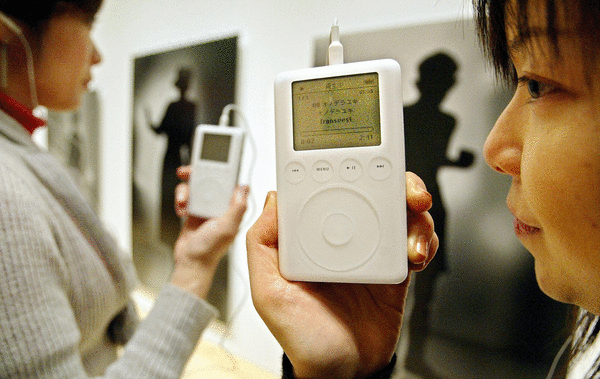
The cyberdeck boom follows the iPod as another Gen Z hardware obsession. Many of the models now being hunted online were released before their new owners were born. Refurbished tech site Back Market said that iPod sales jumped almost 50% last year, while eBay says “iPod” was searched more than 1,300 times an hour.
Going analogue has been trendy forever, but this isn’t about nostalgia. After Alphabet Inc.’s Google announced it was integrating AI into its flagship search engine, DuckDuckGo’s “no AI” alternative saw a surge in traffic. Nobody is a search-engine romantic; what people want is a choice. The rise of AI resistance tech — hardware and software that protects attention, privacy and agency in a world where chatbots and automation are shoved into everything — is a consumer response to a tech revolution they were never really asked to join.
AI might be powerful and unavoidable, but Silicon Valley can’t make it cool. The trend of single-purpose and anti-AI devices reminds me of when covering technology was fun. It meant weird, futuristic gadgets, obsessive experimenters, and platforms that promised to connect people and democratize information.
Then the broligarchy consolidated power and devices became closed, monopolistic ecosystems engineered to be addictive and invasive. Social platforms became hotbeds for some of the most illiberal, enraging discourse imaginable, with especially devastating consequences for young users. It’s not like Big Tech has earned our trust before forcing the public to accept another revolution on its terms. AI, we’re told, might be conscious, might kill us all, might take our jobs — and is also an inevitable path to abundance.
No wonder people are reaching for machines that do less. I understand the appeal. My favorite gadgets this year have been single-purpose devices that subtly reject the AI arms race. I use my tiny e-reader every day because all I can do on it is read books. I recently bought a purple digital notetaker from Japanese stationary company King Jim. All it lets me do is type drafts without the pull of social media or AI suggestions. And its clear purple shell has a hint of Frutiger Aero, the last great visual language of tech optimism.
Karen Hao, author of Empire of AI, a scathing and influential chronicle of the industry’s early growth, recently helped launch the AI Resist List, an online directory that helps people push back. Some organizations are teaching people how to poison their data so it can’t be used for AI training, others are helping workers organize labor coalitions. Together, it’s a political and cultural response to a technology being deployed faster than the public can understand it or meaningfully consent to it.
The industry is starting to take notice. In a blogpost this month, Microsoft Corp. President Brad Smith responded to graduates booing commencement addresses that mentioned AI, calling it “a powerful wake-up call for the tech sector.” Young people usually lead the adoption of new technologies, he added, so when they recoil, the industry should pay attention.
Smith is correct; Gen Z has lived with algorithmic life longer than anyone else. They know what it feels like to have attention harvested and their social lives optimized for engagement. They’ve also seen how quickly convenience becomes dependency. Perhaps waiting as long as possible before using AI is a good thing. It’s easy to outsource homework, essays and even thinking itself. But the struggle is the point for developing brains. Wrestling with a problem is how you learn judgment, taste, resilience and all the problem-solving skills required to thrive in this time of rapid change.
To his credit, Smith is doing what the industry badly needs to do more of. He’s trying to have a human-sounding conversation about AI. He pointed to real, even life-saving, applications, including firefighters in California turning to AI to spot wildfires and teams in Ukraine to remove landmines. These examples matter: The ways the technology is being used to improve medicine, disaster response and accessibility is a much better selling point than pretending it’s conscious.
But do these useful applications justify their compulsory adoption everywhere else? Young consumers are saying no. That distinction matters for the tech industry.
Silicon Valley’s favorite argument is that resisting its version of progress means rejecting progress itself. The inevitability rhetoric sure is a convenient way to flatten debates about labor, copyright, creativity, deepfakes and environmental costs. The new wave of AI resistance tech rejects that fatalism. It says people should still get to choose the tech they use and the attention and data they give away.
Is the AI resistance doomed against the tens of billions of dollars being poured into the revolution? Probably. Long live the AI resistance.
_____
This column reflects the personal views of the author and does not necessarily reflect the opinion of the editorial board or Bloomberg LP and its owners.
Catherine Thorbecke is a Bloomberg Opinion columnist covering Asia tech. Previously she was a tech reporter at CNN and ABC News.
_____
©2026 Bloomberg L.P. Visit bloomberg.com/opinion. Distributed by Tribune Content Agency, LLC.




















































Comments