Marc Champion: Trump's Iran truce has the hallmarks of defeat
Published in Op Eds
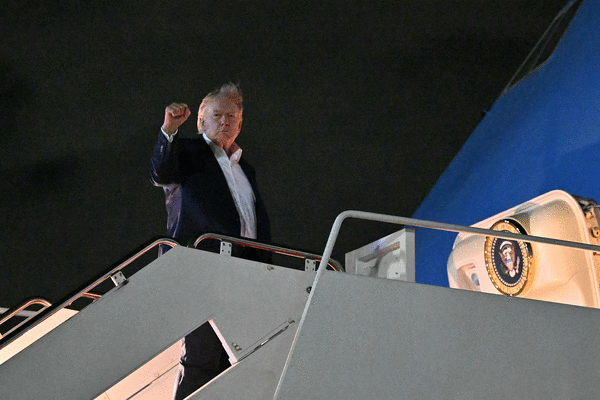
A deal to reopen the Strait of Hormuz is set for signature on Friday, and Donald Trump is already congratulating himself on being the first U.S. president to have made peace with Iran since the country’s 1979 revolution. That’s wrong. He is the first to have taken America to war with Iran, and therefore the first to have needed a truce to stop one. The peace his predecessors sought and failed to achieve has yet to come.
None of this would be cause for criticism if the decision to attack the Islamic Republic were to leave the U.S. in a substantially better negotiating position than it enjoyed before the start of hostilities. We can’t be sure of the terms of the so-called Memorandum of Understanding, because they haven’t been published. But the fact that the Iranians are gloating, while Israelis are horrified, strongly suggests that isn’t the case.
Those reactions and what official comments we have on the agreement’s terms suggest that Trump’s negotiators have, at least for now, solved only the new problems that he himself created. These include the need to eliminate Iran’s stockpile of highly enriched uranium, which did not exist before he collapsed the 2015 nuclear deal, and to reopen Hormuz, which closed only as a result of the war he chose to wage.
The Israelis are aghast, because even though they are a party to the conflict, they have had no role in the negotiations and there’s no indication that Trump’s truce will end any of the problems they went to war to resolve. The nuclear issue is reserved for negotiation after the truce takes effect. Others aren’t even mentioned.
The eventual deal will have at least four requirements, judging by comments where all sides agree. These are: An end to all hostilities, including in Lebanon; reopening the Strait of Hormuz to shipping; a restart of nuclear negotiations; and the release of billions of dollars in frozen Iranian funds, though with conditions and a schedule that remain unclear.
The June 11 statement from Israeli Prime Minister Benjamin Netanyahu’s office on the forthcoming deal amounted to a reminder of all the business that the MOU will leave unfinished: “The prime minister expressed his appreciation for President Trump’s commitment that the final agreement reached at the conclusion of the negotiations will include the removal of enriched (nuclear) material, the dismantling of enrichment infrastructure, limitations on missile production, and the cessation of Iran’s support for its terrorist proxies in the region.”
Iran’s negotiators also are having to sell the deal at home, where hardliners object to any agreement with the U.S. They don’t believe that Washington — which, with Israel, assassinated the nation’s supreme leader while engaged in the last round of nuclear talks — can be trusted. Plus, in their view they’re winning the war.
As part of the sales campaign to counter this opposition, Iran’s state-controlled Mehr news agency has published comments from Mehdi Mohammadi, strategic advisor to the Iranian negotiating team, as well as a leaked, purported 14-point draft of the MOU.
Mohammadi highlighted that the MOU’s terms would mark the first time the U.S. has guaranteed it will control Israeli actions, something he considered highly significant. He also said the agreement would commit Trump — the architect of America’s “maximum pressure” sanctions policies — to lift primary economic sanctions on Iran. And although the MOU does require Iran to enter talks on diluting its stock of highly enriched uranium, negotiations on any other part of the country’s nuclear program are not guaranteed. That would require the assent of both parties: “Without mutual agreement, there will be no negotiations,” he said, according to Mehr.
Other parts of the draft published by Mehr (like the creation of a $300 billion reconstruction fund) are hard to credit, amounting to an Iranian wish list. Yet nothing that U.S. officials have said, either on or off the record, suggests the core elements of the deal Mohammadi describes are wrong. Taken together they would simply reflect the reality that this war was — for the U.S., at least — a strategic folly that has left the Iranian regime wounded, but with more leverage than it had before.
Trump criticized the Obama-era nuclear deal he went on to dismantle because it was impermanent, and failed to completely eliminate Iran’s uranium enrichment program or address other Iranian threats, such as its ballistic missile program and network of proxies. He also faulted the so-called Joint Comprehensive Plan of Action for, in exchange for Iran’s concessions, returning some frozen funds and lifting sanctions. Trump said he could do better.
Yet Friday’s MOU looks set to fail on the same counts, while making even more concessions for a much more limited potential nuclear deal — and all because Iran has discovered it can hold the world to ransom by closing Hormuz. That may not save a hated regime in Tehran once peace returns, but it will make for an inherently volatile situation in the Middle East.
I don’t doubt that the MOU will be signed, because this war has no realistic prospect of success if continued and the cost to the global economy of pursuing it — not to mention to Trump’s personal political fortunes — can only grow. But this is a ceasefire extension and an agreement on Hormuz, not a peace deal that would reimagine U.S.-Iran relations or bring stability to the region. It is a mark of the war’s failure that all of the problems that predate it have been left to the future.
____
This column reflects the personal views of the author and does not necessarily reflect the opinion of the editorial board or Bloomberg LP and its owners.
Marc Champion is a Bloomberg Opinion columnist covering Europe, Russia and the Middle East. He was previously Istanbul bureau chief for the Wall Street Journal.
©2026 Bloomberg L.P. Visit bloomberg.com/opinion. Distributed by Tribune Content Agency, LLC.


















































Comments