Commentary: Rideshare win could bring big changes
Published in Op Eds
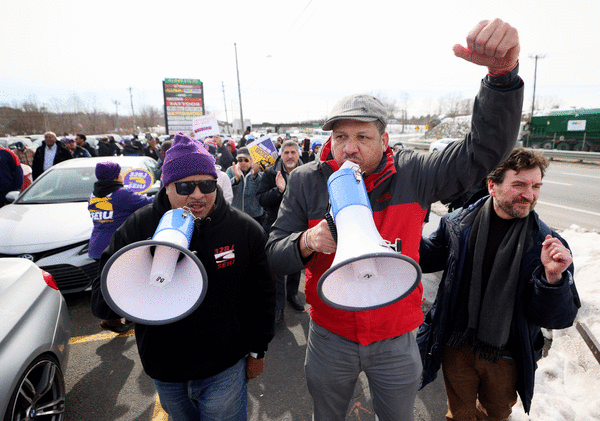
Uber and Lyft drivers in Massachusetts recently secured a major breakthrough in the struggle for union representation of rideshare drivers.
On May 25, the App Drivers Union announced that it has been certified by the Massachusetts Department of Labor Relations as the official bargaining representative for approximately 70,000 rideshare drivers in the state. That means drivers can now start legally bargaining for a contract to improve their pay and benefits.
This could be the largest new private-sector bargaining unit since 1941, when more than 80,000 Ford workers at the River Rouge Plant unionized and selected the United Auto Workers as their bargaining representative. This autoworker victory was seen as one of the key steps towards creating a strong American middle class during the middle of the 20th century.
American workers have not been able to succeed on this scale for the past 85 years, in part because the National Labor Relations Act, the federal law that controls most private sector workers’ unionization efforts, makes it very hard for workers to form a union. This is especially true for isolated workers like rideshare drivers.
The NLRA also channels most bargaining towards a solitary worksite, even as most worksites no longer resemble large factories. In contrast, under the Massachusetts rideshare law, passed by state voters in 2024, workers can form a union through an easier process and bargain across multiple firms to cover the entire industry — often known as sectoral bargaining.
Similar laws have spread to California and could soon be adopted in Illinois. Besides helping transform rideshare gigs into high-quality jobs, these laws would create a model of unionization that could improve other kinds of jobs and revive the labor movement.
While rideshare companies have developed an industry in which it is particularly difficult to create good jobs, the new laws hold promise. Sectoral bargaining models have worked in other highly challenging industries in U.S. history, like garment manufacturing.
In 1933, 60,000 garment workers in four states staged a strike to secure a contract providing minimum workplace standards for the entire apparel industry. The sectoral agreement helped transform an industry notorious for “sweatshop” conditions and firms avoiding responsibilities for fixing them into one with decent jobs.
Rideshare drivers currently contend with low pay, inadequate benefits, occupational injuries and potential violence from passengers. They also face algorithmic compensation-setting and the threat of arbitrary deactivation. What’s more, the rideshare industry will likely be among the first industries hit by major job losses due to artificial intelligence, as autonomous vehicles become increasingly common.
Massachusetts drivers hope to secure a contract that addresses these issues by the end of the year. The rideshare bargaining law provides for mediation and arbitration, which can prevent the tedious employer delays common under the NLRA.
Drivers in California could potentially secure a first contract even before drivers in Massachusetts, as prior stages of California implementation have moved more quickly. For example, California collected necessary data from rideshare companies several months faster than Massachusetts.
If rideshare drivers in both California and Massachusetts reach collective bargaining agreements, around 900,000 workers would gain union coverage. That would mark a major turning point, wiping out the gradual decline in private-sector bargaining coverage during the last 20 years.
Rideshare drivers in Massachusetts and California are making progress towards achieving a historic first contract that could improve the quality of their jobs as well as provide proof of concept for a model that could help many other workers. It is a cause that we should all support.
____
David Madland is a senior fellow at the Center for American Progress and the author of “Re-Union: How Bold Labor Reforms Can Repair, Revitalize, and Reunite the United States.” This column was produced for Progressive Perspectives, a project of The Progressive magazine, and distributed by Tribune News Service.
_____
©2026 Tribune Content Agency, LLC.


















































Comments