Lisa Jarvis: Makary is out, but the FDA is still far from normal
Published in Op Eds
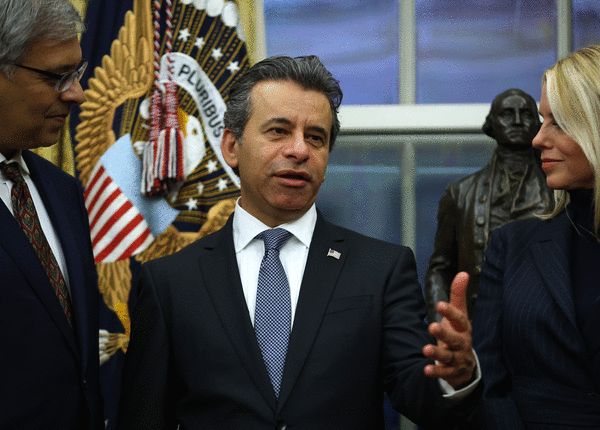
In an ideal world, this week’s resignation of Food and Drug Administration Commissioner Marty Makary would signal the end of a troubling period at the agency — one where the job of overseeing a sizable chunk of the U.S. economy had steadily devolved into dysfunction and chaos.
Yet while Makary’s exit is welcome, it’s hard to imagine an easy path back to normalcy at the FDA. Whomever is confirmed as the permanent head will inherit an agency hobbled by mass layoffs and an exodus of career staff. They will need to restore public confidence and lead with a steady hand, all while grappling with intense political pressure.
Their first task will be to untangle the mess Makary has left.
Good health officials set clear, consistent standards for determining whether a drug, vaccine or device is safe and effective. Pharmaceutical companies, policymakers, investors, ethicists and patients may disagree on those standards, but they should all at least understand the FDA’s rules of the road.
But under Makary’s leadership, the FDA has befuddled stakeholders. In some areas, he took a more relaxed, industry-friendly approach to regulation. For example, Makary created a new mechanism for lightning-fast reviews for certain drugs and upended what he called the agency’s longstanding “two-trial dogma” in favor of companies running just one late-stage study to confirm a product works.
Yet in other ways, the FDA became much more stringent, setting at times unscientific and unrealistic standards for certain products. The agency also rejected treatments previously expected to make it through the review process.
Some of Makary’s decision-making seemed motivated by his personal vendettas, such as his overhaul of Covid vaccine policy, or pet interests, such as his unilateral decision to loosen restrictions on menopause hormone therapy.
Many others seemed motivated by political ambition. Anyone listening closely during his confirmation hearing would have caught the many hints that Makary was willing to bend or even set aside science in order to fit a political agenda. And that has played out again and again during his brief tenure, prompting experienced leaders to leave and undermining trust in the FDA’s decision-making.
Makary’s initiative to speed up new drug approvals has become the prime example of how much the White House is meddling in the FDA’s affairs. Initiatives to accelerate drug development aren’t new, but in the past had typically been authorized by Congress — and eligibility for a speedier review was determined by internal experts considering unmet needs or early evidence that a therapy works.
Makary’s National Priority Review Voucher program, which promises FDA reviews in under two months, was pushed through without congressional input. Meanwhile, the criteria for earning a voucher — and the process for being awarded one — are suspiciously opaque. It soon raised concerns that vouchers were being used as leverage in Trump's negotiations with big pharma companies over drug prices.
That’s become a disturbingly normal part of the FDA’s process. In the first 10 months of the program, the agency has already approved six products under its remit and issued at least 21 vouchers — including some to companies that never asked for one, and one to a company that has since asked for its drug to be removed from the program. In December, Stat reported that the FDA commissioner had gotten the green light from the White House on all the vouchers awarded.
But if Makary’s vouchers might have scored points with Trump, he fell out of favor over other hot-button issues. Makary was the subject of endless critiques over his leadership and the ongoing turmoil at the agency. He had drawn the ire of patient advocates and politicians over his regulation of medicines for rare diseases, and incensed Republican politicians and anti-abortion activists by apparently slow-walking a review of the abortion medication mifepristone.
Ultimately, Makary’s refusal to approve flavored vapes, an issue that Trump reportedly saw as important to MAGA voters, was the final straw — even after he caved on the issue. Just hours after a Wall Street Journal report detailing the president’s frustration with Makary, the FDA gave its rubber stamp to the products.
Following Makary’s departure, Kyle Diamantas, who leads the FDA’s food program, has stepped in as acting commissioner. The appointment of Diamantas, who is considered a more conventional leader, offers a glimmer of hope that Trump’s pick for the permanent role — which requires congressional approval — will fit a more traditional mold.
Still, the next commissioner will surely face similar pressures as Makary, particularly after the precedent he set. Steering the FDA back to a place of regulatory steadiness and certainty — one where science, not politics, is its North Star — won’t be easy. Let’s hope someone far more capable steps up to the challenge.
____
This column reflects the personal views of the author and does not necessarily reflect the opinion of the editorial board or Bloomberg LP and its owners.
Lisa Jarvis is a Bloomberg Opinion columnist covering biotech, health care and the pharmaceutical industry. Previously, she was executive editor of Chemical & Engineering News.
©2026 Bloomberg L.P. Visit bloomberg.com/opinion. Distributed by Tribune Content Agency, LLC.




















































Comments