Andreas Kluth: Will the Iran war make Trump gun-shy or trigger-happy?
Published in Op Eds
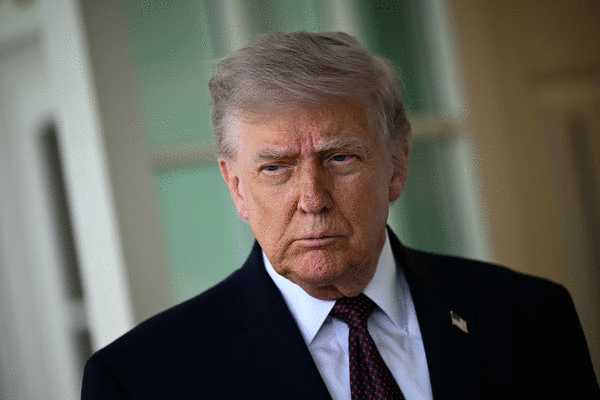
The Iran war, which Donald Trump started in February for no good reason and which could flare up again at any moment, broke a streak of easy American military wins. This raises a question for other countries that the U.S. president might coerce or attack, from Cuba to Nigeria, and from Danish Greenland to North Korea: Will the strategic fiasco in the Middle East make Trump more gun-shy, or even more trigger-happy?
A consensus among national-security insiders in Washington is that Trump launched the war at least in part out of hubris, after scoring what he perceived as several easy military triumphs elsewhere.
Some of the bombings he has ordered in his second term, such as those in Yemen and Nigeria, achieved no identifiable strategic success but also cost little beyond the hardware expended. By contrast, the massive strikes against Iran in June were militarily masterful and did set back Tehran’s nuclear program. And the Hollywood-style capture of the Venezuelan dictator in January persuaded Trump that the U.S. military could deliver quick and decisive regime “decapitations” anywhere, without the risk of American casualties or quagmires.
Those weren’t good inferences. “Venezuela could have gone quite poorly, and it was just sheer luck that no service members died, and that the United States was able to do that in as clean a way as we did,” Rebecca Lissner told me. She was a top national-security advisor in the Biden administration and is now at the Council on Foreign Relations. Even aside from questions of luck versus skill, it was immodest to extrapolate from success in Venezuela to victory against Iran.
And yet it was psychologically tempting, and Trump succumbed. The Iran war has already killed 14 American service members and thousands of people, including many innocents, in Iran and other places in the Middle East. It has disrupted the global economy, spreading the pain even to Americans filling up their cars at the pump. Strategically, it has left the U.S. worse off, with the Strait of Hormuz, which used to be open, still mostly closed.
Above all, the Iranian regime, by refusing to submit to U.S. military might and now in effect dictating the pace of negotiations, is teaching Trump his limits. Speaking for many, the German chancellor describes Trump’s America as “being humiliated by the Iranian leadership.” For a president who lives by the reputational barometers of Reality TV, all of this must seem unbearable.
The social sciences have lots to say about the psychology of leaders in such a pinch. Until the 1970s, the assumption was that people — in economics, warfare, politics or any other pursuit — were rational actors. Commanders-in-chief such as Trump were deemed to integrate empirical outcomes such as the Iran fiasco into refining their risk calculations, becoming, as it were, once bitten, twice shy.
Even at the time, America’s war in Vietnam showed the naiveté of this premise, as several presidents kept escalating, and taking ever bigger risks, despite mounting evidence that victory in Indochina was elusive. (Like the Iran war, the Vietnam war was never declared by Congress and thus not even officially a "war.")
Then scholars of decision-making such as Amos Tversky and Daniel Kahneman (who later won a Nobel Prize for his work) began discovering how the human mind really works — irrationally, that is. For a start, people do not weigh the risks of gains and losses symmetrically. They hate losses much more than they like gains, and may become more, rather than less, risk-seeking to recoup them.
This dynamic rhymes with related concepts, which were also on display during the Vietnam war, and would again become relevant decades later with the various “surges” during the American quagmires in Iraq and Afghanistan.
The sunk-cost fallacy tricks leaders into thinking that they’ve already sacrificed too much to quit. Fear of “audience costs” makes presidents reluctant to admit that they made a mistake or to appear “weak,” lest they lose credibility with voters at home or allies and adversaries abroad. That phobia — of “losing face” — seems paramount for Trump, who ran on “peace through strength” but instead earned himself the label TACO (for Trump Always Chickens Out).
Trump complicates any analysis because his mercurial temperament and unpredictability are off the charts. He is unusually sensation-seeking but simultaneously wrestles with real fear underneath the bravado.
So I asked Richard Fontaine, the chief executive of the Center for a New American Security. He was in the State Department and on the National Security Council during the early years of the wars in Iraq and Afghanistan, and remembers how initial successes led to enthusiastic notions about liberating Syria and Iran next. But “once the quagmires started,” he recalls, “nobody was talking about going to Tehran and Damascus or anywhere else.”
Trump, though, is different from any of his predecessors. “Does he conclude that, given the costly Iran experience, it would be better not to try another ambitious military operation somewhere else? That seems likely,” Fontaine told me.
“But he could also resolve that given the lack of a clean victory in Iran, we need to make up the difference with another big and visible success elsewhere,” he added. That could put Cuba in the crosshairs, which the U.S. is already besieging economically, and which looks to Washington more like Venezuela than the Middle East.
Rebecca Lissner agrees. Trump is “going to be gun-shy on the biggies,” she told me. If China, say, made a move against the Philippines in the South China Sea or against Taiwan in the strait, Trump would “be less likely to respond, or respond in a muscular way.” He probably couldn’t go to a full-blown multi-theater war anyway, since the U.S. has used up so many of the munitions it would need.
At the same time, Trump is likely to look for a “performative” win somewhere else, which could make him order more bombings of weak countries, such as last year’s in Nigeria. “So gun-shy on the things that really matter, but maybe more trigger-happy on the things that feel like they could still be a quick win,” Lissner told me.
This analysis amounts to a devastating indictment of the strategic decision-making that now reigns in the White House. Rather than conserving and concentrating American might to further genuine national interests globally and in the long run, this military superpower seems instead to have embraced a gladiatorial cult of “lethality,” with occasional acts of destruction for show.
____
This column reflects the personal views of the author and does not necessarily reflect the opinion of the editorial board or Bloomberg LP and its owners.
Andreas Kluth is a Bloomberg Opinion columnist covering U.S. diplomacy, national security and geopolitics. Previously, he was editor-in-chief of Handelsblatt Global and a writer for the Economist.
©2026 Bloomberg L.P. Visit bloomberg.com/opinion. Distributed by Tribune Content Agency, LLC.















































Comments