David M. Drucker: Money can't buy you voters' love
Published in Op Eds
No amount of advertising money can sell a bad product — or at least, a product that consumers have determined they don’t want (see: New Coke). This time-tested business principle also applies to American politics.
That’s helpful to remember as midterm elections proceed.
The Democratic and Republican parties, their candidates and their aligned outside groups are — collectively — raising and spending billions on the 2026 campaign. In heated battles for control of the House of Representatives and the U.S. Senate, both sides are already accusing the other of trying to buy the election.
But here’s the thing: That’s not how campaigns work.
Having deep pockets is helpful; and in close contests in competitive districts and states, spending more money can tilt the outcome — not only through TV ads and social media campaigns, but through direct-mail, canvassing and get-out-the-vote activities.
But the broader political atmospherics, including a president’s job approval rating, voters’ views of the economy and other priorities, and candidate quality often weigh more heavily.
As a political writer who has covered campaigns for more than two decades, I’ve seen this dynamic play out time and time again.
We obsess over fundraising totals and can’t help but think that he or she with the biggest war chest wins. And then he or she with the most resources loses, sometimes rather spectacularly.
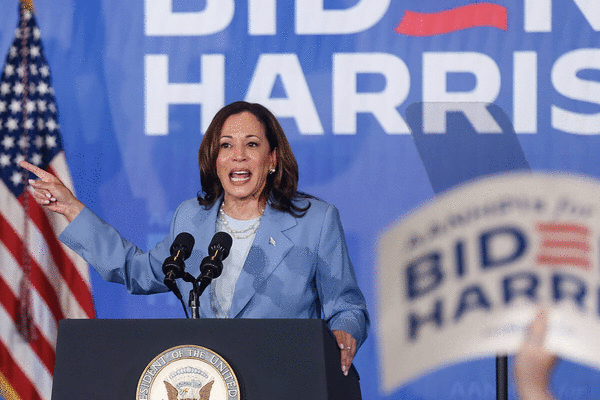
For example, in 2020, Maine Senator Susan Collins, a Republican, won reelection in a landslide, defeating Democratic challenger Sara Gideon by 8.6 percentage points despite being outraised by nearly $50 million. Indeed, Gideon vacuumed up so much cash from Democratic donors eager to retire Collins that she couldn’t spend it all. Meanwhile, President Donald Trump won the White House twice even though he was significantly outraised by his Democratic opponents — Hillary Clinton (2016) and Kamala Harris (2024).
“Money means less and less every year with the vast amounts being spent per targeted race. It gets to a point where every TV ad looks the same,” Jeff Burton, a Republican lobbyist and experienced campaign hand, told me. “The Democrats have more than enough money to compete for the majority and, after the GOP’s loss in Virginia and cost of living going up, the landscape for the House has definitely shifted in their direction.”
This cycle, Republican-aligned outside groups are raising more than their Democratic counterparts — substantially more when accounting for the container ships of cash being hauled in by Trump and his constellation of political action committees. That’s a reversal from some past campaigns that saw Democratic-aligned groups winning the money chase.
On the flipside, Democratic candidates for the U.S. Senate are raising appreciably more than Republican candidates. That’s significant, because under current campaign finance law, candidates pay far less for television advertising and receive better ad placement than do outside groups like super PACs and 501(c)4 organizations. It’s a dynamic that, along with a political environment turning sharply against the GOP, is putting the party’s 53-seat majority in greater jeopardy.
Republicans are in somewhat better shape in the House, where their party is laboring to preserve a razor-thin majority of just a handful of seats. According to Politico, “top fundraisers are split roughly evenly between the two parties” in the districts likely to decide which party wields the speaker’s gavel next year. But particularly because of the Democratic Party’s financial edge among Senate contenders, to say nothing of favorable political winds nationally, party operatives are pleased with the competition for money among congressional candidates generally.
“If you’re a Democrat, you’ve got to like what you see with fundraising — especially with our candidates,” Doug Thornell, a veteran of the Democratic Congressional Campaign Committee and now chief executive officer of SKDK, a government relations firm in Washington.
That doesn’t mean the Republicans’ financial dominance in money raised by party-affiliated and aligned groups is nothing to worry about for the Democrats. The GOP’s superiority in this category, although negligible when comparing the cash positions of the four congressional campaign committees, includes the Republican National Committee besting the Democratic National Committee’s war chest heading into April $117 million to $14 million — and that’s before the DNC’s $18 million in debt is accounted for.
But as I asserted at the beginning of this column: “You need enough; you don’t always need more,” Thornell explained. “You need enough to be able to deliver your message.”
Of course, the Democrats wouldn’t be able to lean on this principle if it was their party’s president who was sporting a 40.5% job approval rating, as is Trump, or if they were on the wrong side of generic ballot polling gauging which party voters would prefer be in control of Congress, as are the Republicans.
Having lots of money, and more of it than your opponent, is comforting — and preferable. I’m the last person to argue otherwise. But even if that turns out to be the case for Republicans when all the votes have been tallied, it won’t have done them much good if voters don’t like what they’re selling.
Just ask presidents Hillary Clinton and Kamala Harris.
_____
This column reflects the personal views of the author and does not necessarily reflect the opinion of the editorial board or Bloomberg LP and its owners.
David M. Drucker is a columnist covering politics and policy. He is also a senior writer for The Dispatch and the author of "In Trump's Shadow: The Battle for 2024 and the Future of the GOP."
_____
©2026 Bloomberg L.P. Visit bloomberg.com/opinion. Distributed by Tribune Content Agency, LLC.





















































Comments