Allison Schrager: AI may be the US economy's only hope
Published in Op Eds
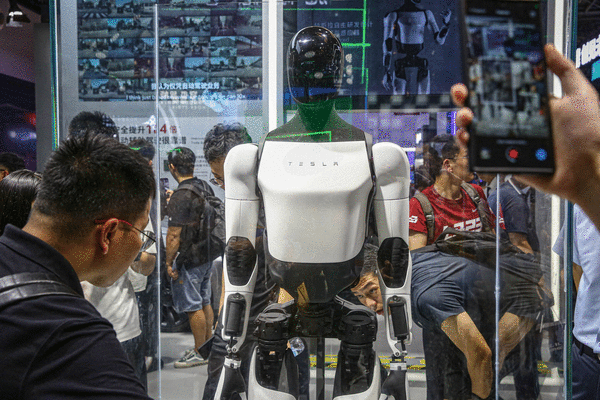
If you take the long view, America’s economic outlook is pretty bleak. Like a lot of rich countries, it is overwhelmed by debt it has no plans to reduce. Even more troubling is its aging population, which will reduce growth and leave fewer people to pay all that debt.
There is only one hope: a sudden increase in productivity that will boost growth so much it will pay for everything. As it happens, that is precisely the promise, or one of them, of AI. But what are the chances of it coming true?
The stock market is banking on it, as is Kevin Warsh, President Donald Trump’s nominee to chair the Federal Reserve, who is hoping AI-driven growth could justify a cut in interest rates.
It’s a tall order, as net interest outlays are expected to take up 5.4% of U.S. GDP by 2055 — and that’s assuming interest rates lower than they are currently. Meanwhile, America’s fertility rate is about 1.7, below the replacement rate of 2.1. It is even lower in other countries; at this rate, the world population is expected to peak in 2055 and take 2 percentage points off GDP by 2050.
But history is full of moments when either the end of humanity or the exhaustion of natural resources seemed inevitable, and we have always persevered, eventually and most of the time (ignoring famine, pestilence and war). We did so mostly because of our ability — especially in the last few hundred years — to come up with some innovation or another that delivered unimaginable prosperity. Innovation makes us more productive, which means we can do more with fewer resources. It can help make up for a shrinking population.
Speaking of which: For most of history people had the opposite concern about population — that it would grow too much and we would run out of food. But we came up with innovative farming techniques that enabled more food from less land and labor. That in turn freed up more labor for factories, which used more innovations, which created even more growth and in many ways made our lives today possible.
So the question is not whether innovation can drive growth. It’s how much growth innovation can drive. The falling population and heavy debt load mean productivity will need to increase GDP by at least 2.5%, maybe 3% depending on the path of interest rates.
For some context, the electrification of the economy resulted in a 2% real average growth rate over the last 150 years. It not only powered the economy in the 1880s, but it also enabled future innovations. AI will have to do better than electricity. Is that realistic?
Google CEO Sundar Pichai thinks so. In 2018, he called AI “one of the most important things humanity is working on,” saying it could be as profound as harnessing the power of fire. It is hard to put a number on that — but fire-level growth sounds like it would be more than 2%. Some chief executives of AI companies, meanwhile, talk more about AI destroying humanity than saving it.
We economists, having studied the industrialization of previous centuries, tend to make more conservative assumptions — something between harnessing fire and destroying humanity. But it may be reasonable to expect better than the 2% growth rate that followed electrification because innovation happens so much faster now. The best-case scenario is a 5% growth rate for some time, though that may not be sustainable.
The U.S. is nowhere near that now. Labor productivity was up 2.1% last year, with a 4.4% annualized rate in the last quarter. It is unclear whether AI, or any innovation, is the reason — it could be the smaller labor force from less immigration. Some industries that use AI are reporting more productivity, but so are non-tech industries. It is still early days: It took the steam engine more than 100 years to show up in productivity statistics, and the internet has yet to. The high-growth scenario will probably take a few decades to transpire, with more modest increases initially.
For David Warsh and other government and elected officials, that’s bad news. It is unrealistic to expect AI to justify rate cuts any time soon. The U.S. will be lucky if AI produces enough extra growth to pay for the next decade’s Social Security shortfalls.
There are also headwinds that may slow adoption and growth. Innovation is messy, leading to financial booms and busts. People lose jobs, and some never find another. The desire to control the downside risk could throttle any upside. Most Americans say the risks of AI outweigh its benefits, and this negativity bias could invite more regulations that will slow implementation, similar to what Europeans are trying. Fear of job loss will also probably slow implementation, because many workers don’t like to use new technology.
All that said, at least right now, innovation from AI is America’s only hope to make up for all its economic shortcomings. It may not be fire, but hopefully it will be close.
_____
This column reflects the personal views of the author and does not necessarily reflect the opinion of the editorial board or Bloomberg LP and its owners.
Allison Schrager is a Bloomberg Opinion columnist covering economics. A senior fellow at the Manhattan Institute, she is author of “An Economist Walks Into a Brothel: And Other Unexpected Places to Understand Risk.”
_____
©2026 Bloomberg L.P. Visit bloomberg.com/opinion. Distributed by Tribune Content Agency, LLC.




















































Comments