Ronald Brownstein: The Supreme Court is re-creating America's worst racial injustices
Published in Op Eds
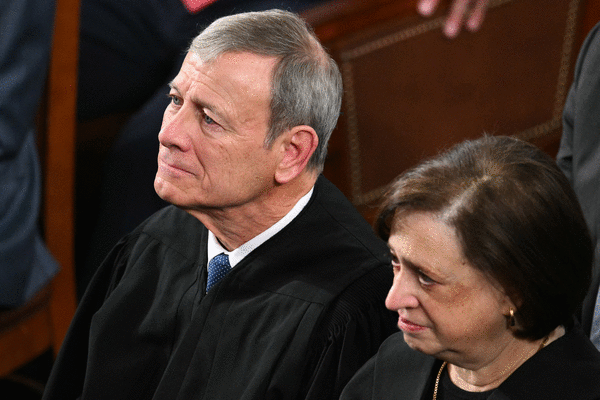
The Supreme Court’s decision further eviscerating the Voting Rights Act will enable a systematic disenfranchisement of minority voters that echoes the darkest moments in America’s racial history.
With their sweeping ruling, the six Republican-appointed Supreme Court justices have empowered Republican-controlled states to erase legislative districts that now elect minority representatives — even as non-White people account for the vast majority, or even all, of those states’ growth, according to an analysis of Census data by the Equity Research Institute at the University of Southern California.
The decision points to a future in which these states will gain more congressional representation primarily (or even solely) because of minority population growth, but then deny those citizens meaningful political representation.
“It is a striking contradiction,” says Manuel Pastor, executive director of the Equity Research Institute. “It is part of a frightening project of trying to lock in minoritarian [white] rule.”
This widening gap between population and representation ominously reprises one of the greatest racial inequities in American history. The notorious three-fifths compromise in the Constitution counted an enslaved Black person as three-fifths of a free white person when allocating House seats and Electoral College votes, but denied those slaves the vote. It also echoes the long years of Jim Crow segregation, when the states of the former Confederacy gained electoral power from their large Black populations, but systematically denied them the ability to vote — until the passage of the Voting Rights Act in 1965.
“The Civil Rights revolution” that included passage of the VRA “really was a completion of what began after the Civil War, to create a modern democracy that [establishes] a citizenship regardless of race or ethnicity,” says University of Connecticut historian Manisha Sinha, author of “The Rise and Fall of the Second American Republic.” That’s what the opponents of the VRA “are fighting against,” she adds. “It’s a very old fight.”
The ruling may come too late for many states to redistrict before the 2026 election. But analysts see about 10 states that could redraw their maps by 2028 to eliminate minority representation under the permissive new standard established by the court this week. There are at least a dozen (and maybe as many as 20) congressional seats, and up to 140 state legislative seats, now held across the South by Black or Latino Democrats that Republicans could target. And even that doesn’t encompass the decision’s full implications. Two-thirds of all the cases brought under the VRA’s Section 2 — the provision the court majority functionally invalidated — concern discrimination in elections for local office.
The impact on Congress in turn will be magnified after the 2030 Census, when many of the southern states likely to disenfranchise minority voters are expected to gain congressional seats. Four years from now, Texas and Florida are set to gain as many as seven new seats between them, and Georgia and North Carolina are likely to add representation as well. Since 2010, minorities account for all of Georgia’s population growth and at least four-fifths of the gains in the other three.
“We are going to get further and further away from the vision of one person one vote,” says Pastor.
For Chief Justice John Roberts, the decision presented an opportunity to reverse a stinging defeat he suffered — largely at the hands of other Republicans — over four decades ago. As a young assistant in the Justice Department under President Ronald Reagan, Roberts led the fight against 1982 amendments to the VRA that reversed a 1980 Supreme Court decision narrowing its scope.
In Mobile v. Bolden, the court had ruled that voting practices (such as district maps) could only be overturned with proof that lawmakers intended to discriminate. When a bipartisan coalition of senators — led by Bob Dole, the future GOP Senate majority leader and presidential nominee — moved legislation to restore the previous understanding that the VRA prohibited actions that had the effect of discriminating, Roberts drafted a flurry of op-ed articles, memos and congressional testimony opposing it.
Congress ignored Roberts’ arguments. The reauthorization of the VRA, with the effects standard crafted mostly by Dole, passed the Senate on a bipartisan vote of 85-8. On Wednesday, Roberts got his revenge.
This personal triumph for Roberts is a travesty for American democracy. It is also a recipe for intensifying social tension as non-White citizens — who comprise an inexorably increasing share of society’s workers, taxpayers and consumers — are methodically denied political representation commensurate with their numbers.
Through a broad range of decisions — covering issues from employment to academic admissions to elections and voting — the Republican court majority is stacking sandbags against a rising tide of demographic change. In so doing, they are operating much like the reactionary Supreme Court that dismantled Reconstruction and midwifed the birth of Jim Crow segregation in the late 19th century. The Roberts Court “is following the same pattern,” says Sinha. “I think they are just as intent about dismantling what we historians call the Second Reconstruction of American democracy during the Civil Rights era.”
But although Black Americans constituted only one-eighth of the nation’s overall population when the 19th century court dismantled their protections, non-White people already represent most of America’s under-18 population. White people are on track to become a minority of the nation’s total population in the 2040s.
The Roberts Court, in other words, is seeking to suppress a demographically driven racial reallocation of economic opportunity and political power. The consequences of doing so may be even more explosive than when the court last moved so aggressively to undermine the Constitution’s guarantee of equal protection for all.
____
This column reflects the personal views of the author and does not necessarily reflect the opinion of the editorial board or Bloomberg LP and its owners.
Ronald Brownstein is a Bloomberg Opinion columnist covering politics and policy. He is a CNN analyst and the author or editor of seven books.
©2026 Bloomberg L.P. Visit bloomberg.com/opinion. Distributed by Tribune Content Agency, LLC.





















































Comments