COUNTERPOINT: NATO's mission is outdated
Published in Op Eds
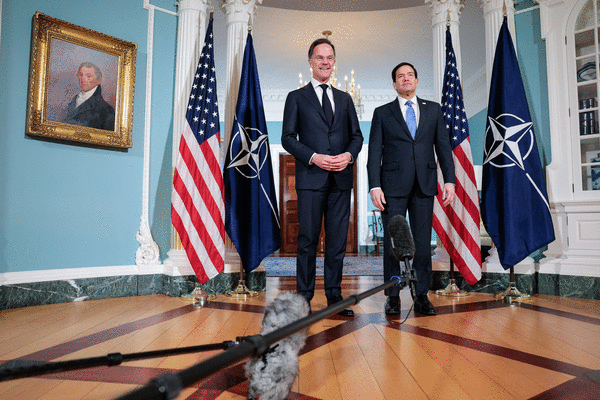
On April 4, 1949, the North Atlantic Treaty Organization was created “to serve three purposes: deterring Soviet expansionism, forbidding the revival of nationalist militarism in Europe through a strong North American presence on the continent, and encouraging European political integration.”
Those objectives were crucial in the aftermath of World War II as the Iron Curtain descended across Eastern Europe. However, they are no longer relevant today, which begs the question: Do we still need NATO?
While some may scoff at the notion that NATO is trivial, a strong case can be made from the U.S. perspective that it needs a substantial makeover.
Foremost, NATO’s mission is outdated.
In late 1991, the Union of Soviet Socialist Republics and its counterpart to NATO, the Warsaw Pact, collapsed, marking the end of “deterring Soviet expansionism.”
Since the end of World War II, “European political integration” has been achieved through the advent of the European Union and the euro. Meanwhile, the “revival of nationalist militarism” on the European continent has not been a problem.
Second, most NATO members do not pay their fair share of the burden, which means the United States has disproportionately funded Europe’s defense for decades. In his first term, President Donald Trump demanded that NATO members “must meet their financial obligations” of at least 2% of their GDP on defense.
To their credit, many NATO members have increased military funding in recent years. However, as the Atlantic Council reported in 2025, “When it comes to total defense spending, the United States is the clear leader — investing much more than all allies across Europe and Canada combined.”
More than 80 years after World War II, it is time for Europe to become self-reliant. Europe is wealthy and more than capable of defending itself.
Third, NATO undermines U.S. sovereignty. In his Farewell Address in 1796, President George Washington advised the United States to “steer clear of permanent alliance with any portion of the foreign world.” Although many will say that Washington’s advice to avoid foreign entanglements is a relic of 18th century isolationism, it still holds true.
According to Article 5 of the NATO Treaty, “an armed attack against one NATO member shall be considered an attack against them all.” To date, Article 5 has been invoked once, after the Sept. 11, 2001, terrorist attacks in the United States. As NATO has expanded over the years, the odds of a regional conflict devolving into a much larger conflict remain a terrifying possibility.
Fourth, and perhaps most significantly, NATO’s hyperfocus on the North Atlantic region as the locus of world affairs ignores emerging threats in areas such as the Pacific.
If the Soviet Union’s expansionism was the impetus for the formation of NATO, one would assume that the geostrategic rise of communist China since the fall of the USSR would make NATO less of a priority. Given that the Chinese Communist Party has clearly stated its intention to “reunify” Taiwan with mainland China in the near future, wouldn’t it make more sense for NATO to take a backseat to a defense partnership in the Pacific?
Of course, some will claim that NATO is still vitally important to the preservation of world peace, and they will point to the Russian invasion of Ukraine as an example of NATO’s necessity.
However, that is a flawed argument on many fronts. The sheer existence of NATO did nothing to stop Vladimir Putin’s invasion of Ukraine, which was seeking NATO membership before the invasion began. What’s more, several European nations, while decrying the Russian invasion, have continued to purchase energy from Putin, thereby funding his war machine.
I find it absurd that European nations are lambasting the United States for not sending even more money and military resources to Ukraine. Perhaps European nations should grow up and take responsibility for events in their neighborhood.
Finally, it is important to note that NATO has become quite political. For instance, NATO claims that “the earth’s rapidly changing climate and an increase in weather extremes have led NATO to accelerate its efforts in environmental security and environmental protection.”
For NATO to make sense going forward and remain relevant, it is time for its leaders to reconsider its fundamental purposes. NATO needs a massive makeover.
____
ABOUT THE WRITER
Chris Talgo is the editorial director at The Heartland Institute. He wrote this for InsideSources.com.
___
©2026 Tribune Content Agency, LLC



















































Comments