Adrian Wooldridge: The EU is moving on from neoliberalism
Published in Op Eds
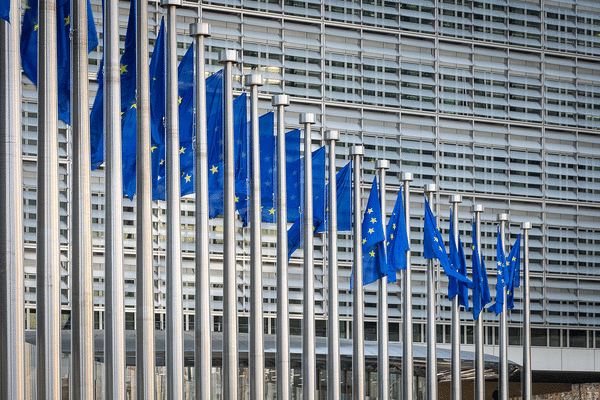
The European Union, which was born in 1993 and sired by the Maastricht Treaty, was a child of neoliberalism: the doctrine of market supremacy and government restraint that swept the world from the 1980s onward.
Globalization and the single market provided the EU with a growth engine; the single currency and the EU regulatory authorities drove integration; and an extensive system of contracting out sustained the EU’s sense that it was a special place, at the forefront of progress. Provided the Chinese did the manufacturing, the U.S. paid for defense and the Russians provided the energy, the EU could afford both a generous welfare state and a green transition.
The global backlash against neoliberalism has finally reached Brussels. I spent last weekend engaged in a very EU activity — discussing the future of the organization with Euro-wonks in a delightful Tuscan village — and everybody seemed to agree about this epochal change.
We were enveloped in a billowing word cloud of new phrases to add to “industrial strategy,” as celebrated in the Draghi report: “regime zero...U.S. de-risking… the arsenal of democracy… made in/with Europe… AI sovereignty…military Keynesianism… European defense/IT/democracy bonds… and choke points.”
In 2023, the European People’s Party Group, the largest grouping in the European Parliament, published a smug report about the single market, “turning thirty and still going strong.” What was needed was a big push on services. Now Europhiles are more likely to quote Jacques Delors’ 1988 warning that “nobody falls in love with a common market.”
Why is the EU moving away from an ideology that served it so well? And, more importantly, what can it put into place to hold the conglomeration together — or at least stop it from falling apart? There are lots of reasons why the market is not what it was. The global economy is fragmenting. The logic of geostrategy is replacing the logic of markets. The Russian threat is growing: If Putin loses in Ukraine, his regime may collapse, but if the West loses, Russia will roll forward, in search of new victims and a new buffer zone. But two factors need particular emphasis.
The first is the reality that America is no longer a reliable ally. Europe’s worries about Trump have reached fever pitch, thanks not only to Trump’s miscalculation in the Gulf but his increasingly bizarre behavior (his criticisms of Pope Leo XIV did not go down well in Tuscany).
But something bigger has happened: Europe’s reservoir of trust in the U.S., accumulated since the 1940s, is running dry. Europeans realize that Trump is not an aberration but a symbol of a wider disengagement. It’s not just that the MAGA wing of the Republican Party regards EU officials as foreign versions of the home-grown Brahmin elite that runs the universities, government organizations and NGOs — in other words, the enemy. It’s that the traditional Democratic elite is more interested in a rising Asia than a falling European continent. The EU’s share of global GDP in terms of purchasing power parity has shrunk from 21.6% in 2000 to 14.2% to 14.7% today.
The other problem is the second China shock, which has mutated from a clever phrase into an economy-shaking reality. A new generation of high-quality and relatively low-price Chinese motor vehicles, particularly electric vehicles, is beginning to flood into Europe, with potentially devastating consequences for its biggest industry and biggest economy, Germany. The first China shock was cushioned by China’s reliability as a market for Germany’s machine tools. Today China is exporting ever more sophisticated products. For a continent that combines high costs with low levels of innovation, globalization in any form, fragmented or not, is more of a threat than an opportunity.
In a forthcoming book, The Rise and Fall of American Europe, Glyn Morgan of Syracuse University argues that the European Community started life as a U.S. project, with America’s postwar Wise Men providing the impetus for unification for both economic and strategic reasons. It would be a neat bookend if America’s withdrawal from Europe provides the momentum for the next stage of unification. There is growing recognition that “de-risking” the EU from the U.S. entails a great many changes.
De-risking Europe vis-a-vis America inevitably entails a larger project of building state and industrial capacity. Europe can only free itself from military dependence on the U.S. if it creates an independent military command structure, the argument goes. Nobody mounts a successful war by committee.
It can only free itself from dependence on the U.S. tech industry by creating European goliaths. That may entail not just rewriting merger rules to favor scale, but also wider intervention.
And it can only produce the weapons that are so desperately needed in Ukraine if it has a vibrant manufacturing sector. That entails going down the Trumpian road of tariffs and subsidies. The great European hope is that all this building of state capacity will replace Europe’s old globalization-driven growth model with a worthy successor.
This growing emphasis on de-risking and state-building raises the Delors question about falling in love in even more stark form: Nobody falls in love with state-cum-industrial capacity. Europe has burnished its credentials as a defender of democracy with its 2020 European Democracy Action Plan and its 2023 Defense of Democracy Package. This burnishing paid off well in the recent Hungarian election. It would do well to put more emphasis on defending civilization from the potential downsides of the tech economy, by keeping smart phones out of classrooms and stopping the deliberate spread of misinformation. Above all, the EU needs to present the battle against Putin and the rest of the Axis of Autocracy as a battle for civilization against barbarism.
Much could go wrong with the European project after neoliberalism. A more interventionist approach could morph into protectionism, with Fortress Europe using tariffs to protect itself from Chinese cars or introducing capital controls to prevent European capital from seeking better returns in the U.S. Part of de-risking from the U.S. should be striking defense deals with as many sympathetic countries as possible. In particular, the EU needs to forge a deep defense pact with the UK in a wider policy of bridge-building. And part of adjusting to a new phase of globalization should be forging bilateral trade relations with as many countries as possible, including Mark Carney’s middle powers.
That said, Europeans seem finally to have grasped that new times demand new thinking. The last few years have seen little but drift and dither — dull bureaucrats pronouncing ancient formulae and panicked politicians producing ad hoc responses to crises. Ideas are circulating. Perhaps the EU project is about to get interesting again.
_____
This column reflects the personal views of the author and does not necessarily reflect the opinion of the editorial board or Bloomberg LP and its owners.
Adrian Wooldridge is the global business columnist for Bloomberg Opinion. A former writer at the Economist, he is author of “The Aristocracy of Talent: How Meritocracy Made the Modern World.”
_____
©2026 Bloomberg L.P. Visit bloomberg.com/opinion. Distributed by Tribune Content Agency, LLC.
















































Comments