Commentary: A fix for gambling, emissions and AI's ills
Published in Op Eds
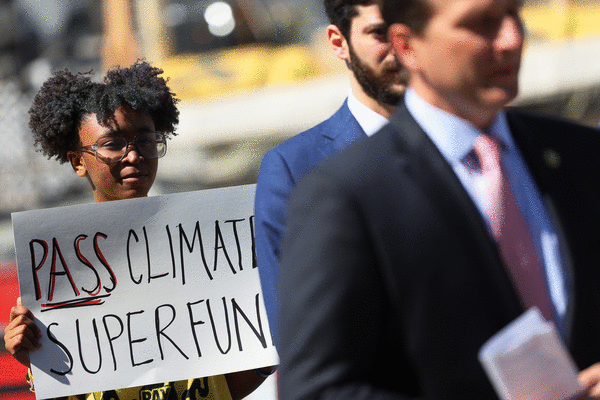
The Supreme Court is preparing to consider whether states and municipalities can pursue billions of dollars in damages from fossil-fuel companies over greenhouse gas emissions. Dozens of local governments argue that these firms misled the public about climate risks and should now pay for rising sea levels, wildfires and extreme weather.
Climate is not the only arena where courts are being asked to resolve the social costs of private enterprise. A growing number of lawsuits target major online sportsbook operators, alleging that their platforms foster addiction and financial harm while failing to implement adequate safeguards.
Whatever one thinks of these cases, their very existence reflects a deeper tension in American capitalism. When industries generate large, measurable profits alongside large, measurable public costs, the system struggles to resolve the imbalance. If legislatures do not act in advance, courts are asked to act after the fact.
American capitalism excels at dynamism. It produces growth, innovation and wealth on a scale no other system has matched. But markets reward gains. They rarely price consequences. When the costs of growth are widely distributed and the benefits are concentrated, political and legal backlash follows.
For much of the last century, we relied on regulation to manage this tension. Over time, trust in government’s capacity and impartiality eroded. Many Americans now view the state as either ineffective or captured by the industries it is supposed to regulate. Simply adding new layers of bureaucracy will not restore confidence. Nor will sweeping attacks on enterprise.
We need a mechanism that preserves dynamism while addressing its side effects before they metastasize into lawsuits and political rupture. Call it a Public Interest Adjustment.
The principle is straightforward. When an industry generates large, quantifiable social costs, a small and predictable share of its profits would be directed toward mitigating those costs. Not into general revenues, but into industry-specific statutory trusts with clear mandates, independent governance and mandatory sunset review.
Each trust would rest on three guardrails. First, scale: Only firms of national consequence would be under scrutiny, protecting small businesses and early-stage innovation. Second, targeting: Funds would flow exclusively to programs linked to the specific harm in question. Third, accountability: Every dollar would be audited and publicly disclosed, with formal review every five to seven years.
This approach is not novel in spirit. Superfund excise taxes have financed hazardous waste cleanup. The Community Reinvestment Act links bank growth to community lending. The tobacco settlement required structured payments in exchange for partial legal peace. The Public Interest Adjustment would update that logic for a faster-moving economy.
Consider energy and heavy industry. Using the federal government’s social cost of carbon as a benchmark, even a modest charge equal to a fraction of that figure could raise tens of billions of dollars annually for climate resilience and community transition efforts. Funds could support methane abatement, infrastructure to ameliorate floods and rising temperatures, and assistance for regions dependent on fossil fuels — without waiting decades for litigation to wind through the courts.
Artificial intelligence presents a different challenge. Estimates suggest AI could displace millions of workers globally, with the U.S. absorbing a substantial share of that disruption. The firms driving that transformation are among the most profitable in history.
A modest levy on the largest developers and deployers, directed into a Workforce Transition Trust, could finance retraining, wage insurance and community college partnerships of meaningful size. Contribution rates could be tied to measurable job-displacement benchmarks, declining if disruption slows.
Then there is online gambling. Americans wagered more than $150 billion on sports betting last year, while national treatment financing remains a fraction of that scale. A 1% assessment on large operators could generate $1 billion to $2 billion annually for addiction treatment, prevention and data transparency initiatives that link harm measurement directly to remediation.
Critics will say this is simply a tax by another name. In a formal sense, any mandatory payment resembles one. The distinction lies in design and purpose. A Public Interest Adjustment would be sector-specific, linked to harm caused, transparent, and have a sunset provision mandating a review of its effects. It would not fund unrelated spending. It would represent a compact: Companies that benefit from operating at massive scale in a stable legal and economic system accept a limited, predictable obligation to help manage the public consequences of that scale.
Others will argue that such measures would undermine competitiveness. Modest, clearly defined adjustments tied to domestic profits are unlikely to alter investment decisions in industries whose primary markets are here. By reducing litigation risk and political backlash, they may enhance long-term stability.
When legislatures fail to create forward-looking mechanisms to align profit with responsibility, the burden shifts to judges and juries. That is an inefficient way to govern a modern economy — for consumers, firms and the communities struggling with the consequences of today’s most profitable industries.
____
This column reflects the personal views of the author and does not necessarily reflect the opinion of the editorial board or Bloomberg LP and its owners.
Nicolas S. Rohatyn is the founder of The Rohatyn Group and a trustee of the Citizens Budget Commission.
©2026 Bloomberg L.P. Visit bloomberg.com/opinion. Distributed by Tribune Content Agency, LLC.





















































Comments