Adriana E. Ramírez: The SAVE Act is not about protecting the vote
Published in Op Eds
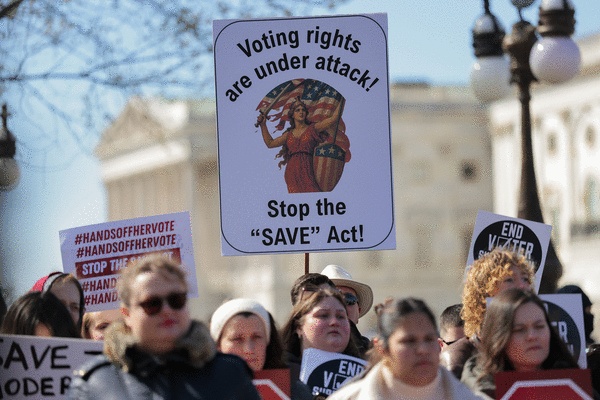
President Donald J. Trump gathered Republican lawmakers in his Florida golf course on March 9, encouraging them to push the controversial SAVE Act through Congress. The proposed law requires “documentary proof of United States citizenship” to vote in federal elections, among other things.
“If you don’t get it, big trouble, my opinion,” he said, soon after asserting that, if enacted into law, the SAVE Act would “guarantee the midterms” for Republicans.
I can think of two possible ways that the SAVE Act could guarantee Republicans victories in fall 2026 midterm elections: 1) it would eliminate fraud that helps Democrats or 2) it would prevent eligible Democrats from voting.
The first contention is a lie. There is no widespread fraud that helps Democrats.
Everywhere a sign
I took some time to look through the Heritage Foundation’s Election Fraud Map, as it “displays a sampling of proven instances of election fraud,” which the foundation hopes will expose “vulnerabilities in the election process and the ways in which fraud is committed.”
It has a color-coded chart, showing states with zero cases like Vermont as well as worst offender Minnesota, which shamefully contends with 138 instances of proven voter fraud from 2004 to 2022 — six of which occurred in 2022 alone.
That’s right. In a state with roughly 2.5 million votes cast in the 2022 midterm election, there were six (or 0.00024%) proven cases of voter fraud, as documented by the Heritage Foundation. Four people voted despite being felons, one voted twice, and one, only one, voted despite being a non-citizen.
One could argue that even one proven instance of fraud is enough to overhaul an entire system, even at the risk of disenfranchising millions. After all, for every proven instance, others must have gotten away with voting illegally. An elections could come down to one vote, and voters should feel secure that the results reflect the will of the people.
But the SAVE Act has no desire to do that. Instead of addressing American citizens voting incorrectly (former felons and other folks who might not know they cannot vote), which is a much larger share of proven fraud, or our system’s vulnerabilities to cyberattacks, the SAVE Act focuses on the incredibly minor instances of non-citizens attempting to vote.
I’d be more worried about hackers than someone without papers risking arrest by walking up to a polling station. Some people point out that most other nations require some kind of voter ID. But their systems don’t make it harder for people to vote, and they’re not being used to affect an election by keeping the other party’s voters out of the polls.
In many Latin American countries, for example, people are issued national identification cards upon birth that enables voters to easily get a voter ID, like the Mexican “Credencial Para Votar,” issued to all Mexicans when they become eligible to vote.
Blockin’ out the scenery
The SAVE Act would federalize election rules, when elections are constitutionally the jurisdiction of individual states. The system has demonstrated the ability to withstand widespread fraud from noncitizen voters. (One proven case among 2.5 million voters, for example.)
None of the documents that allow you to enter a nightclub, purchase a car or buy a firearm are good enough under the SAVE Act. Even I-9 verification, which employers must use to confirm that their employees are eligible to work, only requires a Social Security Card and a driver’s license. Even a REAL ID can be obtained by noncitizens. None of these documents prove citizenship or any person’s ability to vote.
According to the Brennan Center for Justice, about 3.8 million adult U.S. citizens lack proof of citizenship — that’s 2% of Americans. The same report said that 21 million Americans did not have easy access to those documents.
About 25 million Americans will have trouble registering or re-registering to vote. Many of those will not be able to do it in time to vote this fall.
Solving a problem that doesn’t exist, while making it harder for regular people to vote, is political theater designed to please a president who has committed to a lie. And because President Trump cannot admit he lost an election in 2020, Republicans supporting this legislation are doing everything they can to please the president.
Even if it actually ends up costing Republicans the midterms. Because here’s a funny little fact: in some states, overall Republican voters will be more severely reduced by the SAVE Act than Democrats.
Breakin’ my mind
According to the American Communities Project, key Republican voting blocks lack valid passports (which cost money to obtain), including 62% of adults “who live in Evangelical hubs,” 58% of working class adults and 53% of adults in rural middle America. In seven states, fewer than one-third have passports, and all seven went for Trump in 2024.
Passports aren’t everything, but certainly a lot easier to keep on hand than a birth certificate. Married women who have changed their names, like 67% of female Republicans, may be forced to present more documents still.
It might be time to have discussions about a national citizenship card. But the SAVE Act isn’t the way to accomplish that. Political theater worsens our country because it draws attention away from real problems. No one wins, but at least it may hurt the people championing it more than the innocent people they’re trying to disenfranchise.
———
©2026 PG Publishing Co. Visit at post-gazette.com. Distributed by Tribune Content Agency, LLC.

















































Comments