Commentary: China wants to dominate the future of food. And it might succeed
Published in Op Eds
In early February, I was invited to visit a discreet industrial building just outside Beijing’s historic city center. What I saw inside has the potential to radically restructure the global food system.
Peering through laboratory windows at the New Protein Food Science and Technology Innovation Base, I watched as dozens of tissue engineers and biochemists toiled away surrounded by cell banks, 3-D printers and floor-to-ceiling bioreactors, in pursuit of 2026’s most elusive element: security.
Food security, President Xi Jinping has said in recent years, is a “foundation for national security.” Under his leadership, China’s “Greater Food Approach” — a broad framework for increasing stable and diverse food supplies — has launched efforts to shore up “the most basic necessity of the people,” from strategic grain stockpiles to “clean plate” campaigns.
Yet by Xi’s standard, the China of the past decade has been anything but secure.
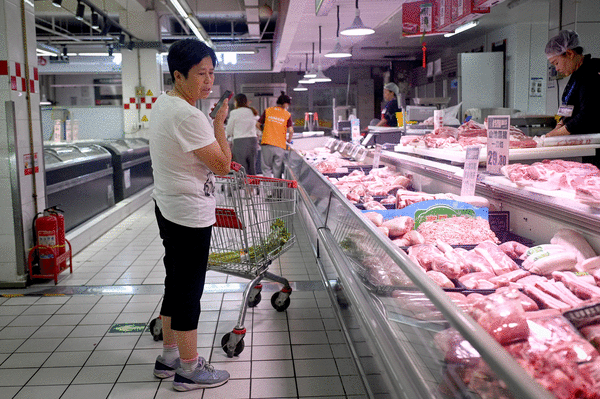
Skyrocketing demand for animal protein has exacerbated risks of land and water scarcity. Zoonotic disease outbreaks have resulted in mass culls of more than 100 million pigs and have sent prices soaring — with the specter of an even larger bird flu pandemic looming. And even under normal circumstances, animal farming is an inherently inefficient process, requiring 10 calories of feed to get just one calorie back as pork.
Worse still, to satisfy its citizens’ insatiable appetite for protein, China has reluctantly converted from an almost completely food self-sufficient country in the early 2000s to the planet’s largest importer of meat, dairy and feed crops like American soybeans — tethering the sustenance of more than a billion people to the whims of foreign leaders, whose on-again-off-again tariffs severely undermine national stability.
This intolerable dynamic clashes with a core tenet of Xi’s belief— reiterated with increasing frequency — that the people’s metaphorical “rice bowls” must always be “filled mainly with Chinese grain.” In other words, it may be time to bring China’s food system in-house.
But rather than recreating the American Midwest in the Sichuan Basin, Xi’s government is shrewdly using this moment of crisis to fundamentally reimagine large-scale protein production for the first time in 12,000 years.
Inside Beijing’s innovation base, the lobby walls are emblazoned with the goals of China’s ambitious five-year agricultural plan and an edict from Xi directing his countrymen to leverage technology to “give rise to new industries, new models, and new drivers of growth.”
By answering the central government’s clarion call to “expand beyond traditional crops and livestock resources” and master the art of making protein from plants, microorganisms and cultivated animal cells, China can produce far more of it and create a food supply insulated from interference.
It’s a vision that has resonated at the highest levels. When thousands of lawmakers convened this month at Beijing’s Great Hall of the People to cement China’s new five-year economic plan, which emphasizes the need for new protein sources, many arrived with comprehensive province-level plans in hand. Shanghai, for instance, recently unveiled a 20-step action plan to leverage biotechnology and artificial intelligence to scale industrial manufacturing of sustainable proteins.
Other public institutions have also stepped in to articulate a path forward. In December, 48 leading Chinese scientists published a series of policy recommendations on behalf of the newly formed NeoProtein Professional Committee of the Chinese Institute of Food Science and Technology, which outlined how the sector could make “a historic leap from ‘supplementation’ to ‘substitution,’ and then to ‘expansion’ and ‘irreplaceability’ within the global food system.”
In his new book “Meat,” author Bruce Friedrich reveals that China’s technology research funding grew five times faster than that of Europe or the U.S. in 2023 — 8.7% compared to 1.7% and 1.6%, respectively. Moreover, China is now the world’s largest public funder of agricultural R&D — more than doubling America, which held the top spot until 2008— and home to eight of the top 20 cultivated meat patent applicants of all-time, compared with only three from the U.S.
Of particular note, Chinese universities and public institutions have filed more cultivated meat patents than their counterparts in the U.S. and Europe combined, which suggests an intentionally collaborative domestic strategy designed to build a national ecosystem.
China’s industry leaders, many of whom have not traditionally focused on protein production, also appear to understand their assignment.
Last November, Yichang-based food manufacturer Angel Yeast — which makes more than half of all the yeast in Chinese buns and breads — opened a future-food factory the size of 75 football fields. The facility now pumps out more than 11,000 metric tons annually of what the company calls “new proteins,” each produced via biomass fermentation in a matter of hours. The resulting ingredient is 50% cheaper than whey protein, provides all nine essential amino acids needed by the human body and can be incorporated into everything from plant-based meat to protein bars to baked goods.
Amid surging domestic and global demand, company representatives told me they will soon break ground on a second protein factory right behind the first, which will increase the complex’s annual output to more than 30,000 metric tons — roughly comparable to an average American slaughterhouse. The company sees the factory as a template it can replicate in many of the 170 countries it operates in.
Given the substantial resources dedicated to Chinese novel-food industrialization, the Center for Strategic and International Studies believes the U.S. should take these precedents seriously to avoid an international inversion. “Today, the United States plays a leading role in the global food economy,” the center wrote in a report about mitigating risks and capturing opportunities related to alternative proteins. “Domestic agricultural strategies — especially those that apply to rising protein demand — will be central to establishing a competitive economic advantage across future global food markets.”
The problem? That report is three years old. Based on what I witnessed in China’s agricultural innovation centers and industrial plants, even keeping pace now would be a triumph.
____
Ryan Huling is a senior writer at the Good Food Institute Asia Pacific and author of the forthcoming book “The Hidden Nations of Animals.”
©2026 Los Angeles Times. Visit at latimes.com. Distributed by Tribune Content Agency, LLC.





















































Comments