Karishma Vaswani: A delayed Trump-Xi summit is not all bad for China
Published in Op Eds
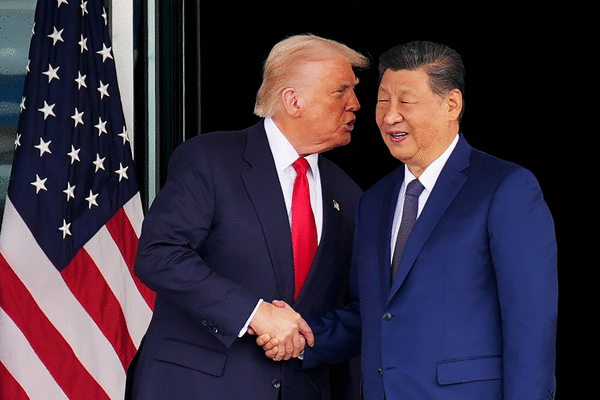
China has no reason to help the U.S. in the Strait of Hormuz — and every incentive to wait out this crisis.
Even President Donald Trump’s request to delay a much-anticipated summit with his Chinese counterpart will work in Xi Jinping’s favor. It allows Beijing to better lay the groundwork on the issues it’s pressing Washington on, from limits on access to American technology and investment restrictions to relief from tariffs and a way to manage tensions over Taiwan. None of that was likely to be secured in a rushed encounter.
China reacted coolly to the White House’s decision to move the meeting by five or six weeks, as it did to Trump’s demands that Beijing and others help counter Iran’s blockade of Hormuz, a key chokepoint through which roughly 20% of the world’s oil passes.
The U.S. president’s heavy-handed approach — he has since abandoned those efforts and scolded allies who uniformly rejected his demand — will only give China further ammunition to argue to its partners in the Global South that Washington’s priorities can shift abruptly in moments of crisis, and not in their favor.
Still, Xi will want nothing to get in the way of a successful summit. Leader-to-leader diplomacy is critical, notes Dylan Loh, an associate professor at the Singapore-based Nanyang Technological University. “The Chinese see Trump as the only one to make the decisions they need resolved,” he told me. “Beijing has given Trump quite a bit of face in this crisis, but also doesn’t want to be seen as pressured into doing what Trump wants in Hormuz.”
Xi can absorb a short delay. A longer, open-ended postponement would suggest the relationship is drifting and it would then be hard for even diplomacy at the highest level to stabilize it.
A similar logic applies to energy. A temporary disruption in the Strait of Hormuz is manageable. But a prolonged closure would raise global prices of everything from food to fertilizers. Ultimately, that would hurt China too, at a time when its economy is under strain.
Iran accounts for roughly 13% of China’s seaborne crude imports, but the disruption to its supplies is not nearly as big a problem as it is for other countries, as the China Global South Project notes. Oil tracking data show that millions of barrels of Iranian crude have continued to flow — much of it to China now that Tehran is allowing some ships through.
Beijing has been working on a Plan B for a while. It has diversified its energy supplies, buying heavily from Russia despite Western sanctions, and building up a strategic reserve that will last several months, while investing aggressively in renewables.
There is also no political scenario in which China could easily justify joining a U.S.-led military coalition. Doing so would cut against decades of foreign policy built around non-interference. It would also undermine Beijing’s positioning as an alternative to Western interventionism — particularly in the Global South, where it has long cast itself as a counterweight to American hegemony.
Instead, Chinese policymakers are likely to assess that the best strategy right now lies in patience. An extended Middle East crisis could again divert U.S. attention and resources away from the region, which is a shift that has historically worked to Beijing’s advantage.
The Iran conflict is forcing Washington to reportedly pull military resources and troops from the Indo-Pacific, which as I have written is causing alarm among allies and partners. Taiwan is the most vulnerable, and will take little comfort from a delay in the Trump-Xi summit. If and when the two leaders do meet, the U.S. president may arrive still preoccupied with Iran, while Xi will come with the benefit of more time to consolidate his position — potentially allowing him to press for concessions that could weaken American support for the island.
Taiwan is already facing pressure from China over U.S. weapons deliveries, at a time when the People’s Liberation Army has stepped up the pace of its sorties around the island.
None of this suggests Beijing welcomes instability. But from its perspective, there is little reason to rush — either into a risky military commitment in Hormuz or into a hastily arranged meeting with Trump. Time is on China’s side.
____
This column reflects the personal views of the author and does not necessarily reflect the opinion of the editorial board or Bloomberg LP and its owners.
Karishma Vaswani is a Bloomberg Opinion columnist covering Asia politics with a special focus on China. Previously, she was the BBC's lead Asia presenter and worked for the BBC across Asia and South Asia for two decades.
©2026 Bloomberg L.P. Visit bloomberg.com/opinion. Distributed by Tribune Content Agency, LLC.





















































Comments