Commentary: How America drilled its way out of the oil-supply straitjacket
Published in Op Eds
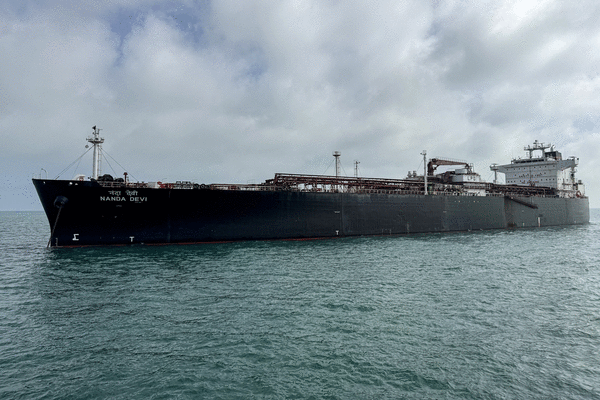
Three weeks into the Iran War, the main impact so far has been oil prices. The dog that hasn’t barked is oil shortages.
While Chinese motorists were lining up for miles to fill up on gasoline, and Asia has been desperately scrambling to find supply, here in America there’s been nothing like the 1970s oil shortages.
And the reason is one of Trump’s top priorities: Drill Baby Drill.
As recently as 2006 America imported a net 13 million barrels of petroleum products per day – roughly two-thirds of what we used, and roughly 1 in every 7 barrels exported in the world.
That’s now flipped to us exporting 2.5 million barrels a day, according to the U.S. Energy Information Agency — making America the biggest oil exporter in the world.
Focusing on Middle East oil, in 2006 we imported around 2.2 million barrels a day – roughly 1 in every 9 barrels we used. Trump slashed that to just 500,000 barrels of net imports from the Middle East today – just over 2% of consumption.
Trump, never shy about connecting dots, recently highlighted this, pressuring China, Japan, South Korea and Europe to help police the Strait of Hormuz. "It’s only appropriate that people who are the beneficiaries of the strait will help to make sure that nothing bad happens there," he added.
This has left America essentially immune to a Middle East oil shock even as Asia panics. Fortune recently reported an "energy shock" coming like a tsunami for China, Japan, South Korea and, above all, India.
Half of China or India's oil comes from the Middle East. Two-thirds of South Korea's. And almost 95% of Japan's.
That means a long war impacts the U.S. mainly by oil prices. But the shortages hit Asia.
The first to be hit is India. They have at most 2 months since they have almost no oil stockpiles because their governments are dysfunctional and can't fix a pothole, much less maintain a strategic oil reserve.
Southeast Asia is even worse. Thailand has 2 months, Indonesia less than a month. And they have a history of riots when there's no gas.
Finally, China, who has just three months of stockpile between government and private stocks. In days that's almost identical to U.S. stocks, but the difference is that America produces three and a half times more oil – and what we import comes from Canada, Mexico and now Venezuela. So if Middle East oil were completely cut off, we would have four years’ supply, which would be easy to replace with sources in our own hemisphere.
China, on the other hand, produces just 1 in 4 barrels domestically and gets nearly half its oil from the Middle East. That means a total closure of the Strait of Hormuz leaves China with just six months’ supply, and few options beyond beggaring neighbors like India or Indonesia.
China has already banned export of diesel and gasoline, plans to draw from its strategic reserves, and is fending off Indian attempts to divert its imports.
The next steps will be rationing to households, then factory shutdowns. Those will start as partial shutdowns -- factories close on weekends. Then they will expand until the only ones who can get oil are government -- who always eats first -- hospitals and farmers.
This is all painful. It could mean tens of millions of layoffs in Chinese factories. Fuel shortages have historically caused mass riots in India or Indonesia, so what they'll try instead is to buy up the rest of the world's oil, jetting off to Texas or Norway with great fistfuls of dollars.
That would put pressure on U.S. prices. But it would also increase U.S. production, as economically marginal fields come back online at $100-a-barrel oil.
And, worst case, Trump just bans oil exports, which might lower domestic prices by $20 a barrel, but would strangle Asia and Europe.
Increasing domestic production has put American energy on a foundation of rock. Asian overreliance on the Middle East -- and Europe’s Net Zero obsession that closed coal and nuclear – have put the rest of the world on a foundation of sand.
____
Peter St. Onge, Ph.D., is a senior economist at the Heritage Foundation.
_____
©2026 Tribune Content Agency, LLC.




















































Comments