Commentary: Bomb first, debate later: The hidden cost of how America makes war now
Published in Op Eds
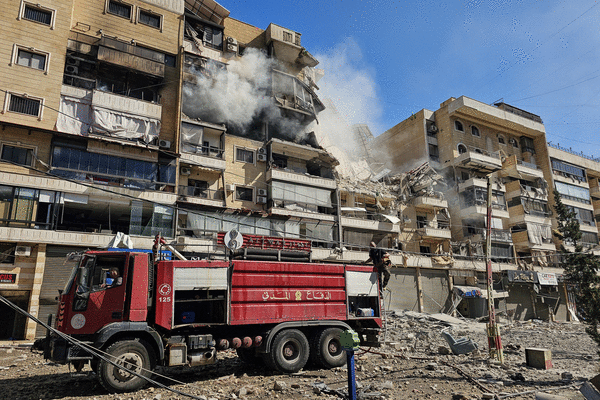
For those old enough to remember the first Gulf War, the scenes feel painfully familiar: Smoke rising over Tehran. Babies carried out of a bombed-out hospital in incubators. Missiles striking cities across the Middle East. Oil markets in turmoil as Iran threatens to close the Strait of Hormuz. The war of choice that began with Israeli and American strikes on Iran is widening by the hour, pulling in multiple countries, including NATO allies, and producing casualties that mount by the day.
Much of the early discussion has focused on obvious questions. How far will the conflict spread? How many people will die? What will it cost the United States in money, lives, and global stability?
Those questions matter. But they leave another one largely unexplored.
How did the United States enter another war in the Middle East in the first place?
There was no extended congressional debate authorizing war. No national moment of deliberation weighing risks and consequences. President Donald Trump ordered the strikes first. The discussion followed.
The public story is a rapidly escalating regional conflict. The deeper story concerns how decisions of war and peace are now made in American governance.
When war decisions move to the executive
This is not just a technicality. The Constitution deliberately gave Congress, not the president, the power to declare war. The framers had studied the history of European monarchies and concluded that executives, left unchecked, were too prone to wage it. James Madison wrote bluntly that the executive branch “is the branch of power most interested in war and most prone to it.” The remedy was simple: The decision to initiate war should require collective deliberation by the representatives of the public.
For much of American history, that expectation held, at least formally. Congress debated the wars of 1812, 1846, 1898 and 1941 before the nation entered them. War was treated as a national decision, not simply a presidential one.
Over recent decades, however, a different pattern has taken hold. Presidents increasingly initiate major military actions first while Congress reacts later, if at all. Legal justifications are drawn from vague or outdated authorizations or from expansive readings of commander-in-chief authority. The institutional sequence has quietly reversed.
The strikes on Iran follow that pattern. The bombs fell first. Congress is left asking questions afterward.
The long shadow of war
The financial consequences may follow a familiar trajectory. Writing in Forbes on March 2, economist Peter C. Earle warned that the costs of a war with Iran could “mount for decades,” long after the fighting ends.
Wars rarely end when the shooting stops. They create obligations that stretch across generations. The United States is still paying for earlier conflicts through veterans’ health care, disability payments and interest on borrowed war spending. The wars in Iraq and Afghanistan alone are projected to cost trillions over their full lifetime.
A conflict with Iran could produce similar effects. Military operations are only the visible part of the iceberg. Energy disruptions ripple through global markets. Oil price spikes feed inflation. Shipping routes become unstable. Insurance costs for global trade rise.
Then come the domestic consequences. Defense spending climbs. Other priorities are squeezed. Federal borrowing grows. Wounded service members require care that lasts for decades.
There is also a deeper institutional cost that never appears in budget projections.
The constitutional framework for war-making was designed to slow decisions down. Requiring congressional authorization forces public debate, exposes assumptions and compels leaders to justify the risks. That friction is not a flaw in the system. It is a safeguard.
When that process disappears, accountability weakens. Members of Congress can criticize a war after it begins, but they are no longer responsible for the decision itself. The public bears the consequences without ever seeing the argument beforehand.
Formally, the constitutional structure remains. In practice, the decisive moment increasingly occurs inside the executive branch.
The war with Iran may widen, stabilize or end quickly. What is already clear is that the United States has again crossed the threshold into another major Middle East conflict with little national deliberation beforehand. Whatever one thinks about the merits of the strikes themselves, such decisions should emerge from open debate and shared responsibility. Instead, the pattern has become familiar: The president orders military action first, and the argument in Congress follows.
That shift carries consequences beyond the battlefield. The financial burdens of war will linger for decades. But there is also a less-obvious institutional cost. When decisions of this magnitude originate inside the executive branch, the country inherits not only the war itself but also further erosion of the constitutional process meant to govern it.
____
Robert Cropf is a Professor of Political Science at Saint Louis University.
____
©2026 The Fulcrum. Visit at thefulcrum.us. Distributed by Tribune Content Agency, LLC.

















































Comments