Commentary: America is sociologically ignorant and it shows
Published in Op Eds
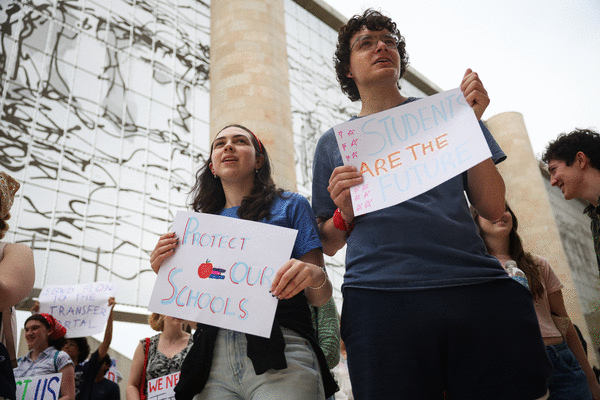
Sociology, the discipline that studies society, is not mainstream. It is rarely taught in the K-12 curriculum. And many youths are forgoing higher education, a space where people learn how to evaluate evidence for themselves. Sixty-two percent of Americans, hundreds of millions of adults, lack a college degree. Less than half of 18- to 24-year-olds are enrolled in college. Further, as enrollment has diversified and expanded, the college wealth premium has decreased. Student debt burdens are particularly stark for low-income and Black and Latino borrowers. The steep financial barriers to postsecondary education need to be eliminated. We need broad access to and support for public higher education to support an informed electorate.
President Donald Trump’s regime has been on a consolidated rampage against education and “wokeism.” It issued an executive order to end “Radical Indoctrination in K-12 Schooling” last year, is wreaking havoc on higher education and has gutted the Department of Education. Those in power are hostile to sociological knowledge in particular. Florida recently disemboweled college-level sociology textbooks. These actions are part of a sweeping anti-public strategy to undermine knowledge, suppress dissent and shift our culture toward a dangerous paradigm.
As a sociologist, I know these brainwashing attempts are not novel. They are regurgitated from deeply alarming periods in our history and based on unfounded ideas. Like the scientific consensus on the human-based responsibility for climate destabilization, sociologists understand, teach and have long shown that investments in education are a public good and that our society suffers from systemic racism, classism and sexism. Talking about these injustices or expanding opportunity to discuss our shared social structure isn’t radical. It’s the “justice for all” part of our pledge of allegiance. So, how is it that those controlling the helm of our country are getting away with their trajectory to slash and burn our schooling system? How are they able to successfully target the fields committed to truth-telling?
For those of us who make it to college, only 7% to 10% of students take an introduction to sociology course. Women make up roughly 75% of majors. Other social sciences, such as economics (Trump) and political science (Vice President JD Vance) dominate the elite circles of policymaking. Compared with economists, sociologists are considerably underused in federal and state governments.
We are sociologically ignorant, and it shows.
The impacts of this exclusivity of higher education and deprioritization of sociology are damning. White supremacy, anti-LGBTQ+ bigotry and misogyny are making comebacks while the wealth gap is wider than ever. People are banning books while conspiracy theories thrive. Nearly 1 in 5 Americans believed in QAnon four years ago, an alt-right extremist fantasy that was as popular as some major religions. Could it be that so many people track down false roots to problems they see in society because they lack access to critical education and sociological insight? That certain sectors of our public are easy to rally against higher education because they have been widely excluded from it?
If we invest more in our schooling systems and sociology, we could be as inspired by truth, justice and equity as we are by alternative facts. Our collective conversations could be more informed, expansive and democratic. We could vote differently.
To be sure, educational systems need to be reformed, not romanticized. For too long, they have hoarded opportunities for the already advantaged. But dismantling them in the name of ideological purity is not reform. It’s sabotage. The answers to the problems that plague our society need better-funded, more accessible and more sociological education.
As the public, we must insist on broad access to higher education and curricular space for sociology in all levels of education. Sociologists need to take up public space and be resources for these national battles over our culture, education, book bans, the propagation of alternative facts, etc.
Censorship, exclusion and mass misinformation campaigns are not new and have always been fascist tactics. Left unchecked, they create a populace less able to challenge inequity, less willing to question authority and less prepared to imagine a better world. We must name them as such and resist them accordingly.
Those in power are leading by a glaring lack of informed insight; that doesn’t mean we have to. Having access to knowledge and being able to collectively reflect are rights too precious to surrender to those who prefer us ignorant.
____
Megan Thiele Strong is a sociology professor at San José State University, a public voices fellow at the The OpEd Project and a member of the Scholars Strategy Network.
___
©2026 Chicago Tribune. Visit at chicagotribune.com. Distributed by Tribune Content Agency, LLC.















































Comments