COUNTERPOINT: Mineral security requires domestic productive capacity
Published in Op Eds
In the wake of the Arab oil embargo in the 1970s, Congress responded by creating the Strategic Petroleum Reserve, an emergency stockpile designed to protect the nation from foreign coercion and sudden supply shocks. The reserve has provided an important tool during price spikes and temporary disruptions.
As we confront today’s mineral crisis and Chinese mineral extortion, we should be honest about the limits of strategic reserves.
The Strategic Petroleum Reserve was only partly successful. While it offered some measure of short-term relief, it did not fundamentally change America’s energy security. In the years that followed its creation, U.S. reliance on oil imports increased, and so did energy insecurity. True energy security arrived decades later with the shale revolution, when American innovation and investment unlocked vast domestic oil and natural gas resources, restoring U.S. productive capacity.
It was not stockpiling that changed the equation. It was production.
That lesson should guide us today as we stare down the immense threat posed by China’s dominance of global mineral supply chains and Beijing’s willingness to cut off exports as a tool of coercion.
Notably, the Trump administration has launched “Project Vault,” a $12 billion effort to establish a strategic reserve of the metals that power our economy and underpin our national security. Like the petroleum reserve before it, Project Vault is intended to blunt the effect of sudden supply chain disruptions. It is a necessary and important step forward. However, it risks building a mirage of security.
The administration has noted that it plans to initially fill the stockpile with minerals sourced from trade partners, including China. That is a reasonable plan considering the urgency of addressing our mineral insecurity and the limited domestic alternatives for many of the minerals and metals we need but don’t produce.
If initial plans to rely on foreign suppliers for the stockpile are not backed up by energetic efforts to develop domestic mining and processing capacity, the U.S. risks papering over our mineral crisis, even though we, in fact, have the resources to fix it.
Overreliance on mineral imports to fill and maintain the vault — particularly from unstable nations — poses real risks. Nationalization of mines in Third World countries, conflict, unrest or Chinese competition can eliminate needed supply overnight. These aren’t theoretical concerns. They are regular occurrences that mining companies operating in Africa, Asia and South America know well.
Overreliance on imports would be repeating the mistake we claim to be fixing. This is not to say we shouldn’t work with allies and trade partners to diversify supply chains and build capacity outside of China’s control. We absolutely should.
Real mineral security requires a foundation provided by domestic mining and processing.
The United States possesses vast mineral resources. From lithium, copper, antimony and gallium to rare earths — all critically important to technological leadership and national security — the resources are here. For example, the McDermitt Caldera on the Nevada-Oregon border is thought to contain the world’s largest lithium deposit.
We’re finally rediscovering our mineral potential and building a policy toolbox to de-risk projects, cut red tape, and catalyze private-sector investment in domestic mining. A robust, cutting-edge and world-leading mining industry should be the foundation of a rejuvenated American industrial base.
Project Vault is an essential first step toward confronting our minerals crisis. It alone — especially if it furthers our overreliance on mineral imports — cannot be a definitive answer. That will be achieved with domestic productive capacity, the irreplaceable key to our economic, energy and national security.
_____
ABOUT THE WRITER
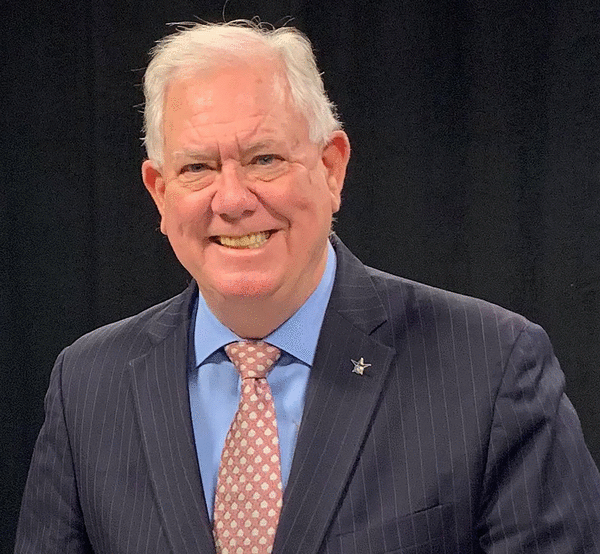
John Adams, a retired U.S. Army brigadier general, is the president of Guardian Six Consulting and a former deputy U.S. military representative to NATO’s Military Committee. He wrote this for InsideSources.com.
_____
©2026 Tribune Content Agency, LLC



















































Comments