David Mills: America would be better if Trump were a Conservative and had better manners
Published in Op Eds
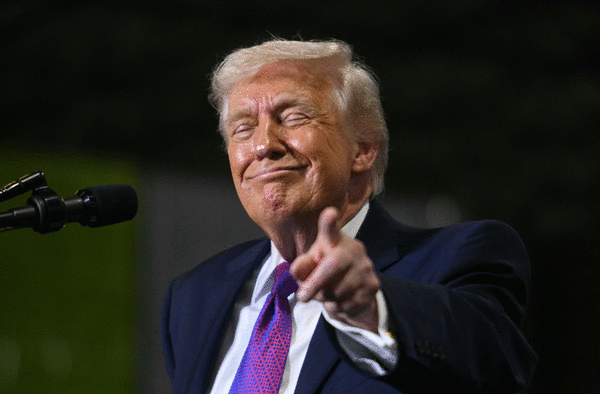
One benefit of Donald Trump’s presidency is that he has inadvertently pointed to the value of Conservatism. His performance in office has shown the dangers against which the great Conservative writers warned.
However, the movement called “conservatism” in America is not listening to them, because it’s not actually Conservative.
The Right is a mixture of nationalism; free market idealism; populism, including a wing with quite liberal economic ideas; sectarian Christianity, and on the fringes various forms of mostly invented paganism; “manosphere” real man movements; anti-vaxxer MAHA; “American exceptionalism” and a ridiculously romantic view of the American past; techno-utopianism, cut-rate Nietzscheism and social darwinism; neo-liberalism; a growing number of open white supremacists and antisemites on the one hand and hardcore Christian Zionists on the other; and lots of reactions to bogeymen like “liberalism” and “the Left,” to “elites,” to “DEI” and attempts to redress past injustices, and most dramatically to immigrants, illegal but also legal.
They believe the system so entrenched and corrupt that it has to be smashed. They want revolution, not reform. (To be fair, most Americans on the right do not hold these views, or hold only some of them to a smaller degree. But they’re not the ones making all the noise.)
Look to Burke
It’s hard to see why they join forces, given the huge differences, except the belief that the enemy of my enemy is my friend, a set of shared resentments, and the desire to bring down the old system and erect a new one in its place. They’re held together, for now, by a deep devotion to the person of Donald Trump.
And that, sadly, is not Conservatism.
What does Conservatism with a capital c have to tell us and why it is a loss that American conservatism isn’t Conservative? Let’s turn to the 18th century British writer Edmund Burke, who founded Anglo-American Conservatism, especially in his great work “Refections on the Revolution in France,” published in 1790.
Burke was a serious and wise political thinker who wanted the maximum of order and liberty, knowing that each depended on the other. He knew well how human beings could mess up anything, especially when they had or wanted power. He believed that a revolutionary break with the past would always be disastrous. (In this he was opposed by Thomas Paine in “The Rights of Man,” published in 1791.)
He also saw that any system would fail if the people were not the kind of people who could sustain it. He had a similar mind to the American Founders, with their creation of the separation and balance of powers in the federal government. In fact, he supported the American Revolution, because he believed the cause just and not the kind of radical break the French made.
I think there is much to be said against Burke, especially that he was too complacent about the nature of his society and that he romanticized the established order (a passage on Marie Antoinette is embarrassingly adolescent), in a way that blinded him to how much it harmed so many people. It was a society whose laws hanged poachers, a crime committed by the hungry. He wanted his society to change, but too slowly.
The importance of manners
But he did see many important truths. One of his most important insights and one relevant to a nation with Trump as its president is his insight into the importance of what he called “manners,” meaning mostly-shared and mostly-unrecognized assumptions about the way the world works, including how people should live together.
Maintaining and nurturing a nation’s manners, assuming they’re good, is part of the essence of Conservatism. The Conservative treats them with extreme care and delicacy, because he knows how easily they can be corrupted. He is a steward of what he has and will be culpable for any damage he does.
“Upon them, in a great measure, the laws depend,” Burke wrote in “Reflections.” Manners, he explained elsewhere, “are of more importance than laws. Manners are what vex or soothe, corrupt or purify, exalt or debase, barbarize or refine us, by a constant, steady, uniform, insensible operation, like that of the air we breathe.”
People and societies will express their manners in the way they live and treat each other, including the way they speak. Manners in Burke’s sense are revealed and either nurtured or corrupted by manners in the usual sense.
A society’s manners should be virtuous, recognizing the moral law and aiming at treating other people well. In some societies, like Revolutionary France, they weren’t.
Manners in Europe had been sustained by what Burke called “the spirit of the gentleman” and “the spirit of religion.” That is, someone concerned to treat people well, to tell the truth about them, and not to hurt anyone unnecessarily, and someone who recognizes a binding transcendent authority.
Unfortunately for America, neither spirit characterizes Donald Trump. The manners he expresses in his manners, especially in his speech, are too often — nearly always — contemptuous of others, often deceitful, and meant to harm, to divide, to rouse his followers, to get total victory in a political war for control. It’s all and only about power. It’s not about nurturing the good, except in the utopian sense of making American great again.
Trump’s manners
Trump has the manners, I think Burke would say, of the French revolutionaries. The kind of manners that lead to the tumbrils, the carts in which victims were led to the guillotine — in the case of the French revolutionaries real, in ours metaphorical.
He does not conserve what he has been given to conserve. He is not a Conservative when America needs one — needs one to help America be what it can be.
“There ought to be system of manners in every nation which a well-formed mind would be disposed to relish,” Burke wrote. “To make us love our country, our country ought to be lovely.”
———
©2026 PG Publishing Co. Visit at post-gazette.com. Distributed by Tribune Content Agency, LLC.















































Comments