Commentary: The window to declare success in Iran is closing
Published in Op Eds
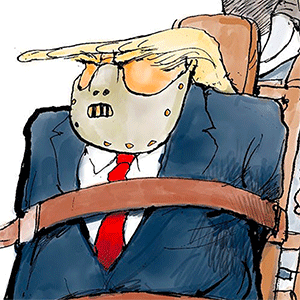
If you’re looking for the most elegant way to wrap up our “little excursion” in Iran, it’s this: President Donald Trump should follow what might politely be called the “declare victory and head for the airport” strategy.
You know the drill: Announce that we’ve set back Iran’s nuclear programs a decade, pounded their navy into submission, and turned the ayatollah into a fine mist. Mission accomplished! Thank you for flying the friendly skies, and please return your seat backs to their full upright and locked position.
Don’t get me wrong. This “cut and run” routine is less than ideal. Trump will have signaled to the world he (we) can’t endure any insurgent resistance, empowered the Islamic Revolutionary Guard Corps to run the country and likely angered Israel in the process.
But his domestic political base will believe he won, and fan service has always been his top political priority.
Besides, once you’ve entered a war without a coherent justification, clearly defined goals or a credible exit strategy, you’re lucky to get out at all. A salutary outcome no longer exists; that ship has already sailed.
Speaking of which, as I write this, we are drifting toward what feels like a point of no return. Mining the Strait of Hormuz, which Iran is now attempting to do, is the ultimate trump card.
Using mines to shut down this narrow shipping lane — which contributes about 20% of the world’s oil supply, not to mention natural gas and fertilizer — could result in a crippled global economy, mass casualties and a situation in which the president can no longer save face while cutting and running.
As retired U.S. Navy Adm. James Stavridis writes, “Iran has been planning a Strait of Hormuz closure operation for decades and probably has more than 5,000 mines; just one hit can severely damage a thin-skinned tanker.”
Yes, once laid, minefields can be cleared. But Stavridis predicts it would take “weeks, if not a month or two” to clear thousands of mines. He warns: “The global economy needs to be prepared for a month or two shutdown.” (Complicating matters is the fact that our dedicated minesweepers were recently decommissioned.)
The Iranians are not idiots. They watch American politics. They understand that Trump’s pressure point isn’t Tehran — it’s the S&P 500. A bad week on Wall Street makes him jumpier than a long-tailed cat in a room full of rocking chairs.
Trump, whatever else you say about him, is a transactional materialist who approaches geopolitics the way a real estate developer approaches zoning disputes: What’s the angle, where’s the leverage, and can everybody just settle already?
Unfortunately, the fellows running Iran are religious zealots who believe — deeply, sincerely and somewhat alarmingly — in something larger than quarterly economic indicators. Their strategic plan appears to consist of two options: survive (which they see as tantamount to victory), or die gloriously while insisting they meant to do that all along.
Which makes their current behavior grimly logical.
The Iranian regime, such as it is, doesn’t have much to lose. But they know exactly what Trump has to lose: His popularity and political legacy are now tied to the price of oil.
Releasing U.S. strategic oil reserves will help to some extent, but this is not a long-term solution. And Iran is betting that when the price at the pump for U.S. consumers starts looking like a luxury car payment, Trump will do what critics like to summarize as TACO — “Trump Always Chickens Out.”
Lots of American political observers agree. And it’s not just moderates or RINOs who are teasing this.
Referring to the U.S. military, former Speaker of the House Newt Gingrich told Larry Kudlow on Fox Business: “They have to keep the Strait of Hormuz open. I don’t care what it costs.”
“If they can’t keep it open,” Gingrich continued, “this war will, in fact, be an American defeat before very long, because the entire world, including the American people, will react to the price of oil if the strait stays closed very long.”
Perhaps the U.S. military can pull off a delicate trick: keep our “armada” in the region, keep the Strait of Hormuz open, clear any mines that are laid and prevent some unlucky tanker from being hit by a mine — or, for that matter, by a drone or missile fired from the Iranian coast. That final risk is why some military analysts believe reopening the strait would require a ground operation.
Imagine that the U.S. manages to thread these needles. Then what?
Total and complete surrender? Regime change? Boots on the ground?
Absent a swift exit (like, tomorrow), we’re left with the two classic options of power politics: a delayed and more ignominious retreat or increased escalation.
And, historically speaking, American presidents are more likely to double down — with tragic results.
____
Matt K. Lewis is the author of “ Filthy Rich Politicians” and “ Too Dumb to Fail.”
©2026 Los Angeles Times. Visit at latimes.com. Distributed by Tribune Content Agency, LLC.



















































Comments