Commentary: Journalists risk everything because the work is so important
Published in Op Eds
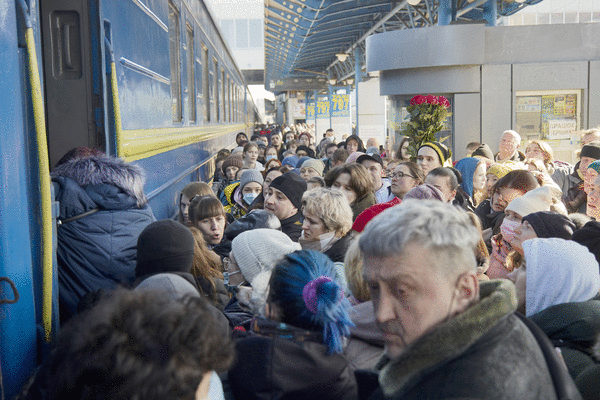
In the first weeks of Russia’s invasion of Ukraine, millions of Ukrainians were displaced in one of the fastest mass movements of people in recent history. Train stations became shelters. Theaters became aid centers. Borders became waiting rooms for grief. Journalists moved in the opposite direction, toward uncertainty, because without witnesses, displacement becomes statistics and war becomes abstraction.
I was one of them, reporting with my colleague and friend, Brent Renaud.
On March 13, 2022, we crossed what remained of a destroyed bridge into Irpin, a suburb north of Kyiv where families were fleeing Russian bombardment. Ukrainian soldiers helped elderly people, children and the wounded move across twisted concrete and rebar, carrying what little they had managed to save. Dogs wandered between abandoned cars. The sound of artillery echoed in the distance — a rhythm that quickly becomes the background noise of war.
As seasoned journalists, Brent and I had spent recent years documenting displacement — migrants crossing rivers in Central America, refugees moving through camps in Greece, families uprooted by hurricanes and conflict across the Americas. Movement had become the story we followed. In Ukraine, that movement felt faster, heavier, irreversible.
Minutes after accepting a ride from a local driver who offered to take us toward an evacuation point, gunfire erupted. I remember the sound of glass breaking, bullets tearing through metal, the instinct to press my face to the floor of the car. When the vehicle stopped, Brent was slumped beside the driver, bleeding from his neck. I tried to stop the bleeding with my hands. He was already unconscious.
That was the moment I stopped being only an observer.
Brent believed deeply in the responsibility of journalists to document history and bear witness. We met as fellows at Harvard and built a friendship grounded in work that sought to make distant suffering visible without spectacle. We drove toward disasters instead of away from them — not out of bravery, but out of a shared conviction that the public has a right to firsthand accounts, to accurate information about events that shape their lives and futures.
Four years ago, he became the first American journalist killed in Ukraine after the invasion.
When journalists are killed for reporting the news, we must fight to ensure truth does not become a casualty too. Focusing only on individual loss risks obscuring the larger truth. Brent’s death was not an isolated tragedy.
Across conflicts around the world, journalists continue to be injured, detained and killed at alarming rates. A report published by the Committee to Protect Journalists recently found that 2025 was the deadliest year on record for the press, with 129 journalists and media workers killed worldwide. Since the start of the Russia-Ukraine war and Brent’s killing, more than 400 journalists and media workers have been killed worldwide.
Journalists are often described as neutral observers, but war makes that idea fragile. The line between documenting violence and becoming part of it can disappear in seconds. Protective vests, press markings and experience do not guarantee safety. What they guarantee is exposure.
In the months after the attack, as I recovered from multiple surgeries, I struggled with a question familiar to many survivors: why him and not me? Survivor’s guilt is not dramatic. It is repetitive. It lives in small details — a seat in a car, a decision made quickly, a memory that replays without resolution.
During the invasion of Ukraine, the world saw images of families crossing destroyed bridges, mass graves uncovered and cities reduced to rubble. Those images shaped public understanding, policy debates and humanitarian response. They existed because a journalist stood close enough to record them.
The cost of that proximity is often invisible.
I remember the evacuation train leaving Kyiv days after the attack. I realized then that I was no longer behind the camera. I was another person being evacuated, another body moved by conflict. War rearranges roles without warning.
I often return to the last moments before the attack, the ordinary conversation in the car, the assumption that we would finish the day and continue working. War interrupts time without warning. What remains are fragments: a seat, a sound, the weight of a camera, the memory of a friend whose life was defined by paying attention to others.
In the years since, trying to make sense of that day became part of the work itself. Brent’s life and death are now the subject of the documentary “Armed Only With a Camera,” which I produced. Making the film meant confronting painful images and memories, but we deliberately chose not to look away. We did not soften the cruelty of war or hide the reality of Brent’s death, because the violence journalists witness — and sometimes endure — is precisely what the world is often shielded from. Bearing witness requires honesty, even when it is uncomfortable.
Today, U.S.-based journalists are facing conditions that could one day mirror the war zones we’ve covered abroad. At the same time, the erosion of trust in the press has coincided with a growing tolerance for attacks on those who document war.
I still return to the places where movement defines people’s lives, borders, evacuation routes, communities living with uncertainty, not because the questions have answers, but because the act of documenting resists disappearance. Brent understood this instinctively. The work was never about recognition; it was about presence.
Journalism does not stop violence. But it makes denial harder. It creates a record that cannot be easily erased.
That is the responsibility Brent carried. It is the one many journalists continue to carry now, armed only with a camera and the belief that the truth matters.
____
Juan Arredondo is a photojournalist and producer of “Armed Only With a Camera: The Life and Death of Brent Renaud.”
©2026 Los Angeles Times. Visit at latimes.com. Distributed by Tribune Content Agency, LLC.
















































Comments