Gene Collier: Blood, sex, song and soul -- and 'Sinners'
Published in Op Eds
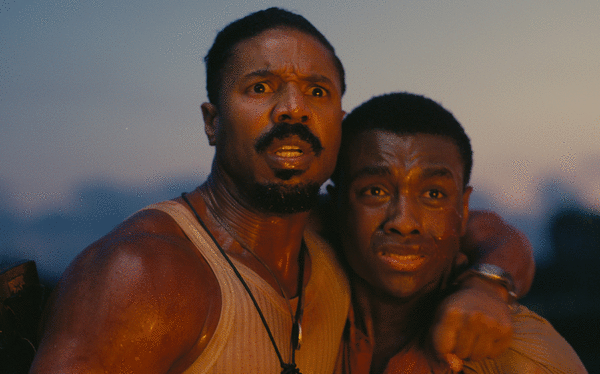
There’s never been a film like “Sinners,” an actual fact even if it wins absolutely nothing Sunday night at the Oscars, because its 16 nominations have already established that there’s never been a film like “Sinners.”
Whether it wins a record-breaking 12 Academy Awards and launches into our cultural history as the most decorated movie of all time is a speculative exercise, but its impact might be profound enough to change the way films are made as well as the way our understanding of the art form evolves in the next creative wave.
A film critic I know called it the best film of 2025 and wrote that he felt it was destined to become an endlessly rewatched classic, so I watched it once and then rewatched it once, and frankly, well, I think I’m still sorting it out.
Plenty of sinners
“Sinners” is well-titled, because there are plenty of ‘em in director Ryan Coogler’s lustrous masterwork. It could have been called “There Will Be Blood,” but that was taken. It could have been called “There Will Be Sex,” because there’s plenty of that too, and it could have been called “Vampires Sing and Dance to Traditional Irish Folk Songs Just As Soulfully As You Please,” but that’s too long.
In both viewings, just as I was getting comfortable with the conclusion that “Sinners” was about the intrinsic power of music — perhaps at the strong suggestion of a disembodied voice near film’s overture touting a kind of music “so pure it can pierce the veil between life and death, past and future” — the blood spatter in and around a Mississippi juke joint on one bad night in 1932 became too torrential to ignore.
So is “Sinners” an epic ode to music’s indispensable place on the long arc travelled by the oppressed, or is it more the freshest and most intricately plotted version of the Vampire Olympics, a subgenre of the horror films that have been mainlined into our hyper violent existence?
Some critics have called this fusion, but it took a very smart person about half my age to explain what he called paradoxical thought in artistic creation, and reference an interview with the Mexican filmmaker Guillermo del Toro, who gave us “Pan’s Labyrinth” and “The Shape of Water” (also “Hellboy” and “Hellboy II”), and whose “Frankenstein” joins “Sinners” in the Best Picture competition this weekend.
Plenty of evil
“Paradoxical creation is essential to art,” Del Toro says in that interview. “You marry things and throw them all together. When you think about (Salvador) Dali, putting together the telephone and the lobster, and it’s a new object that makes no sense as a lobster and no sense as a phone, it’s a third thing. That’s paradoxical thinking I believe, taking things that you instinctively think, this is going to be good together.”
What’s all been thrown together by Coogler in “Sinners,” most conspicuously a searing musical score from Ludwig Goransson based on the American blues canon and a drop dead perfect acting cadenza by Michael B. Jordan in dual leading roles, is going to be judged and interpreted in various artistic contexts for a very long time.
By this time next week, it might have a demonstrable claim as the best film ever, at least the most decorated, and really, any movie that ends with a couple of young vampires chatting up 88-year-old blues legend Buddy Guy in a club bar enjoys some advantage, right?
It is from Coogler’s musical passions, mostly evidently the deep influence of Delta blues, that lifts “Sinners” into its narrative orbit, but it’s soon enough hyperlinked to a variety of musical traditions, and to the way those traditions are informed by the search for justice and the ubiquity of evil.
“We Are All Sinners,” is the subtitle on the film’s posters, and the first explicit warning comes from a Black preacher telling his blues prodigy son, “You play for drunkards, philanderers, folks who’d would rather be sweating all over each other than be in the presence of God — you keep dancing with the devil, one day he’s gonna follow you home.”
Plenty of song
No spoilers here, but when the prodigy joins the twin Jordan characters scheming to pitch a wang dang doodle all night long, as the Blues catechism instructs, things go badly. The prodigy’s transcendent performance unlocks a portal, musically, mystically, spiritually, to the folk musicians outside the juke, the folks who are, well, vampires.
We gonna romp and tromp ‘til midnight
We gonna fuss and fight ‘til daylight
We gon’ pitch a wang dang doodle all night long
And did they ever.
Between viewings of “Sinners,” I’d taken the precaution of seeing “Scream 7,” the highest numbered sequel I can remember paying for and a worthy inoculant against a second round of vampire gore. Part of what I learned from “Sinners” is that if there’s anything more disconcerting than a 1930’s juke joint where everyone seems to be on blood thinners, it was my own misreading of the film’s Irish folk ballads as potentially the work of the devil.
But that’s not it at all. “Sinners,” is about the way music unites and uplifts the oppressed, that it both contains and urges a spiritual universality, and that if we all come together, we can make beautiful music.
____
©2026 PG Publishing Co. Visit at post-gazette.com. Distributed by Tribune Content Agency, LLC.





















































Comments