Commentary: ICE is wasting billions to literally warehouse people. In warehouses
Published in Op Eds
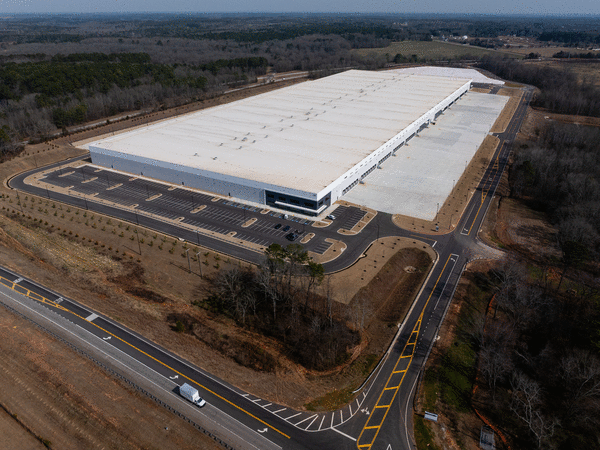
Across the country, Immigration and Customs Enforcement is acquiring industrial warehouses to be converted into detention facilities for people swept up in the Trump administration’s immigration crackdown. ICE has bought at least seven facilities so far, some of which are projected to hold thousands of people. One warehouse in an Arizona town is the size of seven football fields. The new facilities are slated to be up and running by November.
These plans amount to a lose-lose proposition. Warehouses crammed full of people will not be good for local communities, nor for the detainees housed inside the facilities. Literally warehousing people is a terrible idea.
According to Transactional Records Access Clearinghouse, in February there were about 68,000 people in immigration detention. Three-quarters of these folks have no criminal convictions. Now the administration plans to spend$38 billion to boost detention capacity to 92,000 beds.
ICE will be opening its new detention centers in Socorro, Texas, and Social Circle, Ga., among other sites. These facilities will likely generate more problems than benefits. When the federal government takes over a property, it is removed from the tax rolls, so communities will lose potential tax revenue. Large detention facilities will strain local infrastructure, including water supply, sewage and emergency services. The sites may attract protests, diverting law enforcement resources away from protecting area residents.
It’s no wonder that there has been bipartisan pushback against ICE warehouses, with some sellers backing out of deals in response to public opposition.
ICE’s website states that “detention is non-punitive,” and that it is for holding people while they await court dates or deportation. Yet placing people in vast buildings designed for packages will put men, women and children in danger. Warehouses are often drafty, poorly ventilated structures with hard floors. It’s difficult to see how they can be rapidly retrofitted into safe living spaces for detainees who, the government estimates, could be held for an average of 60 days there.
The scope of ICE’s planned detention network is staggering. The agency has already bought two warehouses with capacity for 8,500 people each; by comparison, the country’s largest federal prison holds roughly 4,000 inmates.
The U.S. has not imprisoned people on such a large scale since World War II, when camps were set up to detain Japanese citizens and Japanese Americans.
Buying so many warehouses poses the risk that such facilities could be kept filled to meet quotas in an attempt to justify the huge waste of taxpayer money — a maneuver that would waste even more money. And the multimillion-dollar prices that the government is paying for these spaces don’t include the costs of equipping the buildings with restrooms, showers, kitchens, medical facilities and recreation areas. Our government is pursuing these expensive plans while many Americans struggle to pay for groceries and health care.
ICE is defending its decision to ramp up detention capacity. “These will not be warehouses,” an ICE spokesperson told USA Today. “They will be very well-structured detention facilities meeting our regular detention standards.”
However, ICE has shown that it already struggles to meet its own“regular detention standards.” Detention centers are known for overcrowding, physical and sexual abuse, unsanitary conditions, and inadequate medical care. ICE is not taking proper care of the people it currently has in custody, and scaling up detention will only scale up its human costs.
Both of the country’s largest detention facilities, Alligator Alcatraz in Florida and Camp East Montana in El Paso, Texas, have been plagued with health and safety issues. In February, there were reports of cases of COVID-19, measles and TB in immigration detention. Last year 32 people died in ICE custody, making it the agency’s deadliest year in more than two decades.
If the administration’s goal is to remove as many undocumented people from the country as possible, why is it investing in a national gulag of warehouses to house them? The gulag strategy underscores that expanding ICE detention is not about public safety or going after “the worst of the worst.” This is an overreaching government forcing its unpopular agenda on the public and wasting taxpayer money simply because it was allotted a ridiculous $75 billion in last summer’s reckless spending bill. A January Reuters poll found that 58% of Americans say ICE crackdowns have gone too far. Only 39% approve of Trump’s immigration policies.
Concerned citizens must continue to fight the placement of ICE detention warehouses in their backyards. As a political standoff drags on a shutdown of some Homeland Security functions, lawmakers should exert pressure on ICE to redirect taxpayer money away from warehouse projects — and toward more productive efforts, such as improving existing detention conditions or financing immigration courts adequately so that individuals can get their day in court rather than languishing in a warehouse.
ICE’s planned detention expansion will be cruel, costly and harmful. Human beings do not belong in warehouses.
____
Raul A. Reyes is an immigration attorney and television commentator in New York City. X:@RaulAReyes; Instagram:@raulareyes1
©2026 Los Angeles Times. Visit at latimes.com. Distributed by Tribune Content Agency, LLC.





















































Comments