Editorial: The affordability problem is far from solved
Published in Op Eds
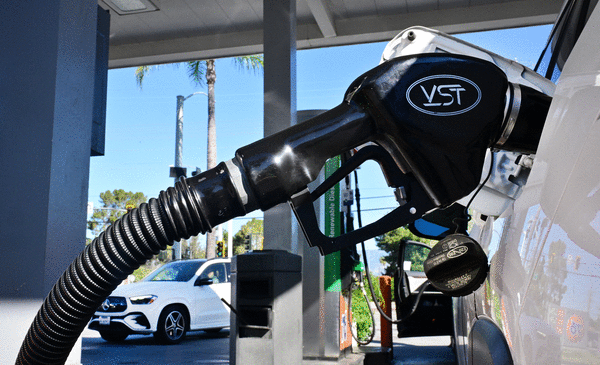
In his State of the Union address on Feb. 24 — how long ago that seems — the president claimed that the problem of “affordability” was solved. He spoke too soon. Even before the strikes on Iran drove the price of oil sharply higher, concern about inflation was mounting. A prolonged conflict in the Middle East would be sure to make things worse.
Higher energy costs threaten higher prices combined with slower economic growth — the toxic phenomenon known as stagflation. It’s the Federal Reserve’s worst nightmare, because standard monetary tools can’t cope. Cut interest rates to stimulate the economy and you risk entrenching the rise in inflation; raise them to curb inflation and you risk a deeper slump. Recommended practice in such cases is for the central bank to “look through” the increase in inflation. In other words, grit your teeth, leave policy unchanged, let the (presumed) one-time rise in prices squeeze real incomes and wait for the economy to get past it.
That would be challenging enough under normal circumstances, but the problem is now compounded because, following the pandemic, higher-than-target inflation has proved so resilient. The Fed’s preferred measure — the price index for personal consumption expenditures, excluding food and energy — is no longer trending downward. It rose in the year to December by 3%. The latest report on the producer price index (the components of which help drive changes in core PCE inflation) surprised almost everybody: Core PPI rose 0.8% in January, against an expected increase of 0.3%; year over year, core producer prices were 3.6% higher.
Most striking was the rise in the cost of trade services — suggesting that retailers and wholesalers are raising prices to restore their margins, belatedly passing along higher tariff-related costs to their customers. The good news is that this shock might not be long-lived. The bad news is that the shocks just keep on coming, thanks to ever-changing tariff policy and, now, a war of uncertain scale and duration in the Middle East. Bear in mind, inflation has already been materially higher than the Fed’s 2% target for five years. The current overshoot risks becoming the new normal.
At the same time, last week’s jobs report showed an unexpectedly sharp drop in payrolls in February. These figures are noisy, and temporary factors played a part, but the labor market might not be as healthy as previously supposed. If the shocks keep coming, the risk of stagflation is real.
The Fed has no quick fix for pressures caused by tariffs or energy costs. But the persistent inflation of recent years should lead it to reexamine one crucial assumption. Investors and policymakers alike are preoccupied with the so-called neutral rate of interest — the rate that neither adds to nor subtracts from aggregate demand. The Fed has long taken this number to be 3% in nominal terms, implying that the current policy rate of 3.5% to 3.75% is still “restrictive” enough to be gently pushing inflation down. This view looks increasingly questionable. The current rate seems all too consistent with stable inflation — stable at 3%, that is, not 2%.
Amid the current uncertainty, investors’ confidence that interest rates have further to fall needs to be set aside. Yes, the tariff shocks might subside after all and the strikes on Iran might conceivably succeed in stabilizing the region and delivering lower energy costs. If and when that happens, a bit more monetary easing might be consistent with getting inflation back to target. In the meantime, one shouldn’t take any of that for granted.
____
The Editorial Board publishes the views of the editors across a range of national and global affairs.
©2026 Bloomberg L.P. Visit bloomberg.com/opinion. Distributed by Tribune Content Agency, LLC.


















































Comments