John M. Crisp: To understand Iran, start its history in the right place
Published in Op Eds
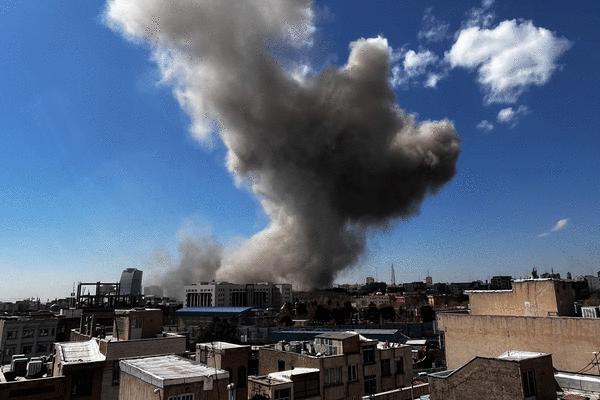
In an effort to justify his war on Iran, President Donald Trump turned to history. He begins with 1979, the year the Islamic Revolution deposed Shah Mohammad Reza Pahlavi and replaced him with the government of Ayatollah Ruhollah Khomeini.
Iran has been a problem ever since. Forty-seven years of repressive theocratic rule hasn’t been good for the Middle East, Iran or Iranians, especially women, LGBTQ+ and dissidents. The regime’s projection of power through proxies has caused considerable disorder and death.
Yes, it’s a bad regime, and the last 47 years have provided Trump with a plausible rationale for striking Iran. Few, outside of Iran at least, mourn the assassination of Ayatollah Khamenei.
But if you start thinking about Iranian history at 1979, you can rationalize nearly anything, even an illegal, unprovoked attack on a sovereign nation.
In fact, Iranian history dates back 2,500 years to the Persian Empire of Cyrus the Great. Modern Iranians take considerable pride in their history. This complicates their reaction to Trump’s attack: Many love their country more than they hate the regime. They won’t take kindly to having their government, their military and their infrastructure destroyed, especially by an impertinent upstart such as the United States, which has been around for a mere 250 years.
Even more important, most Iranians know a lot more about relations between the U.S. and Iran during the last century than vice versa. These are the pre-1979 events that Trump didn’t mention.
Trump pictures the United States as a long-suffering victim of Iran. It’s never popular to blame the victim, but it’s worth remembering that many Iranians, with considerable justification, see the sorry situation at which our two nations have arrived to be the result of the way the United States has treated Iran for over a century.
Iran was always a better potential ally of the U.S. than other Middle Eastern countries, many of which are repressive monarchies—the “Kingdom” of Saudi Arabia, for example.
Iran’s inclinations toward democracy date at least to 1905, when a revolution diminished monarchical power and established a parliament. But most Americans aren’t familiar with the systematic subversion of democracy in Iran by Britain and the United States in favor of a shah who would cater to their interests. The essential interest? Oil, of course.
When Iranian Prime Minister Mohammad Mosaddegh tried to take more control of Iranian oil in 1953, he was deposed by a CIA-backed coup that reestablished the power of the Shah Reza Pahlavi, who ruled by terror, imprisonment and torture. The revolution of 1979 became almost inevitable.
Much of America’s foreign policy since 1979 has been devoted to the sensible goal of preventing Iran from obtaining a nuclear weapon. But is bombing the only way to achieve that goal?
Political scientist Scott Sagan points out in the September/October 2006 issue of Foreign Affairs—“How to Keep the Bomb from Iran”—that nations have concrete reasons for seeking nuclear weapons, and he argues credibly that they can be, and have been, talked out of it with diplomacy.
President Barack Obama tried diplomacy in 2015. The U.S., Britain, France, Germany, Russia, China and the European Union reached an agreement with Iran (the Joint Comprehensive Plan of Action) that severely limited Iran’s ability to develop a nuclear bomb.
By most accounts, the J.C.P.O.A. was working. Trump’s defense secretary, Jim Mattis, called the J.C.P.O.A.’s verification procedures “robust,” and he did not dispute the findings of the International Atomic Energy Agency, which confirmed Iran’s compliance. Further, the agreement bolstered the standing of Iran’s moderate President Rouhani.
Trump’s rejection of the J.C.P.O.A. in 2018 gave the Iranian hardliners just what they wanted: a treacherous, deal-breaking, shah-supporting, external enemy.
But this is what happens if we pretend that our history with Iran started in 1979. Trump’s narrow view of history blinds him to the fact that Iran will not be easily bullied into “unconditional surrender.” He will have no part in choosing Iran’s next leader. Iran’s Revolutionary Guard will not meekly turn over their weapons to the Iranian people.
Thus, this war is likely to be long, chaotic and very deadly.
_____
ABOUT THE WRITER
_____
©2026 Tribune Content Agency, LLC



















































Comments