Mark Gongloff: The insurance crisis is so desperate people are turning socialist
Published in Op Eds
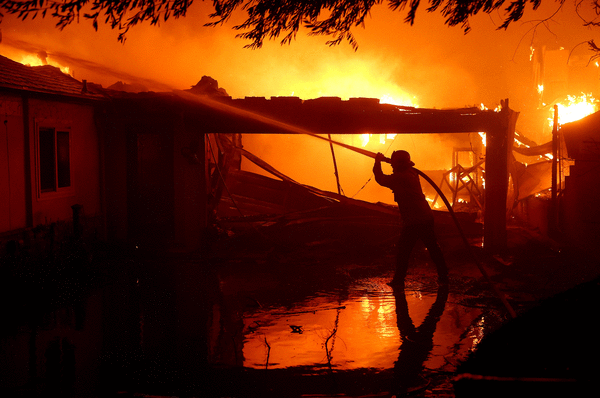
Desperate times call for desperate measures, and Americans seem increasingly desperate about the cost of home insurance.
In a recent survey of U.S. homeowners, large percentages backed some pretty unrealistic solutions to the problem of soaring insurance costs.
Many involve socializing the industry in ways that would keep capitalists awake at night if the methods were politically viable. But as the status quo involves passing on catastrophe losses directly to consumers without recourse, capitalists shouldn’t sleep easy until they start offering some better ideas.
According to a survey of 1,001 homeowners released last month by the comparison-shopping site Insurify, 45% of U.S. homeowners want banks to make home insurance optional for those with mortgages.
Meanwhile, 48% of homeowners want annual premium increases capped. And about a quarter would be fine with the government just nationalizing all insurance and outlawing private companies, Soviet-style. Notably, the percentages favoring all of these solutions are more or less consistent regardless of political leaning.(1)
Let’s break these down.
First, banks are simply not going to make home insurance optional, full stop. Unlike the current U.S. government, banks acknowledge climate change. They’ve seen the data showing the surge in billion-dollar weather disasters over the past 20 years, partly a result of the planet getting hotter.
Now more than ever, they have no interest in gambling that their massive investment in your house will be wiped out overnight. There’s also no chance that any conceivable U.S. Congress would pass a law forcing banks to do so.
Eliminating private insurance companies is another idea that will probably have to wait for the hazy political future, perhaps once we’ve achieved fully automated luxury communism.
Capping premium increases might be somewhat more politically feasible. But insurance companies wouldn’t let that happen without an intense fight, and they’ve got a lot of your money to spend on lobbying.
Limiting annual increases in California may have helped keep costs low for some, but it also encouraged insurers to abandon the state as wildfire losses rose, pushing hundreds of thousands of homeowners into the state-backed insurer of last resort, the FAIR Plan. Its loss exposure has more than tripled in four years, endangering its financial health. It’s far from alone.
There’s one solution that, while a political nonstarter now, might only need conditions to worsen a bit to get a better reception: setting up a government-run provider to compete with private insurers. About a third of U.S. homeowners support this, including 32% of the self-described “conservative” ones.
In fact, such an insurer already exists: the National Flood Insurance Program (NFIP). For more than five decades, it has been the primary provider of flood insurance for American homeowners. You can just about envision a world in which Congress expands the NFIP to include coverage for wind, wildfire and severe storms, all of which have become more damaging in recent years.
But in the world we inhabit, the NFIP is too underfunded and underutilized to even handle flood insurance properly. It owes the Treasury Department $22.5 billion for loss-covering loans and is expected to add an additional $27 billion in debt through 2045, according to the Peter G. Peterson Foundation.
Meanwhile, though 99% of U.S. counties have flooded in the past 30 years, only 4% of Americans have flood insurance, according to the Federal Emergency Management Agency, which operates the NFIP. FEMA’s flood maps, which determine which homes need flood coverage, are dangerously out of date and don’t reflect a future in which a hotter atmosphere means storms dump much more rain.
After a 69% surge in premiums in the past six years, according to Intercontinental Exchange Inc., combined with retreating insurers and rising costs, the number of uninsured and underinsured homes is rising.
About 14% of U.S. houses have no insurance at all, according to LendingTree. The highest rates of uninsurance are in disaster-prone states such as Florida, Louisiana and Texas. Meanwhile, millions of homeowners don’t have enough insurance to cover disaster losses, threatening to blow a $2.7 trillion hole in home valuations, by one measure.
Hard choices are ahead. At some point we must stop subsidizing wealthy people rebuilding in risky areas, as my Bloomberg Opinion colleague Jonathan Levin has suggested. We may need to require insurers to cover all risks and all homeowners or leave the market, as California Western School of Law professor Kenneth Klein has suggested. We may need to create national risk pools that compete and possibly replace private insurers.
These may sound increasingly like socializing the solution, but there’s probably only so much socialization of losses the public can take. More than half of the homeowners in the Insurify survey said they “generally distrust” the insurance industry, to which they assign the biggest blame for rising premiums.
We could make this problem more manageable for everybody by helping homeowners and communities bolster themselves against disasters, limiting future losses. And we could hasten the transition away from the fossil fuels that are heating the planet. Unfortunately, the Trump administration is aggressively thwarting both solutions.
American homeowners are like that meme of the unhappy guy with the stick, poking a dead fish and telling it to “C’mon, do something.” The longer we take to seriously address this problem, the fewer people will enjoy what gets done.
(1) Instead of Republican and Democrat, the survey breaks homeowners down by "conservative" and "liberal."
_____
This column reflects the personal views of the author and does not necessarily reflect the opinion of the editorial board or Bloomberg LP and its owners.
Mark Gongloff is a Bloomberg Opinion editor and columnist covering climate change. He previously worked for Fortune.com, the Huffington Post and the Wall Street Journal.
©2026 Bloomberg L.P. Visit bloomberg.com/opinion. Distributed by Tribune Content Agency, LLC.



















































Comments