Commentary: The first places I'll visit when Iran is free, if Iran is free
Published in Op Eds
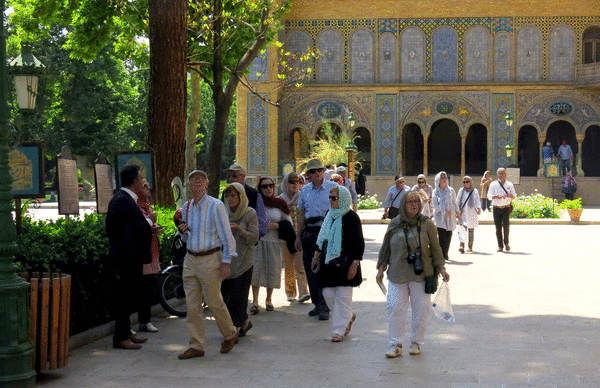
We were on a bus to visit the beautiful city of Masuleh. And like any trip in Iran, the journey was just as much fun as the destination.
Our tour guide sat at the front of the bus with a tombak (drum) and started singing: “Fahtee, Fahtee, Fahtee, Fahtee, Fahtee, az esghet kardam gharo ghaty. Fahtee joon,”
Fahtee is a woman’s name. Translated, he was singing: “Fahtee, my love for you makes me crazy. Fahtee, my soul.”
He repeated the verse multiple times, changing his accent; we had to guess what part of Iran he was singing from. It was joyful because it celebrated the diversity of Iran.
Iran is richly diverse by region, ethnicity, religion and culture.
My favorite accent is the Isfahani accent. It sounds like a song, and I can see the musical notes in the air as the octave and tone changes. Whenever Isfahanis finish their sentence, I just want to shout, “Encore!”
The people of Shiraz are sheereen (sweet). They are known for their incredible kindness and hospitality, which says a lot given the centrality of hospitality to Iranian culture more broadly.
Some of our most well-known artists outside of Iran are Azeri, like Jafar Panahi and Googoosh.
Our Assyrian friends always had the best underground sources to help us find wine and charcuterie.
As a child, I would wear traditional Kurdish tulle and satin dresses — adorned with beautiful coins and vibrant colors.
“I’ll be right back, bacheha (kids),” my grandma would say to answer the Islamic call to prayer. Before she went, she would tell us what she’d pray harder for that day. These days, she has the same prayer every day; that we all return to Iran.
Every region, religion and ethnicity celebrates the 3,000-year-old holiday of Nowruz, the Iranian New Year that’s rooted in Zoroastrianism and celebrated on the first day of spring.
We’re all Iranian.
I once visited the Tomb of Esther and Mordechai in Hamadan, an important pilgrimage site for Jews. It was such a surreal experience. The tomb was right there in front of me. But then I looked around — where is everyone? My family was the only one at the site. There should have been lines of tourists up and down the street. Instead, the caretaker looked surprised to see us there and that anyone had visited at all.
The older I got, the more my heart broke at Iran’s shuttered tourism industry. Takht-e Jamshid, or Persepolis, the capital of the Achaemenid Empire, was empty. The epic Naqsh-e-Jahan, “Map of the World,” in Isfahan should have been packed with foreigners. In Iran, there are historical sites on top of historical sites. The north’s lushness is just as beautiful as the south’s deserts. Each town and city have their own culinary specialty — where are the foodies? Kerman’s kolompeh (date-filled pastry) and Rasht’s mirza ghasemi (smoky eggplant dip) are heavenly.
When we weren’t singing on the long bus rides, we would be dancing. We’d close all the curtains, women who wanted to remove their hijabs would, and the bus driver would turn on the latest hit Iranian song. As soon as the bus driver turned off the music, we knew we were arriving at a security checkpoint. Time for the dancing to stop, to put on the hijab and to take our seat, quietly.
I’ve long waited for the day, the possibility, the dream to build Iran’s tourism industry. Do I include that “dancing on moving buses comes at your own risk” in a waiver? Even thinking through the legal details brings me such joy, and I get filled with such hope.
The first place I’ll visit when Iran is free, if Iran is free, is Yazd. I never got a chance to see Yazd.
Seeing pictures of the damage to Kakh Golestan from the recent bombings is heartbreaking. I remember visiting the palace vividly as a child. The title of one of its most epic rooms, “hall of mirrors,” does not do its true beauty justice. Mirrors within mirrors within mirrors. Mirrors, that have now been shattered.
I never have and never will get tired of seeing Iran’s historical sites. What will be left when this war is done? Who will be left when this war is done? And will Iran still be Iran?
All these elements — culture, diversity and history — bond Iranians together under one national identity. We are all Iran.
For 47 years, Iranians have been subject to a regime that seeks to divide them, isolate them, oppress them, torture them and dispose of them.
Yet the only element the regime has not managed to steal is the people’s love for their Iran. My Iran. Our Iran. That is something they can never do.
Iran, Iran, Iran, Iran, Iran, az esghet kardam gharo ghaty. Iran joon.
____
Talla Mountjoy is senior director of programs for the Forum for Free Inquiry and Expression at the University of Chicago.
___
©2026 Chicago Tribune. Visit at chicagotribune.com. Distributed by Tribune Content Agency, LLC.




















































Comments