Allison Schrager: Is free trade worth the cost in lives lost?
Published in Op Eds
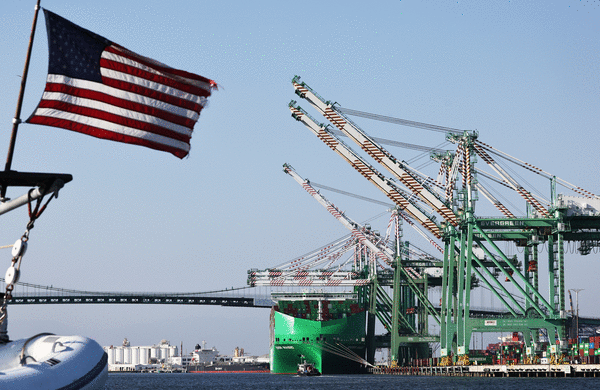
There is something about manufacturing jobs, and the manufacturing industry, that makes people sentimental. When they think of a factory worker, they think of him (it’s usually a he) as having great benefits, job stability and the ability to support his family. Donald Trump was elected president partly because of his promise, which he is finding hard to fulfill, to bring back manufacturing.
We economists are not a sentimental bunch. For us, jobs are jobs so long as they pay well. But a new paper has me reconsidering this view — or at least recalibrating my estimate of just how important manufacturing jobs can be, and how to respond when they disappear.
The paper finds more deaths in communities most impacted by NAFTA and trade with China. Americans who lived in a commuting zone with average exposure to Mexican import competition had a higher mortality rate (by 0.68% overall, or 41.8 more deaths per 100,000 residents in the most vulnerable group), on an annual and age-adjusted basis.
These were not just deaths of despair or deaths from drugs, though those were certainly factors. A big cause of death was infectious diseases, and deaths were particularly high for men aged 25 to 44. And it’s notable that when there is job loss for other reasons, such as a recession, mortality rates tend to decrease.
That suggests a reason that both Republicans and Democrats are so fixated on bringing manufacturing back: Job loss in these industries is particularly devastating. Even if the economy as a whole ends up better off, even if new and better paid jobs were created in other towns and cities, they can’t make up for the lost years of life.
The economists who wrote the paper on NAFTA don’t offer many answers about what makes manufacturing job loss so catastrophic. It could be because it takes with it a whole way of life. Communities grew up around factories, and when they closed, new jobs did not emerge — or if they did, they were far away or demanded skills the manufacturing workers didn’t have.
If you lose a job to a recession, odds are you’ll find another eventually. But when you lose a job because of a big structural change in the economy, and that change also ravages your community, your prospects are grim.
The paper looks at job loss related to NAFTA because it was a single shock that increased trade. But technology also destroyed manufacturing jobs as many tasks became mechanized. It is not clear if that had the same impact on mortality. It could be trade is different, because the impact of NAFTA was more sudden (the agreement took effect on New Year’s Day in 1994). Mechanization happens more slowly, allowing people more time to adjust and retrain. A technology shock might also be different because the factory is still in operation, and potentially more profitable, which means the loss of jobs or tax revenue is not as great.
Or it could be that job loss from technology also increased mortality, but it’s just harder to isolate in the data. In either case, what happened to manufacturing employment offers an important warning.
When agricultural jobs disappeared during the Industrial Revolution in the 19th century, so did a way of life, as well as many communities. It is unclear if it also led to earlier deaths, but it certainly caused lots of disruption and populism. We are all better off today for it, but many people paid a steep cost.
AI is raising similar concerns today, because there is a possibility of entire industries being transformed and more widespread job loss, this time for white-collar workers. Like NAFTA, the change is happening fast, as AI is being adopted with remarkable speed.
I am still an optimist and believe that the new jobs and many of the economic benefits will be a net positive. But this research on manufacturing jobs underlines the need to take the human costs more seriously. Fortunately, we are in a better position to help: America is a far richer nation now than it was 150 years ago.
None of this is to say that increased trade was a mistake 30 years ago, or that tariffs are good policy today. Economies are constantly changing, and no matter how much or how little we trade, there will be fewer manufacturing jobs in the US. Delaying this process also poses costs — human ones, too.
The NAFTA experience shows how politicians and officials failed many communities, which paid the worst possible price for the benefits gained by the rest of the economy. What the government could have done better, or could do now, is not clear. People need jobs and purpose. Permanent welfare for people who lose jobs creates other problems. Job retraining programs have not had much impact. Attempts to control the pace of innovation don’t work, and trade can create even more economic damage. The only thing that’s clear, as the economy faces another major potential shift in employment, is that we need better answers.
____
This column reflects the personal views of the author and does not necessarily reflect the opinion of the editorial board or Bloomberg LP and its owners.
Allison Schrager is a Bloomberg Opinion columnist covering economics. A senior fellow at the Manhattan Institute, she is author of “An Economist Walks Into a Brothel: And Other Unexpected Places to Understand Risk.”
©2026 Bloomberg L.P. Visit bloomberg.com/opinion. Distributed by Tribune Content Agency, LLC.


















































Comments