Andreas Kluth: Trump doesn't want democracy in Iran or anywhere. He wants puppets
Published in Op Eds
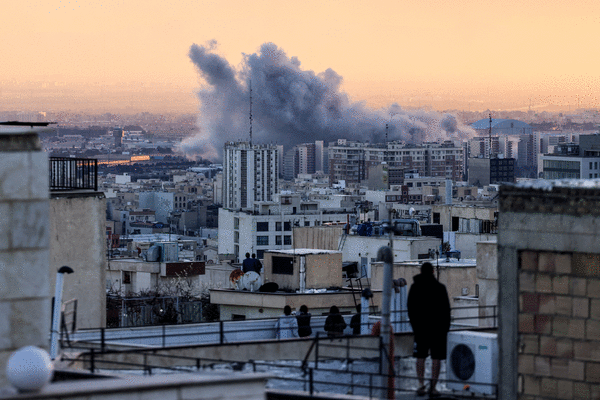
Absent a “real” strategy in his aggressive foreign policy, President Donald Trump is nonetheless revealing an emergent style or pattern. From Iran, which he is currently pounding, to Venezuela and perhaps Cuba and other countries, he’s not interested in building democracies, but in erecting puppet states.
“What we did in Venezuela, I think, is the perfect, the perfect scenario,” Trump told the New York Times in a conversation about his ongoing campaign against Iran. “Everybody’s kept their job except for two people.”
Trump was referring to his recent “decapitation” of the anti-American regime in Caracas, when U.S. forces extracted the dictator and his wife but otherwise left the Chavista government in place. Since then, Trump has done little to help Venezuela’s democratic opposition. Instead, he seems content to retain Delcy Rodriguez, Venezuela’s acting president, as a pliant client, as long as she keeps taking orders on any matter that the White House cares about, starting with Venezuela’s oil.
In Iran, the initial regime decapitation has already taken a more literal form, after the country’s longtime leader, Ali Khamenei, and about 40 of his henchmen were killed in the early rounds of the U.S.-Israeli air strikes. Beyond that tactical success, the Trump administration seems to have given little thought to possible leadership transitions.
In announcing the attack, Trump merely warned the remaining regime to “lay down your arms” or else “face certain death.” His message to the Iranian people, who only recently protested so bravely for their liberty, was that freedom “will be yours to take.” Not his to give, in other words.
As in Venezuela, his administration had apparently eyed a few successors to Khamenei within the regime, although the same strike that killed the ayatollah also killed most of those. “It’s not going to be anybody that we were thinking of because they are all dead,” Trump told another interviewer; “second or third place is dead.” In any event, Trump’s team, including the CIA, seems to assume that the regime is here to stay. What matters to Trump is that the next guy, whoever he is (and it won’t be a she), is an Iranian Delcy Rodriguez — in short, a puppet.
A similar, if currently less explosive, campaign appears to be underway in Cuba. After Venezuela, it was to be the next anti-American regime in the Western Hemisphere to be toppled, and America has in effect set the scene with a de facto oil embargo. Marco Rubio, the secretary of state and national security advisor (whose parents immigrated from Cuba before its revolution), has been talking to the grandson of Raul Castro, Cuba’s former leader. Trump is already referring to a “friendly takeover,” where “friendly” appears to mean “without decapitation.”
If it were up to Trump, other leaders would take the hint and voluntarily become clients, puppets or vassals, even without a visit by American aircraft carriers. That, presumably, is what the president had in mind when he kept taunting Canada about becoming America’s 51st state, or Denmark about ceding Greenland. It fits with his “neo-royalist” view of world politics, according to which everything is about him, and specifically about submission to him.
America is no novice in cultivating puppet states, of course: For a nation that, historically, has preferred to see itself as anti-imperialist, it has installed surprisingly many over the years. One notable example was Iran, starting in 1953, when the U.S. (and Britain) instigated a coup that ousted an elected prime minister and installed a pro-American shah — a “success” that turned into the disaster of 1979, and helped to create the mess we’re in now.
And yet the overall character of American foreign policy since the Cold War has largely turned away from installing proxy regimes and toward nurturing democratic change. Sometimes, as in Iraq or Afghanistan, that has led to disastrously naïve attempts at “nation-building.”
Washington frowned on flagrant demands of subjugation as something that America’s autocratic adversaries did. The posterchild among the bogeys has been Russia’s Vladimir Putin, who views all post-Soviet states from Belarus to the ’Stans of Central Asia as his rightful fiefs. His current war against Ukraine started in 2014, after its people booted out Putin’s then-puppet in Kyiv, Viktor Yanukovych.
As bombs detonate across the Middle East, it is far too early to predict who will eventually govern Iran and its long-oppressed people. Even the long-term fate of Venezuelans, Cubans and others remains up in the air. And yet it is neither too early nor too late to pause and observe what until recently would have been shocking but now seems almost banal: America’s commander-in-chief is no longer a leader of the free world, but just another strongman.
____
This column reflects the personal views of the author and does not necessarily reflect the opinion of the editorial board or Bloomberg LP and its owners.
Andreas Kluth is a Bloomberg Opinion columnist covering U.S. diplomacy, national security and geopolitics. Previously, he was editor-in-chief of Handelsblatt Global and a writer for the Economist.
©2026 Bloomberg L.P. Visit bloomberg.com/opinion. Distributed by Tribune Content Agency, LLC.


















































Comments