Kaitlyn Buss: The Guthrie search shows what's possible. Can we make it the standard?
Published in Op Eds
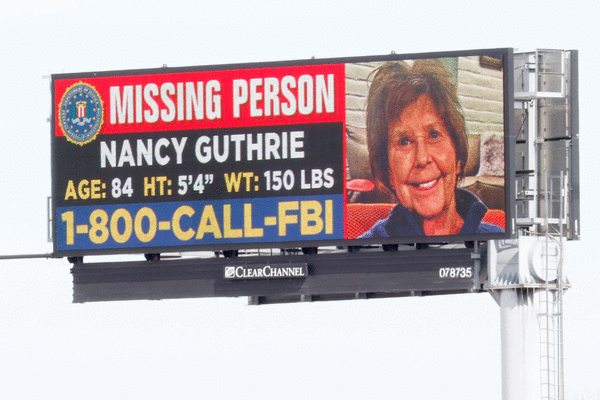
If there’s any chance Nancy Guthrie’s assailant will not be found, it won’t be for lack of awareness. Her disappearance has mobilized extraordinary attention nationwide.
It’s heartbreaking to think the 84-year-old Arizona woman — the mother of Savannah Guthrie, co-host of NBC’s Today Show — might still be held against her will in the Tucson area after being kidnapped nearly two weeks ago.
The story and its developments have been broadcast widely ever since. Savannah Guthrie has been spreading the word about her mother’s disappearance — including in a public video plea to her kidnappers — and attracting first-rate help.
And she should. Anyone in her position would likely be doing the same thing for a loved one who vanished under troubling circumstances.
But what if the same level of wall-to-wall media coverage, law enforcement efforts, and coordination with the FBI that has been given to Guthrie’s disappearance were given to other missing people?
The exhaustive coverage has laid bare the uncomfortable reality that not all missing people receive this level of attention, despite the seeming availability of on-demand law enforcement and broadcast services.
As of Wednesday, the attention around Guthrie’s case had led to more than 4,000 calls coming into the tip line over 24 hours to the Arizona sheriff’s department investigating the disappearance. Since Feb. 1, when Guthrie was reported missing, it has received nearly 18,000 calls altogether. The FBI is offering $50,000 for information leading to her recovery.
That is a remarkable response — and hopefully it will work.
But there are thousands of missing people throughout the United States whose family members will never get that same level of help or awareness.
In 2024, there were 93,447 active missing persons records in the U.S. — 37% under the age of 21.
In Michigan, there are currently 2,646 missing persons, according to Michigan State Police.
Behind those numbers are Michigan families living in suspended time. Parents, brothers and sisters who scan headlines hoping their case will resurface. Their disappearances rarely draw helicopters or national broadcasts.
Savannah Guthrie is a nationally known figure, and kidnapping is a fear Americans haven’t fixated on much in the last decade, making it an intriguing high-profile case.
But at this point, the contrast with lesser-known cases is impossible to ignore — even though it’s understandable.
Consider the law enforcement response, which has heavily included FBI Director Kash Patel.
It is common for state and local investigations to request federal help. But the scale of urgency and response seems far greater than a standard kidnapping case.
“All resources have been dedicated to this investigation,” Patel said on Tuesday on Fox News.
More than 100 law enforcement personnel from multiple agencies have been involved in the investigation and search efforts around the clock, according to Pima County Sheriff Chris Nanos.
The prayer is that Guthrie is found alive.
If this is what justice looks like when resources are relatively unlimited, the real question is why we accept less for everyone else.
_____
©2026 www.detroitnews.com. Visit at detroitnews.com. Distributed by Tribune Content Agency, LLC.





















































Comments