Commentary: LA is rebuilding for the Olympics, not the next fire
Published in Op Eds
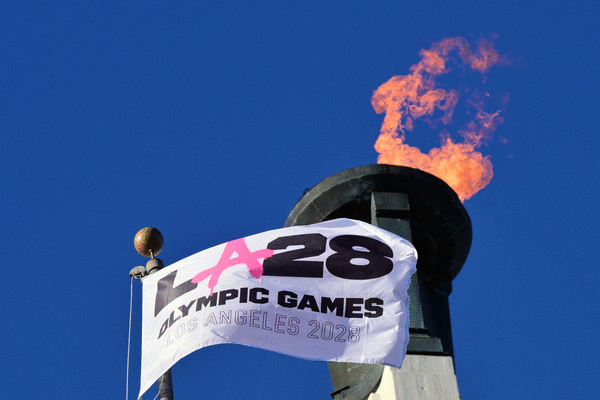
Los Angeles is racing at breakneck speed to rebuild after the most destructive fire in the city’s history. It’s a pace so publicly tethered to the 2028 Summer Olympics that Gov. Gavin Newsom referred to the global event as the “Recovery Games.”
But in the sprint for gold, public safety is being sidelined. This massive rebuild is now about damage control more than it is prevention. The tone was set almost immediately.
Just 24 hours after the Palisades fire ignited in January 2025, while homes were still burning and firefighters were stretched thin, Newsom and L.A. Mayor Karen Bass toured the burn zone. The visit itself was unusual: Active fire scenes are not typically stages for political walk-throughs. Their presence underscored the criticism they were already facing over a failed response, including the absence of clear public warnings ahead of historic 100-mph winds. No live news conference was held before the storm, a break from past emergencies of this scale.
Bass was actually in Africa when the fire erupted, a fact unknown to many outside her inner circle. She was unresponsive during a critical hour of the disaster while attending a reception at the U.S. ambassador’s residence in Accra, Ghana, and she couldn’t communicate reliably during her 22-hour journey back to Los Angeles, as I report in my forthcoming book, “Torched.” Newsom had been preoccupied with planning a visit by then-President Joe Biden to designate the Chuckwalla and Sáttítla national monuments.
“The first time they toured the damage, they discussed the Olympics and federal funding,” one city official told me, speaking on condition of anonymity. “Losing the Palisades hurt them politically. Losing the Olympics would be game over.”
Game over, unless they changed the rules.
Within days, as flames still tore through the Palisades and Altadena, which had been hit by the Eaton fire, the governor unveiled a state “Marshall Plan,” invoking postwar reconstruction as if nature had agreed to peacetime conditions. Permitting timelines were slashed to under 30 days. Environmental reviews, meant to scrutinize where and how building should occur in high-risk terrain, were suspended.
Homes were allowed to rebuild closer together — “taller and longer,” as Bass explained — often in the same fire corridors that had just failed.
A team of state and city appointed “wildfire czars” was installed to oversee the rebuild. Bass selected longtime civic leader Steve Soboroff, even though he had no experience in wildfire recovery. Newsom, through his“L.A. Rises” initiative, named Lakers legend Magic Johnson, Dodgers Chairman Mark Walter and Casey Wasserman, president of the city’s Olympic organizing committee. All three were versed in sports spectacle, not disaster mitigation.
The promise of a speedy rebuild quickly became a selling point, most visibly in real estate listings that touted fast-track approvals and larger floor plans. “Now made easier with expedited permitting… this property offers a rare chance to create your dream home without delay,” one listing teased on Zillow. That such properties were being listed at all hinted at something else: Hundreds of survivors had already decided they would not return, choosing to sell the land beneath what had once been their homes.
Investors moved quickly and the approval rates were “historic” as Newsom described it in January. Roughly 20% of destroyed homes in L.A. received residential building permits within a year, according to state records, far outpacing recoveries following the 2023 fires in Lahaina, Hawaii, where only about 2% of homes were permitted one year on, and in Paradise, Calif., where just 5% of properties had permits following the 2018 fires in Butte County, according to the Urban Institute.
Cutting red tape didn’t just accelerate the first phase of the rebuild. It triggered a speculative rush, optimized for rapid approvals and relatively quick resale, not long-term safety.
At the same time, Los Angeles has disinvested in the very system meant to defend those neighborhoods. The city has fewer fire stations today than it did in the 1960s, even as the population has nearly doubled and development has pushed deeper into fire-prone terrain. Firefighters are being asked to protect more homes, spread farther apart, with fewer resources.
There is a safer path.
Concrete composite materials, fire-resistant panels made from cement and reinforced fibers, are four times more resistant to wildfire than wood, and comparable in cost. After my recent report on these materials for CBS’ “Sunday Morning” aired, my inbox filled with messages from fire survivors, and even a local architect, asking why they had never been told such options existed.
Equally important: space. “Our urban layouts are not designed to survive 70-mile-an-hour fires. We must increase the distance between structures,” forensic wildfire investigator Faraz Hedayati told me after surveying the aftermath in the week following the L.A. County fires. As Hedayati explained, dense housing associated with mid-century suburbs, development that occurred before the true threat of fire arrived, easily allowed flames to leap from structure to structure.
In a state where housing is already scarce, this is not an argument for shrinking communities. It is an argument against expanding them irresponsibly, especially when new construction does little more than meet the bare minimum of the code.
Other fire-prone communities have followed the science. The Dixon Trail development in Escondido, just outside San Diego, was built with greater spacing between homes and hardened materials that exceed minimum code. Homeowners there have been rewarded with affordable insurance premiums at a time when insurers are retreating from much of California, including the Palisades and Altadena.
Insurance companies are not guided by sentiment or politics. They follow risk. Their retreat is not ideological. It is financial. And it should be a warning.
In Los Angeles, where entire communities are rebuilding from scratch, it is not too late to change course, in part because the promised speed has stalled where it matters most. More than 13,000 homes were lost in January 2025, yet only a fraction have broken ground. Even as emergency orders slashed permitting timelines and approvals moved relatively fast, that speed collided with a system lacking the manpower to execute what followed. Inspectors, architects, engineers and builders have become choke points. Insurance payouts lag rising construction costs, leaving many homeowners unable to proceed. The result is a delay, not the one leaders envisioned, but one that still offers a chance to rebuild smarter, not just faster.
But if we continue to rebuild for optics rather than for resilience, we are choosing pageantry over saving lives, racing to look ready for the world while locking in the same failures that erased entire neighborhoods. When the next fire comes, the legacy of that decision will be impossible to outrun. No matter how bright the Olympic torch burns.
____
Jonathan Vigliotti is a national correspondent for CBS News and a Los Angeles resident.
©2026 Los Angeles Times. Visit at latimes.com. Distributed by Tribune Content Agency, LLC.





















































Comments