Commentary: When liberty shows cracks
Published in Op Eds
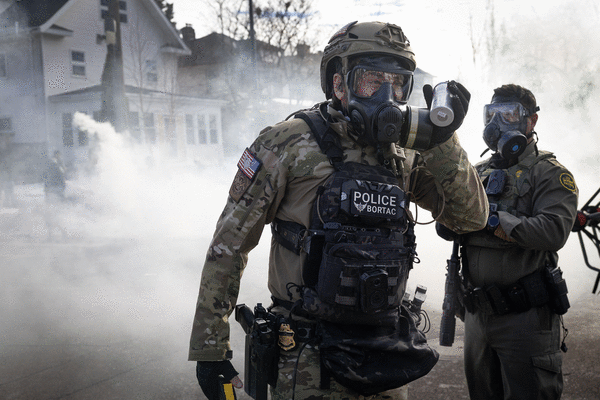
On the streets of Iran in recent weeks, security forces have killed thousands of protesters demanding basic rights and opposing the state’s authority. That stark image is not meant to equate our politics with theirs, but it poses a question Americans cannot ignore: What does it look like when government violence becomes routine and when institutions are used to intimidate citizens?
In the United States, we haven’t yet seen rifles aimed at large crowds, but we do observe masked federal agents detaining protesters in unmarked vehicles, flashy ICE raids staged like military operations, and pardons for political violence — all clear warning signs. Ignoring this is the first step toward complacency, which can kill liberty.
Fascism is often misunderstood. It is not just political oppression; it is a set of traits, as scholars and observers point out, that aim to centralize power, crush opposition, glorify violence and reshape society to serve a leader or ideology.
Benito Mussolini’s Italy, Adolf Hitler’s Germany and Francisco Franco’s Spain provide historical examples, but the patterns often appear gradually, long before a fully authoritarian state emerges.
In the United States today, these patterns are visible: law enforcement wielding authority as a tool of political intimidation, independent media under assault, elections questioned and delegitimized, and political opponents treated as enemies rather than citizens.
Some actions may seem “justified”: a raid here, a prosecution there, or shutting down critical media. However, accepting these acts or waiting for the system to “self-correct” is how freedom gradually diminishes. Political theorists warn that the “glorification of violence” and the “accumulation of power” — both phrases highlighted in The Atlantic — are not abstract concerns; they are patterns that, if left unchecked, quietly weaken democracy from within.
James Madison warned in Federalist No. 47 (1788) that “the accumulation of all powers, legislative, executive, and judiciary, in the same hands … may justly be pronounced the very definition of tyranny.” George Washington, in his Farewell Address (1796), cautioned against factions that prioritize loyalty over principle. These warnings are not partisan; they are guideposts for citizens of any era, rural or urban, who care about the durability of self-government.
This is all happening: politicized law enforcement, demanding the courts acquiesce, and pardons for political violence. Across the country, communities see the effect — federal agents acting nearly with impunity and local leaders pushed to call for investigations. In January, federal immigration agents in Minneapolis shot and killed Alex Pretti, a 37-year-old ICU nurse and U.S. citizen — the second such fatal shooting by federal officers in the city in weeks.
These are not theatrics; they are hints of creeping authoritarianism. Ignoring them or convincing yourself that “it will pass” is exactly how liberty dies.
The United States still has safeguards. Courts operate independently. The free press continues to report. States exercise authority to check federal power, and elections are largely respected. These institutions are not self-operating. They require citizens who notice when norms bend and act before they break. Complacency is the greatest threat: each tolerated violation chips away at the system that protects our freedoms.
Preserving liberty is a shared responsibility. It does not rest on a single party or figure, but on ordinary citizens paying attention. It is natural to ask, “What can we do?” when even protest — the most visible form of civic action — can end in tragedy, as it did in Minneapolis.
Yet civic life is a continuum: voting, community organizing, and local advocacy all strengthen democratic norms and weaken coercion. No single act guarantees success, but together they ensure that our collective rights are defended and not eroded by the few. Ignoring these signals, on the other hand, leads to serious consequences.
America may never resemble Iran’s bloody streets. Indeed, our institutions remain resilient. Yet the government can still gradually erode rights, shaping citizens into compliant instruments of the state if left unchecked.
Masked enforcement officers, politicized prosecutions, and attacks on independent institutions are warning signs that liberty can be hollowed out in plain sight. Recognizing danger before it is too late is prudence. In the end, democracy’s strength has always depended as much on watchful citizens as on institutions.
_____
ABOUT THE WRITER
Ken Silverstein has covered energy and international affairs for years. He wrote this for InsideSources.com.
_____
©2026 Tribune Content Agency, LLC.

















































Comments